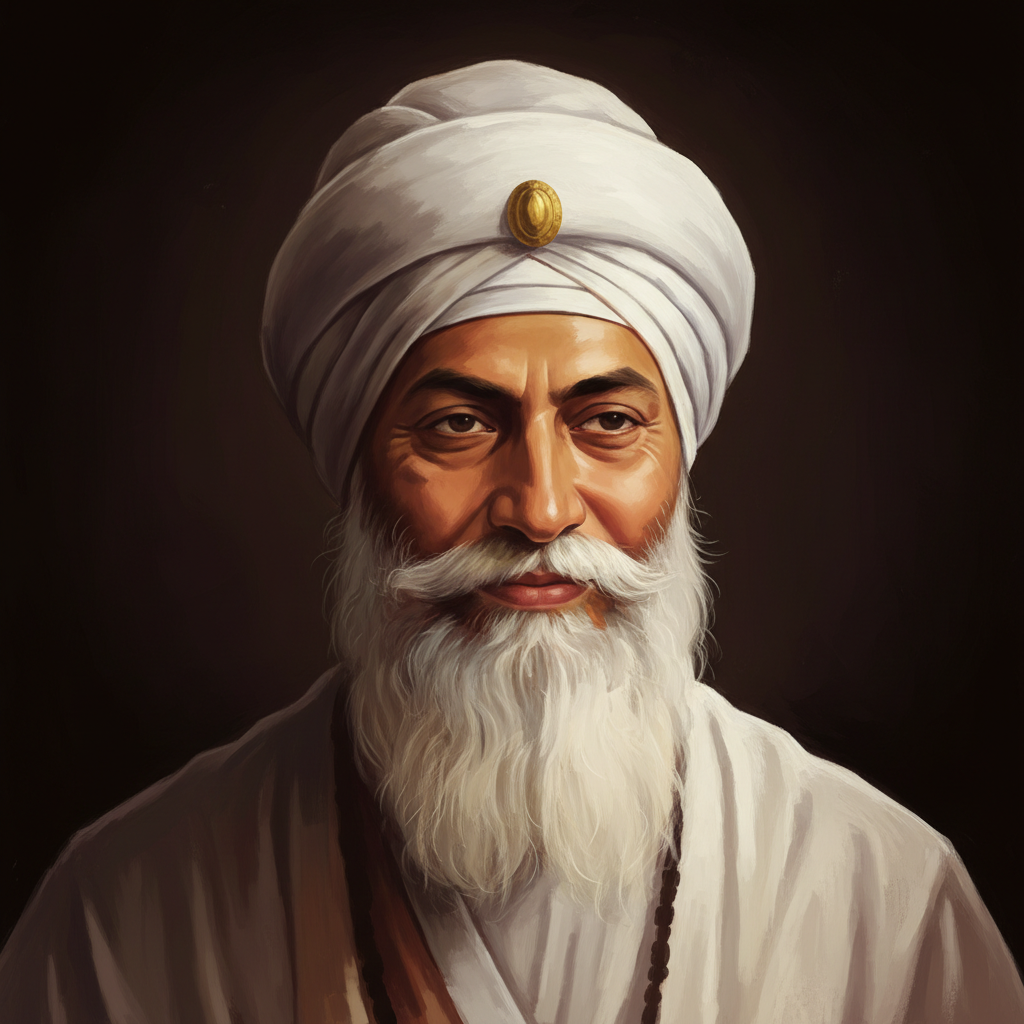
Guru Nanak — "Only fools argue whether to eat meat or not. They don't understand truth nor do …"
Only fools argue whether to eat meat or not. They don't understand truth nor do they meditate on it.
Only fools argue whether to eat meat or not. They don't understand truth nor do they meditate on it.
Click any product to generate a realistic preview. Up to 3 at a time.
* Initial load can take up to 90 seconds — revising the preview in another color is nearly instant.
"The whole world is a manifestation of the Lord."
"Na Ham Hindu Na Musalmaan - I am not a Hindu, nor am I a Muslim."
"The Lord is the ocean, and we are the fish in it."
"Death would not be called bad, O people, if one knew how to truly die."
"That one plant should be sown and another be produced cannot happen; whatever seed is sown, a plant of that kind even comes forth."
Founder of Sikhism and the first of the Ten Sikh Gurus, whose teachings of one universal God and rejection of caste shaped Punjab. Closely associated with Kabir (mystical poet whose verses appear in the Sikh Guru Granth Sahib). For an intellectual contrast, see Brahmanical orthodoxy, the Hindu caste-and-ritual establishment of his era — Sikhism was founded as a deliberate alternative to both Hindu ritual hierarchy and Islamic exclusivism — Nanak's universalism was a structural rejection of caste and priestly mediation.
Found in 1 providers: gemini
1 source checked
This quote cuts through obsessive religious debate about food rules by declaring them spiritually irrelevant. Guru Nanak argues that people who fixate on whether eating meat is sinful or acceptable have fundamentally missed the point of spiritual life. True wisdom lies in comprehending deeper truth and cultivating a genuine meditative practice—not in policing what enters the mouth. Outer ritual compliance is worthless without inner transformation.
Guru Nanak (1469–1539) spent his life challenging empty ritualism across all religions. His extensive travels—the Udasis—brought him face-to-face with Hindu brahminical purity codes and Islamic dietary laws used to enforce identity and hierarchy. He consistently taught that devotion, honest labor, and meditation on Waheguru's name constituted true religion. Dismissing meat debates reflects his core teaching: God judges the heart, not the plate.
In 15th–16th century Punjab, dietary restrictions were fierce markers of communal identity. Hindus observed caste-based purity laws, Muslims required halal slaughter, Jains practiced strict vegetarianism—each tradition using food to police belonging and enforce social boundaries. Religious conflict between Hinduism and Islam ran deep under the Delhi Sultanate and early Mughal rule. Guru Nanak's dismissal of these debates was a radical act of spiritual egalitarianism in a deeply divided society.
AI-generated insights based on extensive research and information for context. Factual errors? Email [email protected].
Your cart is empty