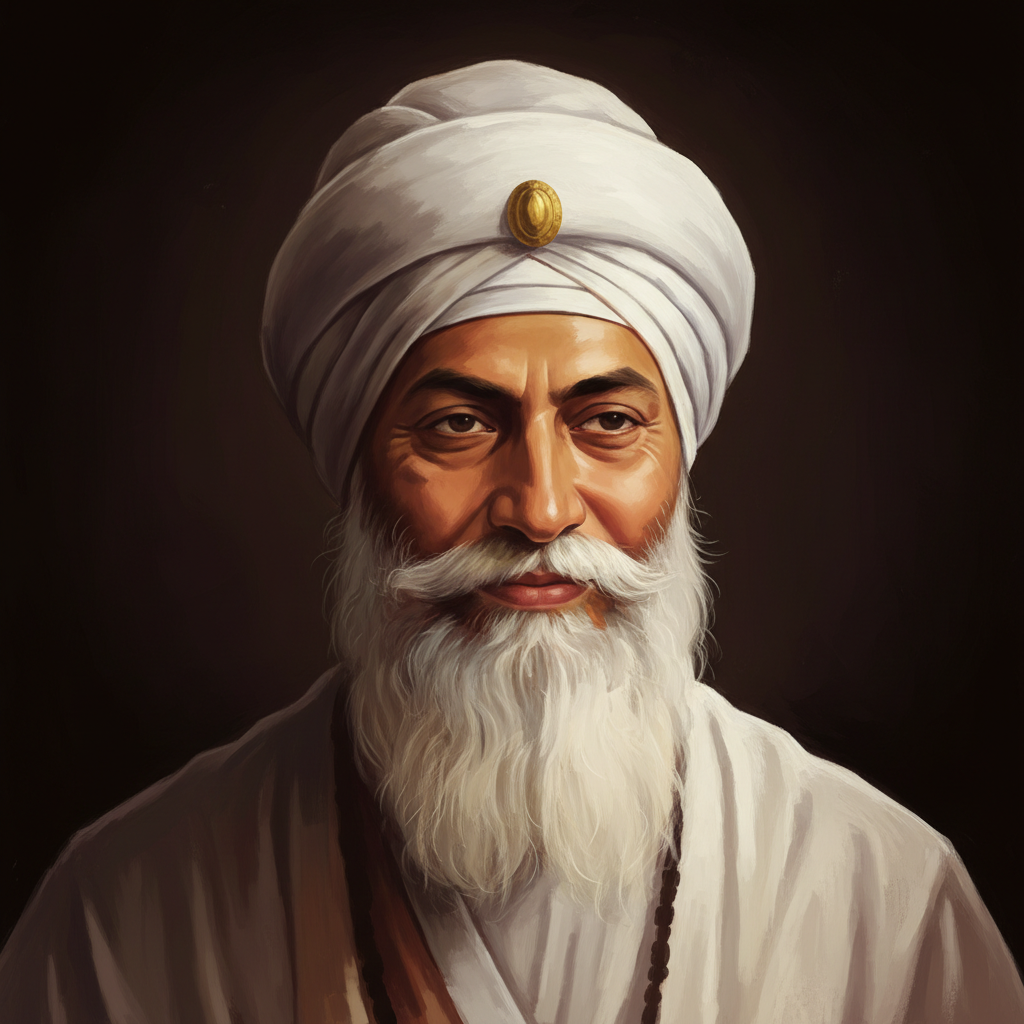
Guru Nanak — "The mind is like a wild elephant, it needs the goad of the Guru's word to contro…"
The mind is like a wild elephant, it needs the goad of the Guru's word to control it.
The mind is like a wild elephant, it needs the goad of the Guru's word to control it.
Click any product to generate a realistic preview. Up to 3 at a time.
* Initial load can take up to 90 seconds — revising the preview in another color is nearly instant.
"One cannot comprehend Him through the intellect, even if one were to try a hundred thousand times."
"Even Kings and emperors with heaps of wealth and vast dominion cannot compare with an ant filled with the love of God."
"Death would not be called bad, O people, if one knew how to truly die."
"The ignorant person is blind, even though he has eyes."
"Only fools argue whether to eat meat or not. They don't understand truth nor do they meditate on it."
Founder of Sikhism and the first of the Ten Sikh Gurus, whose teachings of one universal God and rejection of caste shaped Punjab. Closely associated with Kabir (mystical poet whose verses appear in the Sikh Guru Granth Sahib). For an intellectual contrast, see Brahmanical orthodoxy, the Hindu caste-and-ritual establishment of his era — Sikhism was founded as a deliberate alternative to both Hindu ritual hierarchy and Islamic exclusivism — Nanak's universalism was a structural rejection of caste and priestly mediation.
Found in 1 providers: gemini
1 source checked
The human mind is naturally restless and undisciplined, prone to wandering toward distraction, desire, and ego. Just as a wild elephant requires a training hook to be guided, the mind needs the Guru's sacred teaching as its controlling force. Without that spiritual discipline, the mind causes suffering; with it, one finds focus, clarity, and alignment with divine truth.
Guru Nanak spent his life traveling thousands of miles across Asia challenging empty ritual and ego-driven religion. He taught that direct inner transformation mattered more than external observance. His concept of Shabad, the divine Word, was central to Sikh practice: reciting and meditating on the Guru's hymns was the specific mechanism by which the restless human mind could be stilled and directed toward Waheguru.
In 15th-16th century Punjab, ordinary people were caught between rigid Hindu caste orthodoxy and Mughal Islamic rule, both emphasizing external conformity. Guru Nanak emerged in this spiritually fractured landscape teaching that inner mental discipline and personal devotion mattered more than birth or ritual. His elephant metaphor resonated in a culture where trained war elephants were symbols of both power and the danger of uncontrolled force.
AI-generated insights based on extensive research and information for context. Factual errors? Email [email protected].
Your cart is empty