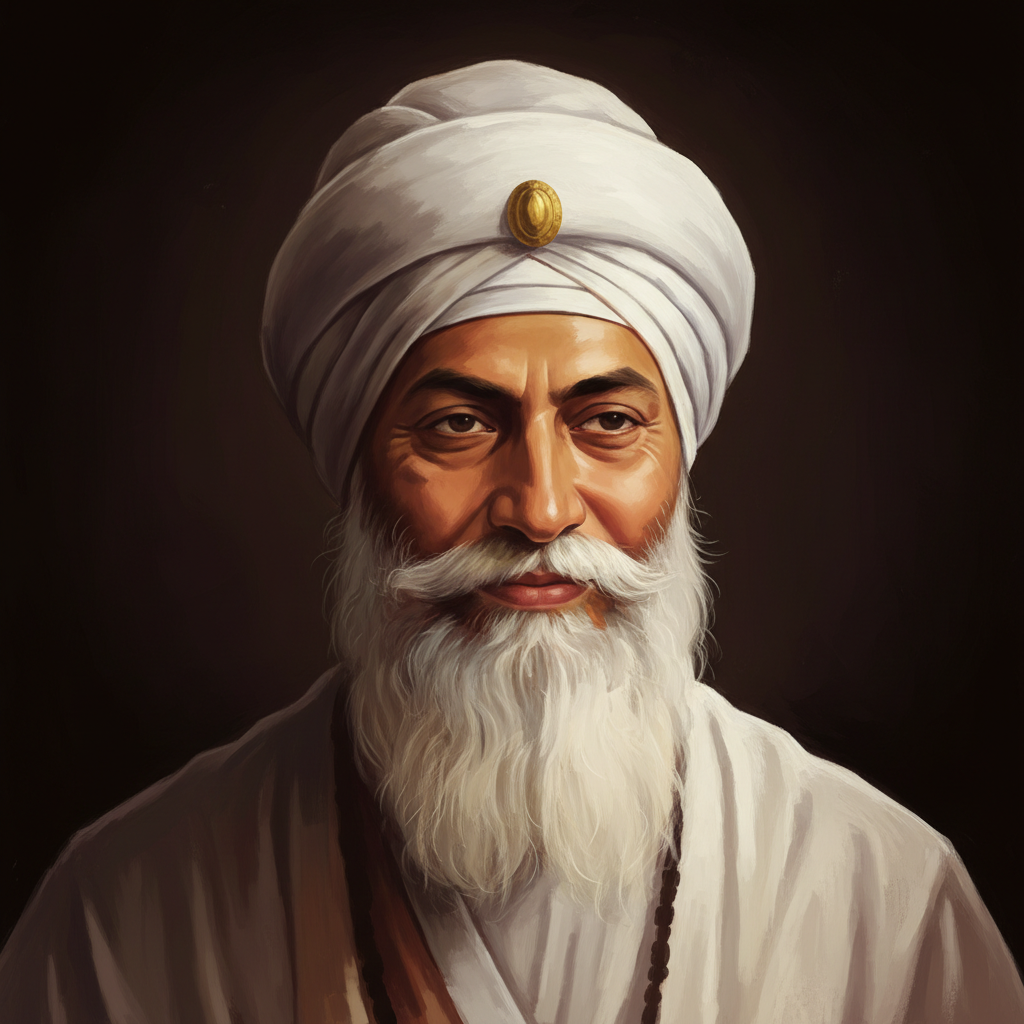
Guru Nanak — "The ignorant person is blind, even though he has eyes."
The ignorant person is blind, even though he has eyes.
The ignorant person is blind, even though he has eyes.
Click any product to generate a realistic preview. Up to 3 at a time.
* Initial load can take up to 90 seconds — revising the preview in another color is nearly instant.
"O Lord, You bless all with Your bountiful blessings."
"There is but One God. His Name is Truth; He is the Creator, Sustainer of all, Free from fear and hate, Immortal, Unborn, Self-existent, Realized by the Guru's Grace."
"Let no one be proud of his caste; he who knows God is a Brahmin."
"Bathing in holy rivers alone cannot wash away sins of injustice and greed; the most important thing is not ritual purity, but purity of words and deeds."
"The Guru is the ladder, the boat, the raft, the ferryman, the ship, and the captain."
Founder of Sikhism and the first of the Ten Sikh Gurus, whose teachings of one universal God and rejection of caste shaped Punjab. Closely associated with Kabir (mystical poet whose verses appear in the Sikh Guru Granth Sahib). For an intellectual contrast, see Brahmanical orthodoxy, the Hindu caste-and-ritual establishment of his era — Sikhism was founded as a deliberate alternative to both Hindu ritual hierarchy and Islamic exclusivism — Nanak's universalism was a structural rejection of caste and priestly mediation.
Found in 1 providers: grok
1 source checked
Having functioning eyes does not guarantee true sight. A person can observe the world physically yet remain completely unaware of deeper realities, moral truths, or their own spiritual condition. Real vision comes from understanding, reflection, and inner awareness, not from the mechanical act of seeing. Without wisdom, someone walks through life missing what matters most, mistaking surface appearances for substance and remaining disconnected from meaning despite being surrounded by it.
Guru Nanak built Sikhism around inner awakening over outward ritual. He traveled across South Asia and the Middle East challenging those who performed ceremonies without genuine understanding, famously rebuking pilgrims who bathed in sacred rivers while ignoring their neighbors. For him, true devotion required direct awareness of the divine, honest living, and service. Physical observance without spiritual insight was exactly the blindness he named, and he spent his life urging people to actually see.
Guru Nanak lived from 1469 to 1539 in Punjab, where Hindu caste orthodoxy and Islamic authority under the Lodi and early Mughal rulers both dominated daily life. Religious practice was heavy with ritual, priestly gatekeeping, and sectarian boundaries, while ordinary people often followed customs without grasping their meaning. Nanak's era saw Babur's invasion, social upheaval, and rigid formalism in both faiths, making his insistence on direct, thoughtful spiritual sight a pointed critique of the performative religiosity surrounding him.
AI-generated insights based on extensive research and information for context. Factual errors? Email [email protected].
Your cart is empty