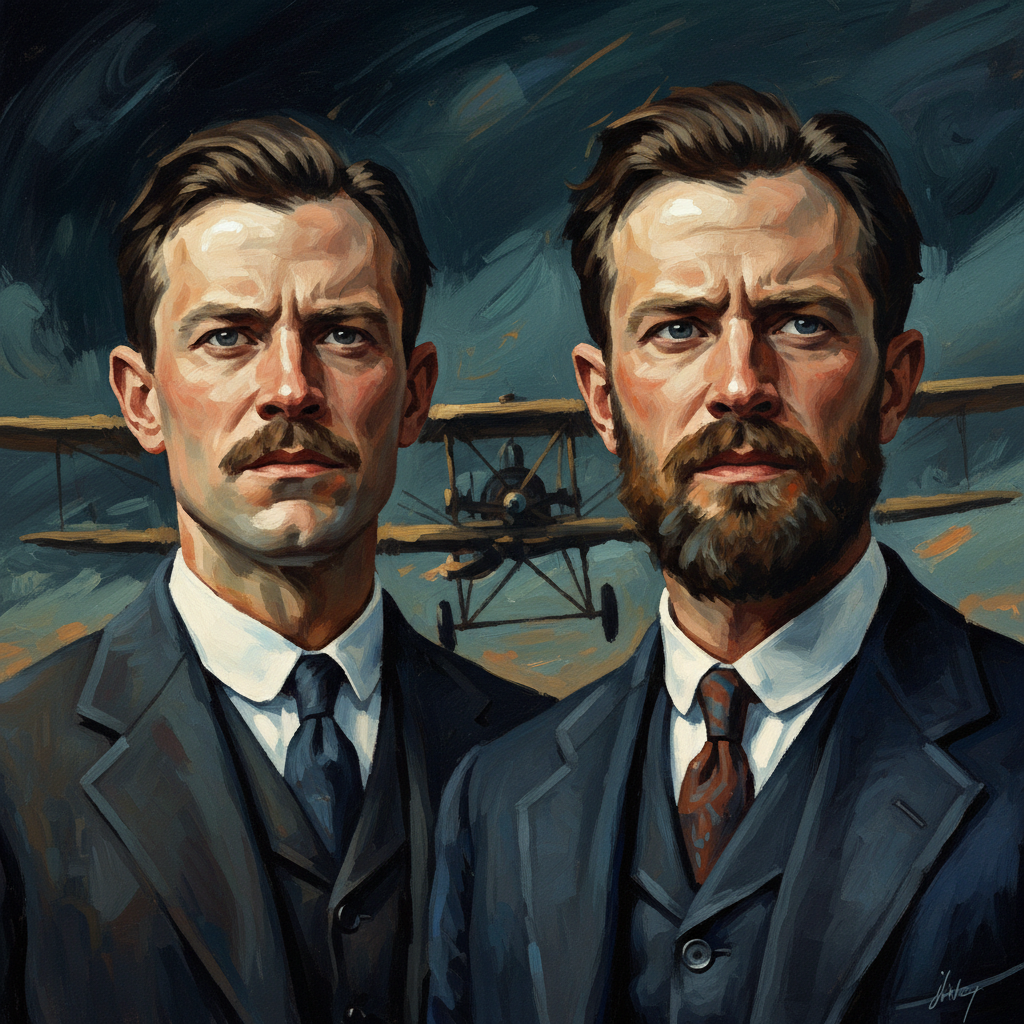
Wright Brothers (Orville & Wilbur) — "The best dividends on the labor invested have invariably come from seeking more …"
The best dividends on the labor invested have invariably come from seeking more knowledge rather than more power.
The best dividends on the labor invested have invariably come from seeking more knowledge rather than more power.
Click any product to generate a realistic preview. Up to 3 at a time.
* Initial load can take up to 90 seconds — revising the preview in another color is nearly instant.
"The problem was not to build a machine that would fly, but to build a machine that would fly safely."
"The desire to fly is an idea handed down to us by our ancestors who, in their weary journeys over endless plains, yearned for a swifter and less laborious mode of travel."
"We kept at it, and we kept on learning."
"The age of the flying machine is at hand."
"The machine is a success and we are well pleased with it."
American aviation pioneers who achieved the first sustained powered controlled airplane flight at Kitty Hawk, NC, on December 17, 1903. Closely associated with Octave Chanute (their gliding mentor and aeronautical correspondent). For an intellectual contrast, see Samuel Pierpont Langley, Smithsonian Institution Secretary and government-funded aviation researcher — Langley's Aerodrome crashed twice into the Potomac in October-December 1903 with $50,000 of War Department funding; the Wright Brothers' bicycle-shop empiricism beat Langley's institutional Big Science by 9 days. The most-cited example in engineering history of empirical-tinkerer beating institution-funded credentialism.
Found in 1 providers: gemini
1 source checked
Investing your effort into learning pays off more reliably than investing it into gaining control or dominance. Knowledge compounds: every question answered opens up new capabilities, solves future problems, and unlocks returns you could not have predicted. Chasing authority or influence, by contrast, tends to produce brittle, short-term gains. The smarter long-term strategy is curiosity and mastery, because understanding how things actually work is what eventually makes real achievement and lasting impact possible.
The Wrights were self-taught bicycle mechanics with no engineering degrees, no government contracts, and no institutional power. They out-flew better-funded rivals like Samuel Langley by obsessively studying lift, drag, and control, building their own wind tunnel in 1901 to correct flawed published aerodynamic data. They chose understanding over prestige, patenting their three-axis control system only after they truly grasped flight. Their 1903 Kitty Hawk success was a direct dividend of prioritizing knowledge over influence, funding, or fame.
The turn of the twentieth century was an era of industrial titans and empire-builders, where power, capital, and scale were seen as the engines of progress. Flight itself was a crowded race: Langley had $50,000 in Smithsonian and War Department funding, while the Wrights self-financed from their bike shop. Newspapers mocked aviation attempts as folly. In that climate, their quiet, research-first approach stood against the age's worship of industrial muscle, proving that patient inquiry could outperform well-funded ambition.
AI-generated insights based on extensive research and information for context. Factual errors? Email [email protected].
Your cart is empty