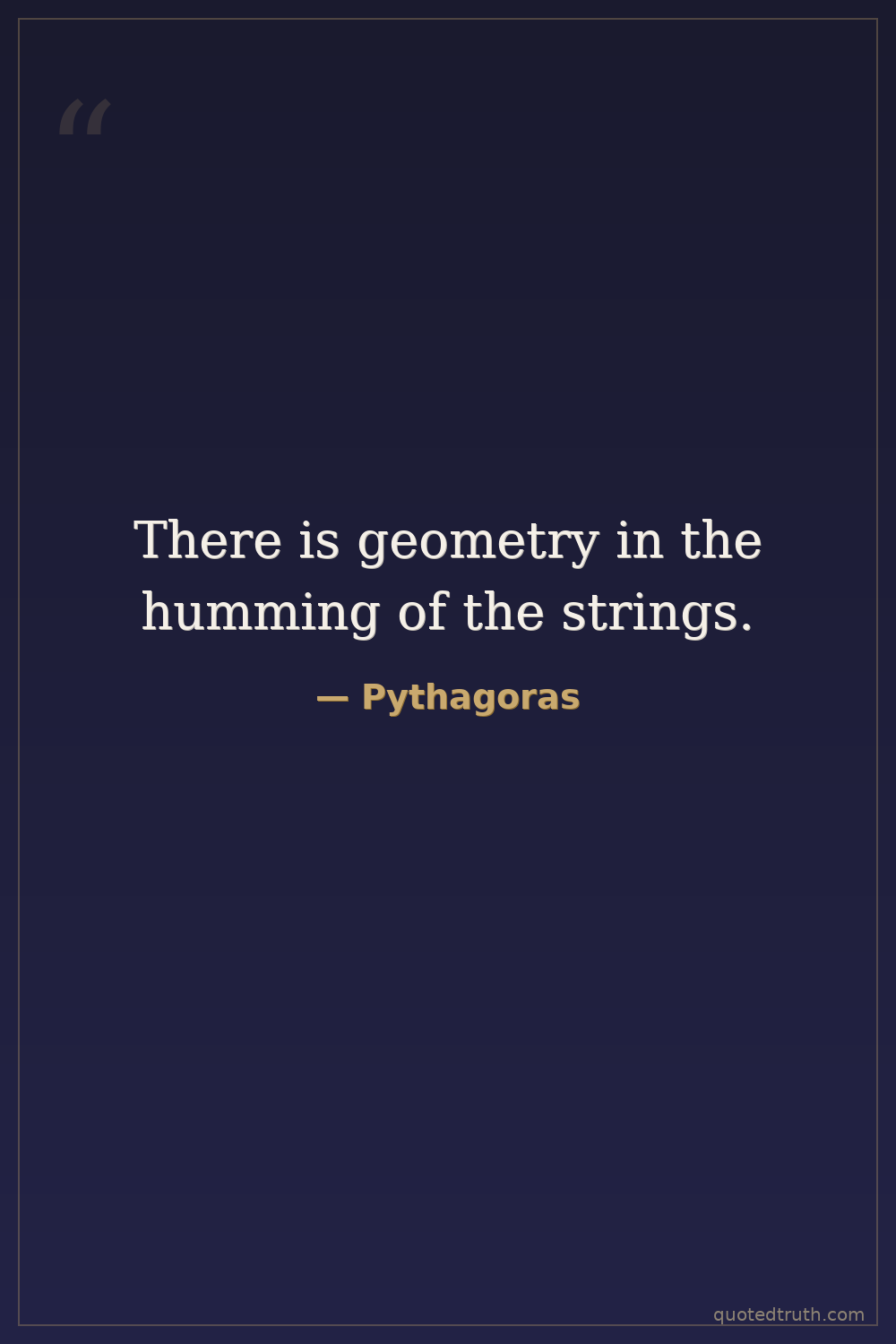
Pythagoras — "There is geometry in the humming of the strings."
There is geometry in the humming of the strings.
There is geometry in the humming of the strings.
Click any product to generate a realistic preview. Up to 3 at a time.
* Initial load can take up to 90 seconds — revising the preview in another color is nearly instant.
"Do not receive the swallow into your house."
"When abroad, don't turn back at the border."
"Don't wipe up a mess with a torch."
"Concern should drive us into action and not into a depression. No man is free who is not master of himself."
"You should make great things, not promising great things."
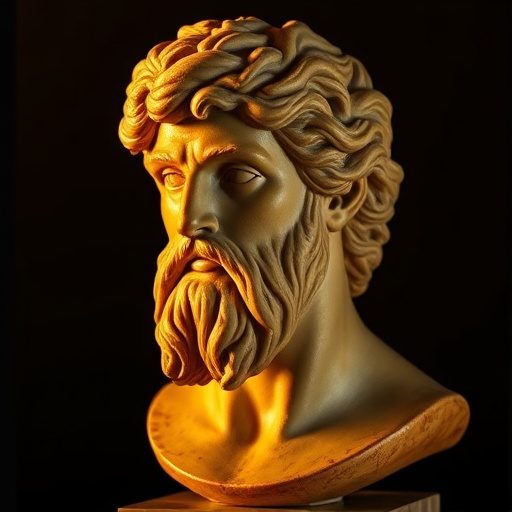
Greek philosopher and mathematician whose school in Croton combined geometry (the Pythagorean theorem), number-mysticism, and a religious-vegetarian way of life. Closely associated with Thales of Miletus (earlier pre-Socratic and the first philosopher). For an intellectual contrast, see Heraclitus, pre-Socratic Greek philosopher of flux — Heraclitus called Pythagoras 'the chief of swindlers' — among the founding insults of the philosophical-rivalry tradition. Their 'all is flux' vs 'all is number' poles still organize the philosophy of mathematics today (Platonist vs anti-realist).
Refers to the discovery of mathematical ratios in musical harmony, connecting music and geometry.
Date: c. 5th Century BCE
PhilosophicalFound in 1 providers: gemini
1 source checked
Musical sounds follow precise mathematical rules. When a string vibrates and produces a note, the pitch depends on measurable ratios of length, tension, and thickness. What sounds like pure art is actually governed by proportion and number. Beauty in music is not mystical but structured, and anyone who studies the intervals can uncover the same orderly patterns that appear in shapes, distances, and the motions of physical objects.
Pythagoras reportedly discovered that harmonious musical intervals correspond to simple whole-number ratios by experimenting with vibrating strings and weighted hammers. For him, number was the hidden substance of reality, and music proved it. His school treated arithmetic, geometry, music, and astronomy as one unified study. This saying captures his central conviction that the same ratios producing a pleasing chord also structure triangles, planetary orbits, and the soul itself.
In sixth-century BCE Greece, explanations for natural phenomena were shifting from myth toward rational inquiry. Thinkers in Ionia and southern Italy were asking what underlying principle organized the cosmos. Pythagoras founded a community in Croton where mathematics, religion, and ethics blended. Music was performed on lyres and flutes at religious rites and symposia, so linking audible harmony to geometric proportion gave ordinary experience a philosophical weight and helped seed the later Greek conviction that nature is intelligible.
AI-generated insights based on extensive research and information for context. Factual errors? Email [email protected].
Your cart is empty