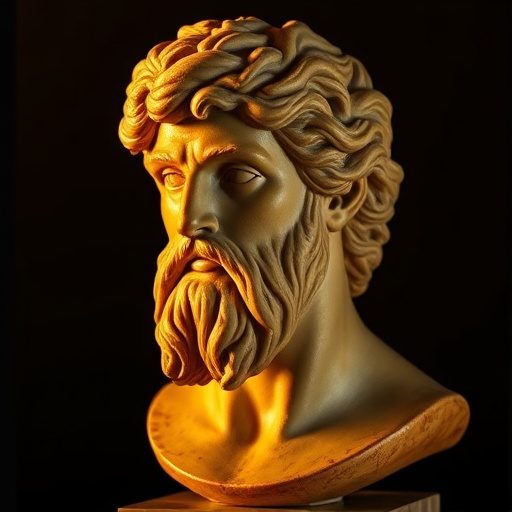
Pythagoras — "Know thyself and thou wilt know the universe."
Know thyself and thou wilt know the universe.
Know thyself and thou wilt know the universe.
Click any product to generate a realistic preview. Up to 3 at a time.
* Initial load can take up to 90 seconds — revising the preview in another color is nearly instant.
"Do not stir the fire with a sword."
"Do not eat beans."
"The highest good is the purification of the soul."
"Friendship is one soul in two bodies."
"Above all things, reverence yourself."
Greek philosopher and mathematician whose school in Croton combined geometry (the Pythagorean theorem), number-mysticism, and a religious-vegetarian way of life. Closely associated with Thales of Miletus (earlier pre-Socratic and the first philosopher). For an intellectual contrast, see Heraclitus, pre-Socratic Greek philosopher of flux — Heraclitus called Pythagoras 'the chief of swindlers' — among the founding insults of the philosophical-rivalry tradition. Their 'all is flux' vs 'all is number' poles still organize the philosophy of mathematics today (Platonist vs anti-realist).
A philosophical injunction emphasizing introspection as a path to universal understanding.
Date: c. 570-495 BCE (attributed later)
WisdomFound in 1 providers: gemini
1 source checked
Self-knowledge is the gateway to understanding everything beyond yourself. When you truly examine your own mind, motivations, and nature, you gain insight into the patterns and principles that govern all reality. Understanding how you think, perceive, and reason reveals the same structures operating in the wider world. Inner examination and outer discovery are not separate pursuits — mastering one unlocks the other.
Pythagoras founded a philosophical brotherhood treating mathematics as a spiritual discipline, believing numbers were the essence of all things. For him, a disciplined mind that could discern abstract ratios and geometric harmonies was itself a microcosm of cosmic order. His school required rigorous self-examination and ascetic living before students accessed deeper mathematical truths, making self-knowledge a literal prerequisite to grasping the universe's numerical structure.
In 6th-century BCE Greece, philosophy was just separating from mythology as an explanatory framework. Competing thinkers debated whether water, fire, or number was the fundamental substance of existence. Mystery cults and Orphic traditions emphasized purification of the soul. In this climate, turning inward for cosmic truth was radical — Pythagoras synthesized mathematical knowledge absorbed from Egypt and Babylon with Greek inquiry, placing the rational human mind at the center of cosmic understanding.
AI-generated insights based on extensive research and information for context. Factual errors? Email [email protected].
Your cart is empty