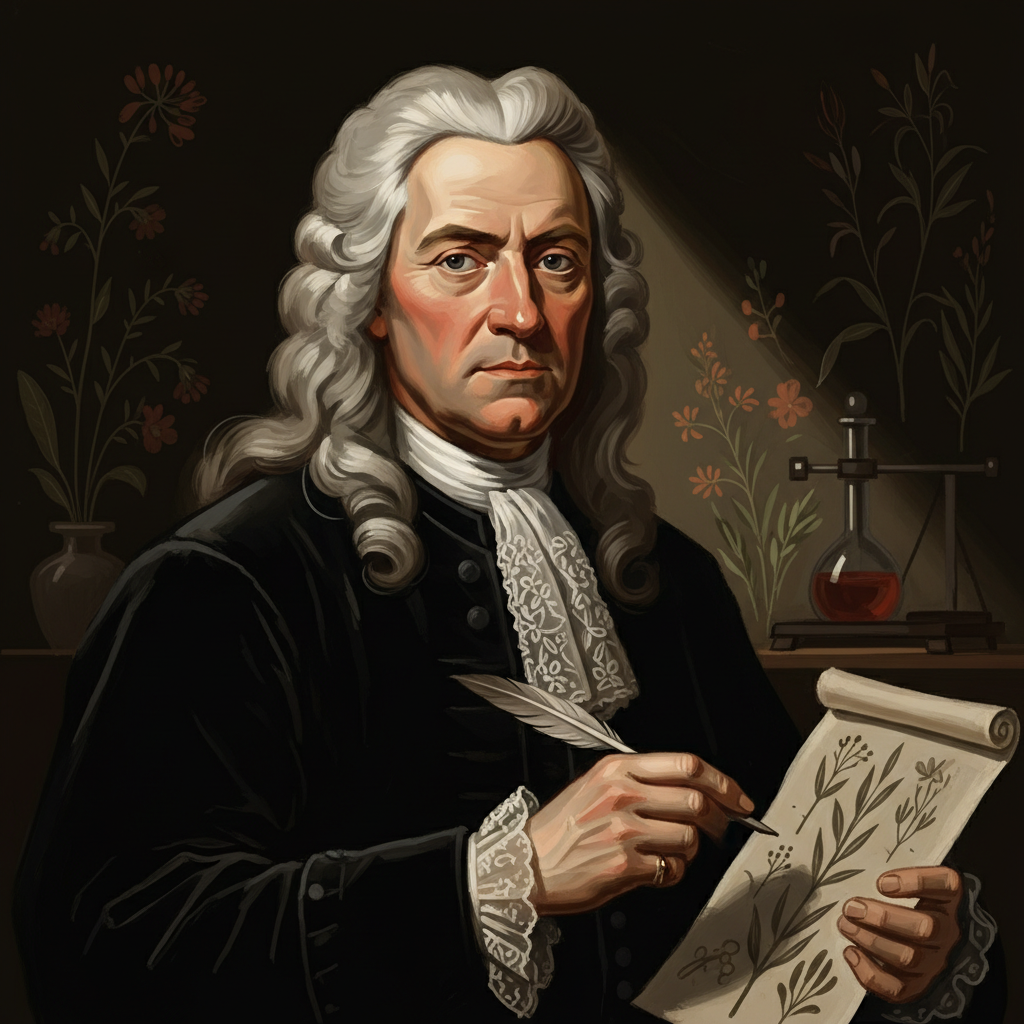
Carl Linnaeus — "The plant kingdom covers the entire earth, offering our senses great pleasure an…"
The plant kingdom covers the entire earth, offering our senses great pleasure and the delights of summer.
The plant kingdom covers the entire earth, offering our senses great pleasure and the delights of summer.
Click any product to generate a realistic preview. Up to 3 at a time.
* Initial load can take up to 90 seconds — revising the preview in another color is nearly instant.
"I have been called the Prince of Botanists."
"Natura non facit saltus. (Nature makes no leaps.)"
"The Creator's wisdom is seen in the smallest insect as well as in the greatest elephant."
"The greatest pleasure is to be found in the smallest things."
"The Creator's hand is visible in every part of creation."
Swedish botanist and the father of modern taxonomy whose Systema Naturae (1735) introduced binomial nomenclature for naming all species. Closely associated with Joseph Banks (British naturalist who carried Linnaean classification on Cook's voyages). For an intellectual contrast, see Comte de Buffon, French naturalist and Histoire Naturelle author (1749-1788) — Buffon explicitly attacked Linnaean fixed-categories taxonomy as artificial and rejected the binomial system; his gradualist, environment-shaped natural history was the explicit alternative. Anticipates the fixed-species-vs-evolution debate Darwin would later resolve.
A poetic appreciation of the aesthetic and sensory value of the botanical world.
Date: 18th Century
PhilosophicalFound in 1 providers: gemini
1 source checked
Plants blanket our world completely, and their presence brings genuine joy to human senses across every season of growth. This is a direct observation about nature's abundance and beauty—that the green world surrounding us is not merely functional but a source of real delight and pleasure for anyone who pays attention to it.
Linnaeus dedicated his life to cataloguing the plant kingdom, describing over 7,700 plant species. His passion for botany began in childhood in Sweden's forests. His system of binomial nomenclature emerged from genuine wonder at plant diversity. His famous 'Systema Naturae' reflects this belief that nature deserved serious, loving attention—science driven by aesthetic reverence as much as intellectual rigor.
The 18th-century Enlightenment saw Europeans systematically exploring and cataloguing the natural world for the first time. Botanical gardens flourished across Europe, and plant collectors traveled to every continent. Linnaeus worked during an era when global exploration was revealing staggering biodiversity, making his observation about plants covering the earth literal—new species arrived in European herbaria constantly, validating his sense of plant kingdom's extraordinary scope.
AI-generated insights based on extensive research and information for context. Factual errors? Email [email protected].
Your cart is empty