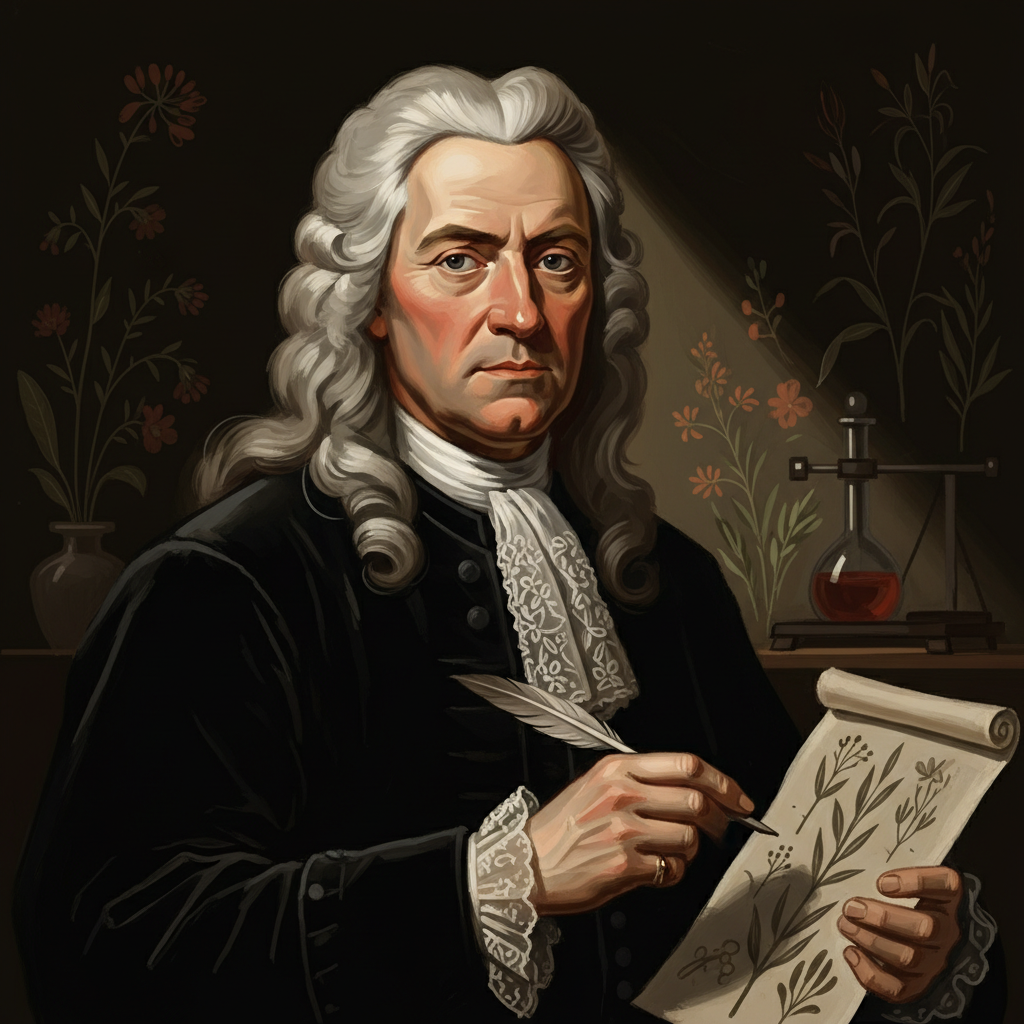
Carl Linnaeus — "The stony rocks are not primeval, but daughters of Time."
The stony rocks are not primeval, but daughters of Time.
The stony rocks are not primeval, but daughters of Time.
Click any product to generate a realistic preview. Up to 3 at a time.
* Initial load can take up to 90 seconds — revising the preview in another color is nearly instant.
"The whole of natural history depends on the accurate knowledge of species."
"The study of nature is the study of God."
"The greatest pleasure of a gardener is to survey his work, and to admire the result of his own industry."
"The most important thing in life is to be useful."
"The greatest pleasure of a naturalist is to make new discoveries."
Swedish botanist and the father of modern taxonomy whose Systema Naturae (1735) introduced binomial nomenclature for naming all species. Closely associated with Joseph Banks (British naturalist who carried Linnaean classification on Cook's voyages). For an intellectual contrast, see Comte de Buffon, French naturalist and Histoire Naturelle author (1749-1788) — Buffon explicitly attacked Linnaean fixed-categories taxonomy as artificial and rejected the binomial system; his gradualist, environment-shaped natural history was the explicit alternative. Anticipates the fixed-species-vs-evolution debate Darwin would later resolve.
From 'Systema Naturae' (1735). A profound statement on geological time and the formation of the Earth, predating modern geology.
Date: 1735
PhilosophicalFound in 1 providers: gemini
1 source checked
Rocks and geological formations are not eternal, original features of existence — they were shaped and built by time itself. Nothing in the physical world is truly primeval; even the hardest stone has a history of formation. The natural world is a product of ongoing temporal processes, not a fixed, unchanging creation. Time is the architect behind even the most solid, seemingly permanent structures we encounter on Earth.
Linnaeus classified not only plants and animals but also minerals in early editions of his Systema Naturae — rocks were part of his ordered natural system. Though deeply religious and a believer in divine creation, this quote shows him acknowledging temporal processes in nature. It reflects his empirical observer's mind: even a man committed to cataloguing the fixed order of creation recognized that geological features bore the unmistakable marks of time's passage.
In the 18th-century Enlightenment, the age of the Earth was fiercely debated. Biblical chronology placed creation at roughly 6,000 years ago, making rocks seem primeval. But naturalists like Buffon proposed far longer timescales, and early geologists found evidence of gradual formation in rock strata. Linnaeus's observation aligned with emerging proto-geological thinking — challenging the assumption that Earth's physical features were fixed and original — decades before Hutton formally established the concept of geological deep time.
AI-generated insights based on extensive research and information for context. Factual errors? Email [email protected].
Your cart is empty