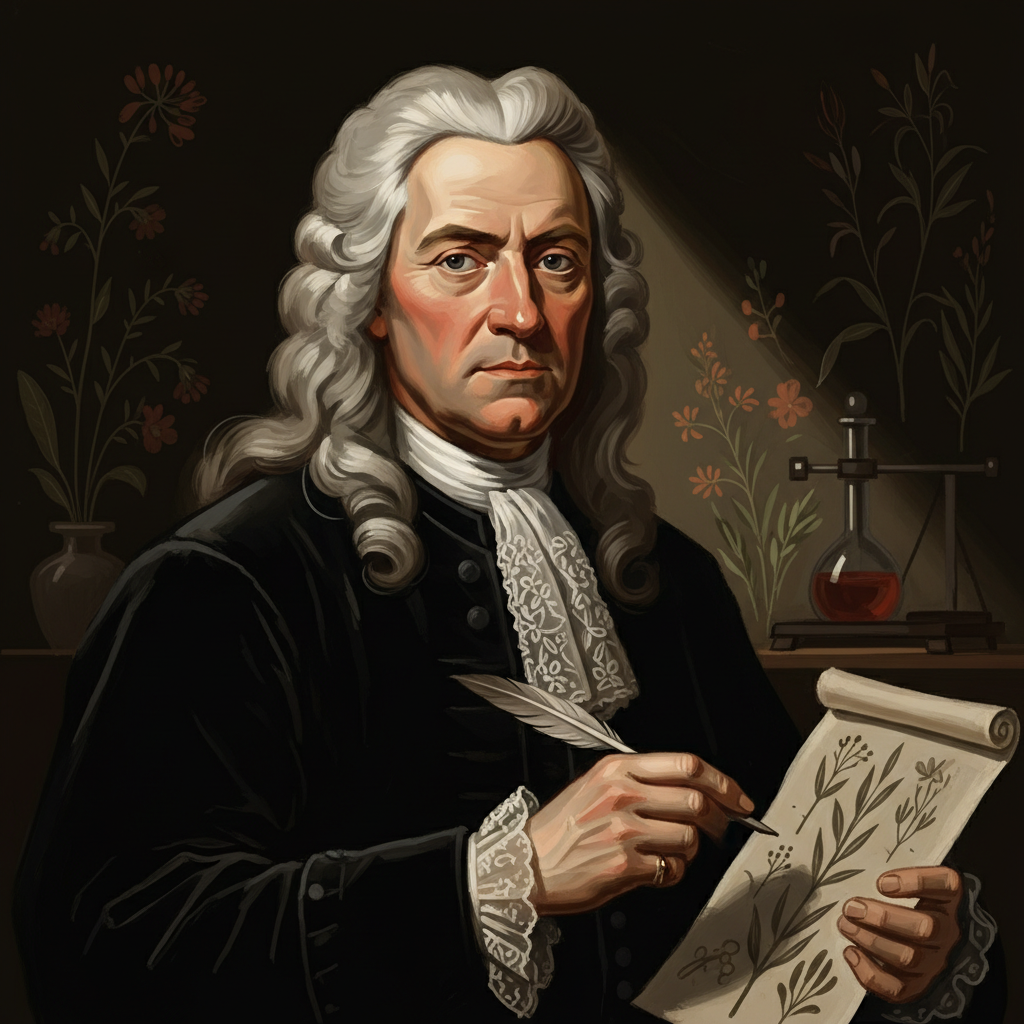
Carl Linnaeus — "The most beautiful flower is the one that is most accurately drawn."
The most beautiful flower is the one that is most accurately drawn.
The most beautiful flower is the one that is most accurately drawn.
Click any product to generate a realistic preview. Up to 3 at a time.
* Initial load can take up to 90 seconds — revising the preview in another color is nearly instant.
"The whole world is a museum, and all its inhabitants are specimens."
"The greatest delight is to behold the earth, and to know what it is."
"The world is ruled by three things: money, women, and botany."
"The book of nature is the only book that offers a wealth of content on every one of its pages."
"The earth is a paradise, but men make it a hell."
Swedish botanist and the father of modern taxonomy whose Systema Naturae (1735) introduced binomial nomenclature for naming all species. Closely associated with Joseph Banks (British naturalist who carried Linnaean classification on Cook's voyages). For an intellectual contrast, see Comte de Buffon, French naturalist and Histoire Naturelle author (1749-1788) — Buffon explicitly attacked Linnaean fixed-categories taxonomy as artificial and rejected the binomial system; his gradualist, environment-shaped natural history was the explicit alternative. Anticipates the fixed-species-vs-evolution debate Darwin would later resolve.
Found in 2 providers: gemini,grok
2 sources checked
Beauty is not decoration or sentiment — it is precision. A flower is most beautiful when rendered with complete accuracy, capturing every structural detail faithfully. True appreciation comes from exact knowledge, not artistic embellishment. Understanding something fully — seeing it as it actually is — creates its own profound beauty. Accuracy and aesthetics are not opposites; precision is the highest form of appreciation.
Linnaeus built his entire taxonomic system on precise observation and exact description. His Species Plantarum (1753) demanded faithful botanical illustrations — he collaborated with artists like Georg Ehret who depicted plant structures with scientific rigor. To Linnaeus, accurate depiction was the foundation of classification itself: you cannot name or categorize what you have not precisely observed. For him, scientific truth and beauty were identical.
During the 18th-century Enlightenment, Europe was cataloguing the natural world at unprecedented scale — expeditions to the Americas, Asia, and Pacific returned with thousands of unknown species requiring documentation. Botanical illustration became a serious scientific discipline. Accurate drawings determined whether a species could be identified or classified. The tension between ornate decorative art and scientific precision was actively contested; Linnaeus firmly sided with exactness over aesthetics.
AI-generated insights based on extensive research and information for context. Factual errors? Email [email protected].
Your cart is empty