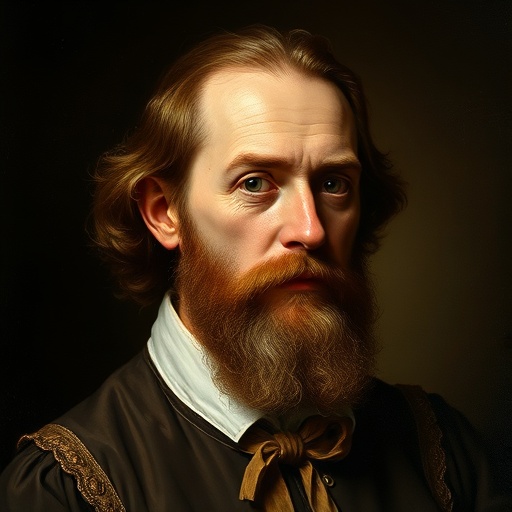
William Harvey — "The heart itself is the first to live and the last to die."
The heart itself is the first to live and the last to die.
The heart itself is the first to live and the last to die.
Click any product to generate a realistic preview. Up to 3 at a time.
* Initial load can take up to 90 seconds — revising the preview in another color is nearly instant.
"All animals, even man himself, are produced from an egg."
"I have often wondered and even laughed at those who fancied that everything had been so consummately and absolutely investigated by an Aristotle or a Galen or some other mighty name, that nothing coul…"
"The circulation of the blood is the greatest discovery ever made in medicine."
"The physician must be a man of experience."
"Truth is the daughter of time, not of authority."
English physician whose On the Motion of the Heart and Blood in Animals (1628) demonstrated blood circulation, overturning 1,400 years of Galenic medicine. Closely associated with Francis Bacon (his contemporary in the new English empiricism). For an intellectual contrast, see Galenic medicine, the 2nd-century Greek medical tradition (humors, blood-as-consumed-fuel) — Harvey calculated that the heart pumps more blood per hour than the body could possibly produce as fuel — a single quantitative observation that demolished the entire Galenic-Aristotelian medical worldview. The cleanest example in medical history of arithmetic disproving 14 centuries of authority.
From 'De Motu Cordis' (1628). A concise and profound statement on the heart's vital role throughout life.
Date: 1628
PhilosophicalFound in 1 providers: gemini
1 source checked
The heart is the foundation of life itself, the first organ to begin functioning and the last to cease when life ends. This expresses the heart's central, irreplaceable role in sustaining all biological existence, preceding every other organ in its vital activity and outlasting them all in the final moments before death.
Harvey spent decades meticulously studying the heart through dissections and vivisections, ultimately proving in 1628's De Motu Cordis that the heart pumps blood in a closed circulatory loop. This observation reflects his empirical, organ-centered approach and deep reverence for cardiac function as the engine of life that defined his entire scientific legacy.
In early modern Europe, Galenic medicine still dominated, teaching that the liver produced blood and the heart generated vital spirits. Harvey's era saw the Scientific Revolution challenging ancient authority through observation. Understanding the heart's primacy was revolutionary, as physicians still debated basic anatomy and physiology using texts centuries old rather than direct empirical investigation.
AI-generated insights based on extensive research and information for context. Factual errors? Email [email protected].
Your cart is empty