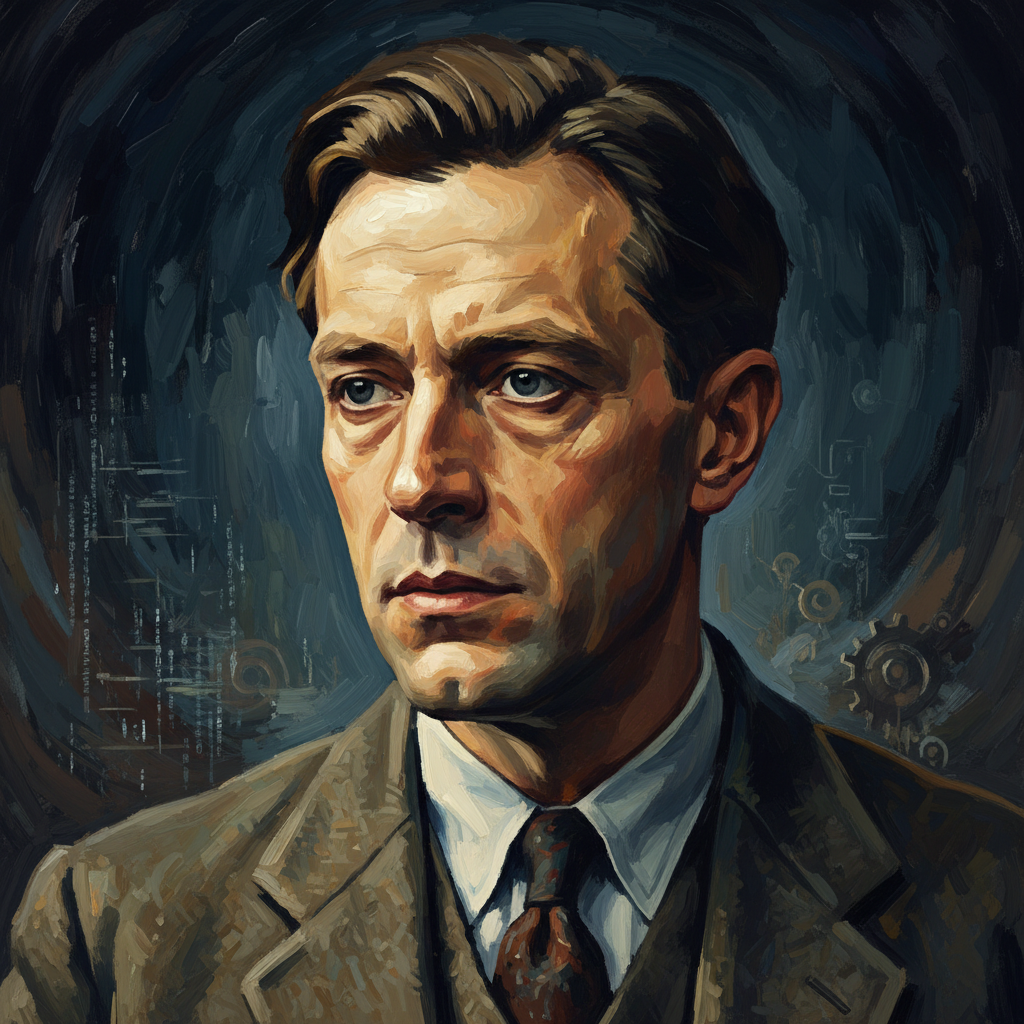
Alan Turing — "A computer would deserve to be called intelligent if it could deceive a human in…"
A computer would deserve to be called intelligent if it could deceive a human into believing that it was human.
A computer would deserve to be called intelligent if it could deceive a human into believing that it was human.
Click any product to generate a realistic preview. Up to 3 at a time.
* Initial load can take up to 90 seconds — revising the preview in another color is nearly instant.
"The activity of the intuition consists in making spontaneous judgements which are not the result of conscious trains of reasoning. These judgments are often but by no means invariably correct…"
"The machine has a definite state at any moment, which is determined by the instructions it has received and by the results of its previous operations."
"If it is accepted that real brains, as found in animals, and in particular in men, are a sort of machine it will follow that our digital computer suitably programmed, will behave like a brain..."
"Science is a differential equation. Religion is a boundary condition."
"Hyperboloids of wondrous light. Rolling for age through Space and Time Harbour there Waves which somehow Might Play out God's holy pantomime."
Found in 1 providers: grok
1 source checked
True machine intelligence isn't measured by speed, memory, or processing power — it's measured by behavior. If a machine can hold a conversation so naturally that a real person cannot tell they're talking to software, it has crossed the threshold into genuine intelligence. This shifts the question away from 'how does it work inside' toward 'what can it do' — a practical, human-centered test for a concept that resists easy definition.
Turing proposed this idea in his landmark 1950 paper 'Computing Machinery and Intelligence,' introducing what became the Turing Test. His wartime codebreaking at Bletchley Park also centered on deception — cracking Nazi Enigma communications by simulating enemy logic. Personally, Turing lived as a gay man in an era requiring concealment. He understood intimately the gap between what one truly is and what one must appear to be.
In 1950, computers filled entire rooms and performed basic arithmetic. The concept of a thinking machine was science fiction to most. Post-WWII Britain was rebuilding, and tools that helped crack Enigma raised urgent questions about whether machines could reason. Philosophers debated consciousness; scientists debated mechanism. Turing's behavioral framing cut through speculation with an empirical challenge that still defines artificial intelligence discourse seventy-five years later.
AI-generated insights based on extensive research and information for context. Factual errors? Email [email protected].
Your cart is empty