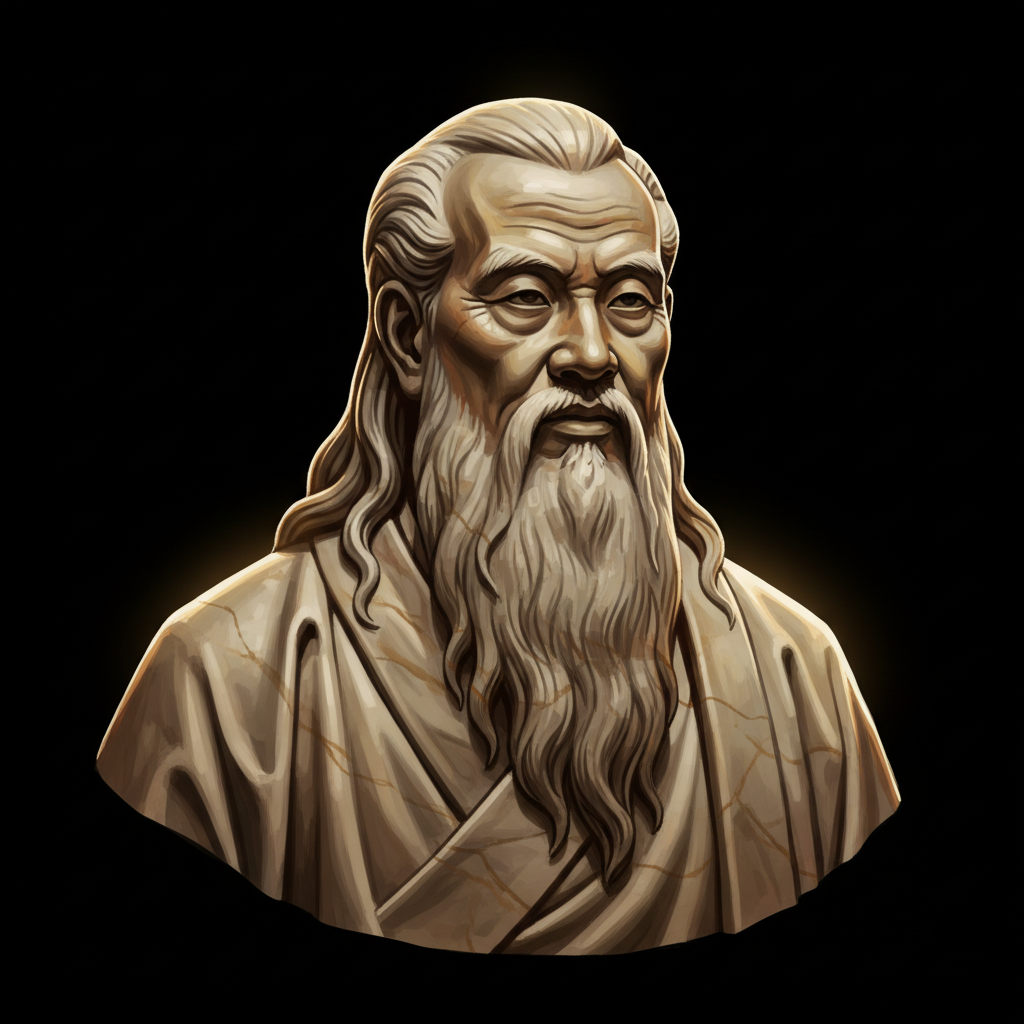
Laozi — "The greatest evil is to have no satisfaction."
The greatest evil is to have no satisfaction.
The greatest evil is to have no satisfaction.
Click any product to generate a realistic preview. Up to 3 at a time.
* Initial load can take up to 90 seconds — revising the preview in another color is nearly instant.
"He who boasts of his own achievements will not endure."
"Let people return to making knots on ropes, instead of writing."
"Knowing others is intelligence; knowing yourself is true wisdom. Mastering others is strength; mastering yourself is true power."
"Therefore even the sage treats some things as difficult. That is why in the end no difficulties can get the better of him."
"The whole world knows that the good is good, and this is how evil arises. The whole world knows that the beautiful is beautiful, and this is how ugliness arises."
Reputed founder of Taoism and author of the Tao Te Ching, whose wu wei (effortless action) shaped East Asian philosophy. Closely associated with Zhuangzi (later Taoist who extended Laozi's framework). For an intellectual contrast, see Confucius, near-contemporary Chinese sage of social ritual and duty — Confucius systematized social order through ritual and hierarchy; Laozi argued that all such systems were the disease, not the cure — the two founding poles of Chinese moral philosophy.
Found in 1 providers: grok
1 source checked
Constantly wanting more than you have is the root of most harm people cause themselves and others. When nothing is ever enough, you chase wealth, status, or pleasure without end, and that chase breeds anxiety, conflict, and ruin. The quote argues that learning to feel content with what you already possess is not passive weakness but the strongest defense against a life spent grasping.
Laozi built Taoism around wu wei, simplicity, and alignment with the natural flow of things. He reportedly served as a keeper of royal archives before withdrawing from court life, disillusioned with ambition and political scheming. His Tao Te Ching repeatedly warns that desire distorts perception and breeds suffering. Urging contentment fits a thinker who literally walked away from power and status to live quietly.
Laozi lived during China's late Zhou period, around the 6th century BCE, as feudal lords waged constant war for land, titles, and tribute. Ministers chased promotion, merchants chased profit, and ordinary people paid in conscription and taxes. Rival schools like Confucianism stressed duty and hierarchy. Against this backdrop of endless striving and upheaval, a teaching that named insatiable desire itself as the deepest evil was a pointed cultural critique.
AI-generated insights based on extensive research and information for context. Factual errors? Email [email protected].
Your cart is empty