Max Planck — "A scientific truth is not a truth that is true in all possible worlds, but a tru…"
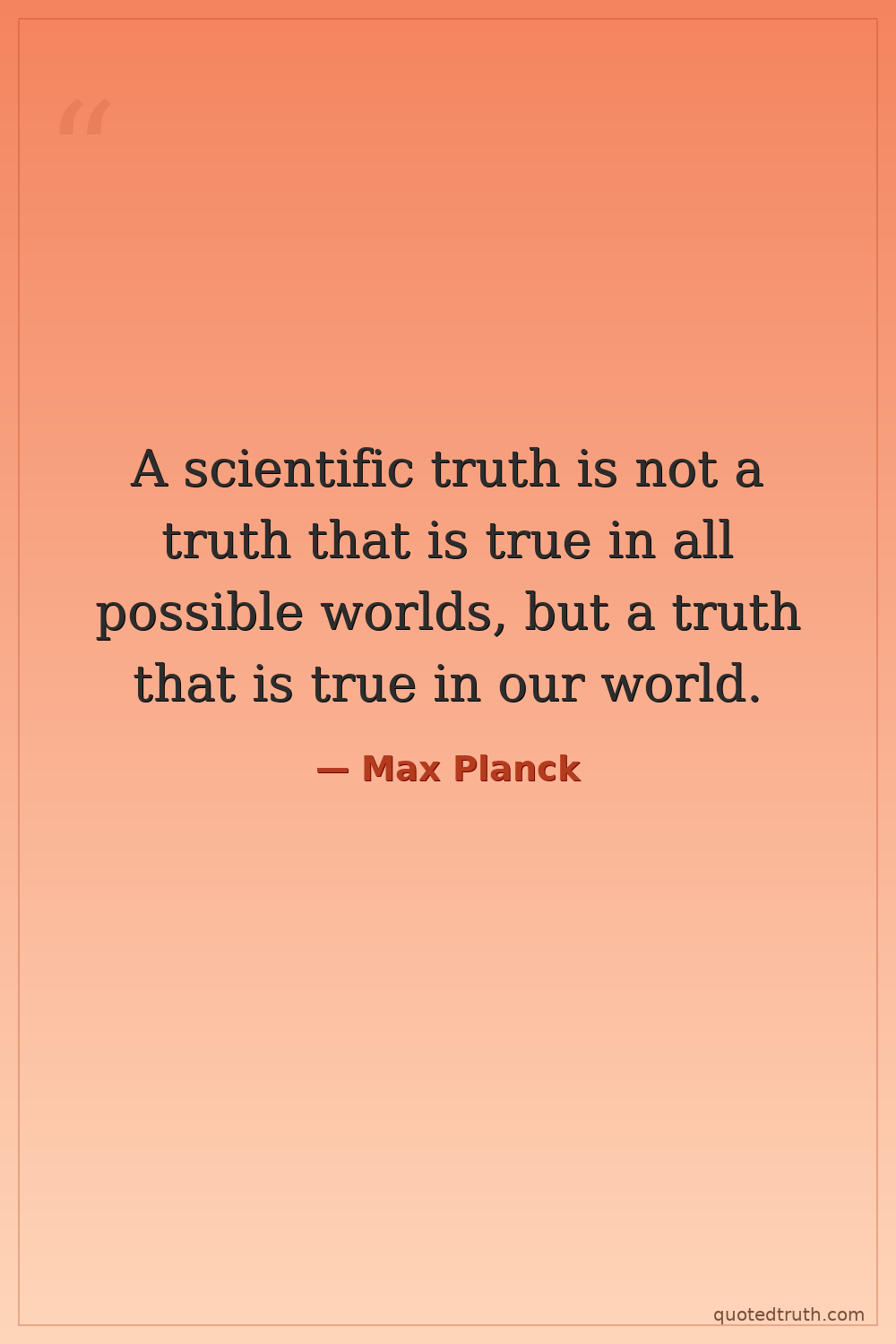
A scientific truth is not a truth that is true in all possible worlds, but a truth that is true in our world.
A scientific truth is not a truth that is true in all possible worlds, but a truth that is true in our world.
Click any product to generate a realistic preview. Up to 3 at a time.
* Initial load can take up to 90 seconds — revising the preview in another color is nearly instant.
"The highest task of physics is to arrive at the knowledge of the human mind."
"We have no right to assume that any physical laws exist, or if they have existed up to now, that they will continue to exist in a similar manner in the future."
"Anybody who has been seriously engaged in scientific work of any kind realizes that over the entrance to the gates of the temple of science are written the words: 'Ye shall have faith.' It is a qualit…"
"The scientist must be a dreamer and a realist at the same time."
"There can be no such thing as a religion without a God."
Found in 1 providers: grok
1 source checked
Scientific truths are not absolute certainties that hold across every imaginable reality. Instead, they are reliable descriptions of how our particular universe behaves, based on observation and experiment. A claim counts as scientifically true when it accurately captures the rules governing the world we actually live in, not because it must logically be so in every conceivable alternative reality we might dream up.
Planck founded quantum theory by accepting what experiments forced upon him, even when it violated classical intuition. His quantized energy hypothesis seemed arbitrary, yet it fit our world. This quote reflects his empiricist humility: truth comes from nature's verdict, not human preference. Having watched Newtonian certainties crumble, Planck knew physics describes this universe as measured, not timeless absolutes carved into logic itself.
Planck worked as physics underwent its deepest revolution. Newtonian mechanics, long considered eternal truth, was toppling before relativity and quantum mechanics in the early twentieth century. Philosophers debated whether science revealed necessary laws or contingent regularities. Planck witnessed two world wars, the Nazi corruption of German science, and the loss of his son Erwin to Hitler's regime, deepening his conviction that truth is tied to real conditions, not ideology.
AI-generated insights based on extensive research and information for context. Factual errors? Email [email protected].
Your cart is empty