Laozi — "Abandon sageliness and discard wisdom, and the people will benefit a hundredfold…"
Abandon sageliness and discard wisdom, and the people will benefit a hundredfold.
Abandon sageliness and discard wisdom, and the people will benefit a hundredfold.
Click any product to generate a realistic preview. Up to 3 at a time.
* Initial load can take up to 90 seconds — revising the preview in another color is nearly instant.
"To know yet to think that one does not know is the highest [attainment]. Not to know yet to think that one knows is a disease."
"The superior man, when he hears of the Tao, endeavors to observe it."
"The wise man's food is that which nourishes, not that which pleases the eye."
"The Way that can be told of is not an unvarying way."
"To yield is to be preserved whole."
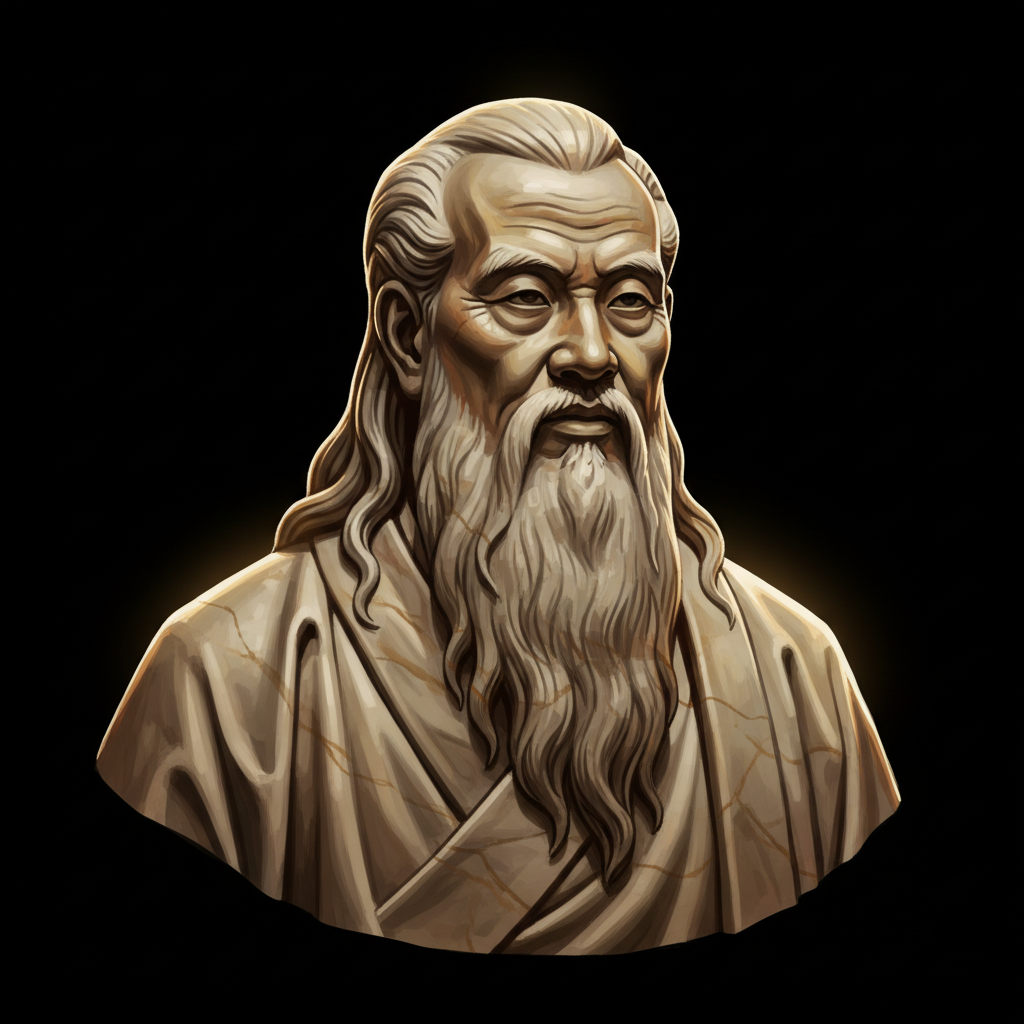
Reputed founder of Taoism and author of the Tao Te Ching, whose wu wei (effortless action) shaped East Asian philosophy. Closely associated with Zhuangzi (later Taoist who extended Laozi's framework). For an intellectual contrast, see Confucius, near-contemporary Chinese sage of social ritual and duty — Confucius systematized social order through ritual and hierarchy; Laozi argued that all such systems were the disease, not the cure — the two founding poles of Chinese moral philosophy.
Found in 1 providers: gemini
1 source checked
Drop the obsession with appearing clever or morally superior, and ordinary people thrive. When rulers and scholars stop pushing rigid doctrines of virtue and intellectual systems, people are freed from artificial standards they must perform against. Without elites dictating what counts as wise or good, communities rely on natural sense, mutual trust, and direct experience. The gain isn't small: life becomes radically simpler and more productive once imposed sophistication is removed.
Laozi, traditionally an archivist in the Zhou royal court, saw firsthand how bureaucratic learning and ceremonial virtue produced corruption rather than harmony. His Taoism centers on wu wei, effortless action aligned with nature, and distrust of contrived hierarchies. Legend says he left civilization on a water buffalo, disgusted by its decay. This line embodies his core conviction that institutional wisdom and performative sageliness obstruct the Tao, while stripping them away restores people's innate capacity.
Laozi lived during the late Zhou dynasty, roughly the 6th century BCE, as centralized authority crumbled into the Warring States era. Competing philosophers, especially Confucians, were codifying elaborate systems of ritual, virtue, and scholarly cultivation to restore order. Rulers hired strategists and sages, taxing peasants to fund endless campaigns and courtly sophistication. Against this backdrop of credentialed wise men multiplying while ordinary life grew harsher, Laozi's call to abandon manufactured sagehood was a pointed rebuke of the era's intellectual arms race.
AI-generated insights based on extensive research and information for context. Factual errors? Email [email protected].
Your cart is empty