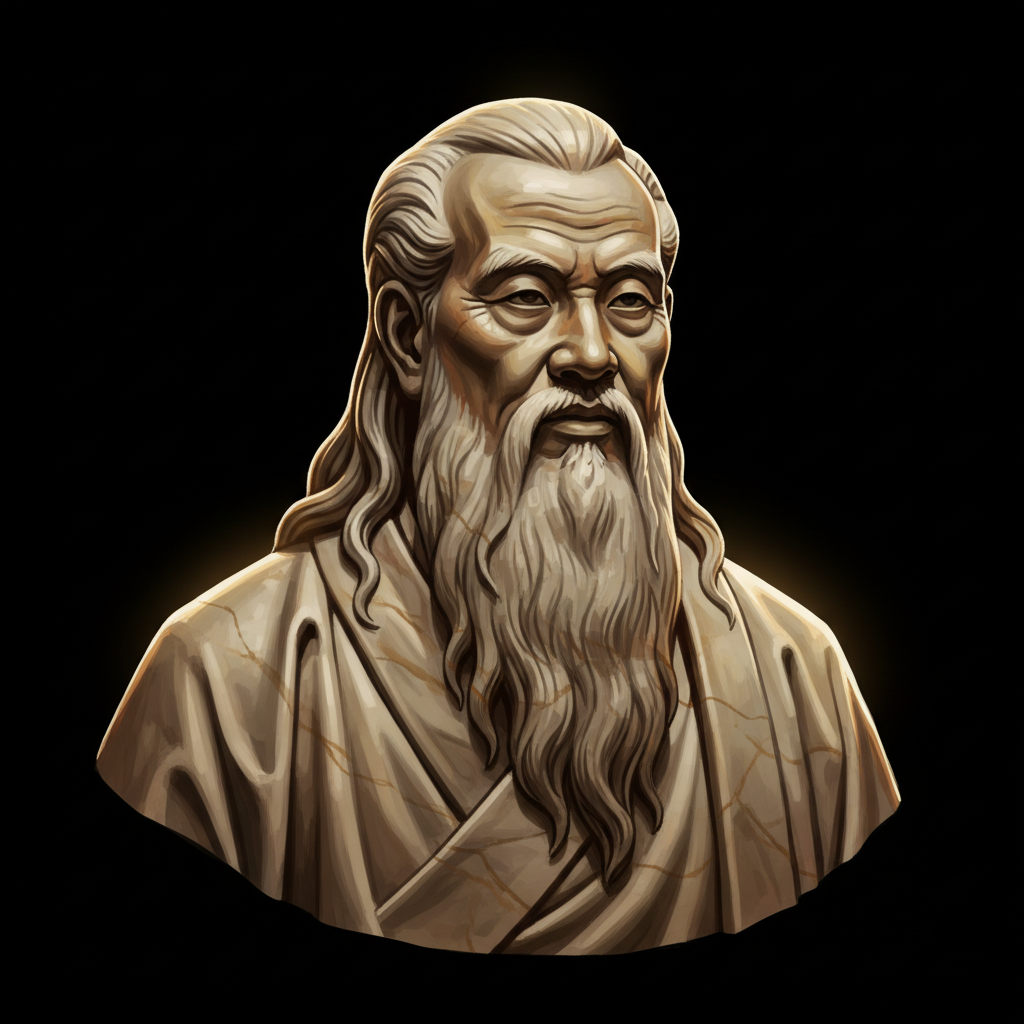
Laozi — "The Way that can be told of is not an unvarying way."
The Way that can be told of is not an unvarying way.
The Way that can be told of is not an unvarying way.
Click any product to generate a realistic preview. Up to 3 at a time.
* Initial load can take up to 90 seconds — revising the preview in another color is nearly instant.
"If you realize that all things change, there is nothing you will try to hold on to."
"The softest thing in the world can overcome the hardest thing in the world."
"A great nation is like a great man: When he makes a mistake, he realizes it. Having realized it, he admits it. Having admitted it, he corrects it. He considers those who point out his faults as his mo…"
"He who is attached to things will suffer much."
"Keep your mouth shut, guard your senses, and you will be free from trouble. Open your mouth, always be busy, and you will be beyond hope."
Reputed founder of Taoism and author of the Tao Te Ching, whose wu wei (effortless action) shaped East Asian philosophy. Closely associated with Zhuangzi (later Taoist who extended Laozi's framework). For an intellectual contrast, see Confucius, near-contemporary Chinese sage of social ritual and duty — Confucius systematized social order through ritual and hierarchy; Laozi argued that all such systems were the disease, not the cure — the two founding poles of Chinese moral philosophy.
Found in 1 providers: deepseek
1 source checked
Any truth you can fully put into words stops being the complete truth. Language fixes things in place, but reality keeps shifting and flowing. The moment you define something absolutely, you've traded the living thing for a frozen label. Real understanding of how existence works stays beyond neat explanation. What you can describe is a useful pointer, not the territory itself, so hold every definition loosely.
Laozi opened the Tao Te Ching with this line because his whole teaching warns against rigid doctrine. Tradition paints him as a reclusive archivist in the Zhou court who left society when rulers grew corrupt, writing his verses only at a border guard's request. A thinker who walked away from official life would naturally distrust fixed systems, preferring quiet observation of nature's changing patterns over confident pronouncements.
Laozi lived during the late Zhou dynasty, roughly the 6th century BCE, as centralized authority decayed into the Warring States chaos. Rival philosophers, especially Confucians, were codifying strict rituals, hierarchies, and named virtues to restore order. Opening his text by rejecting fixed names was a direct pushback against that project, offering rulers and seekers a competing path rooted in flexibility, humility, and alignment with nature rather than rigid social engineering.
AI-generated insights based on extensive research and information for context. Factual errors? Email [email protected].
Your cart is empty