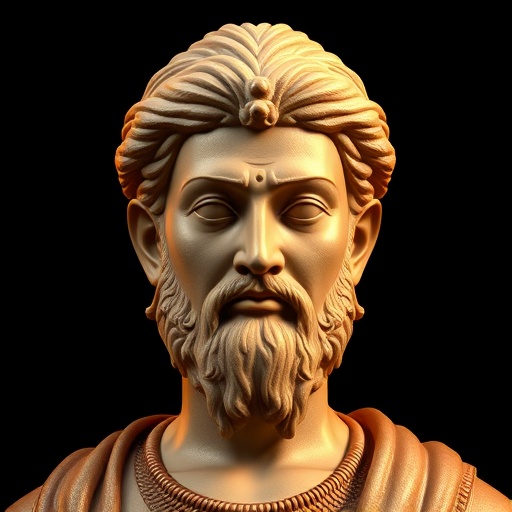
Mahavira — "The self is the friend and enemy of the self."
The self is the friend and enemy of the self.
The self is the friend and enemy of the self.
Click any product to generate a realistic preview. Up to 3 at a time.
* Initial load can take up to 90 seconds — revising the preview in another color is nearly instant.
"One should not steal."
"The world is a prison, and the soul is the prisoner."
"The greatest penance is to bear all hardships with equanimity."
"The universe is a beginningless and endless cycle of creation and destruction."
"Attachment leads to bondage; detachment leads to liberation."
24th and last Tirthankara of Jainism, whose teachings of strict ahimsa (non-violence), aparigraha (non-attachment), and karma reshaped ancient Indian religion. Closely associated with The Buddha (near-contemporary moral revolutionary, also reacting against Vedic ritualism). For an intellectual contrast, see Vedic Brahmanical ritual sacrifice, the animal-sacrifice-centered Vedic religion of his era — Mahavira's ahimsa demanded total non-violence, including not eating root vegetables that kill the plant — a maximum-distance ethical move from the Vedic priestly tradition that ritually sacrificed cattle and horses. The two cleanest poles of ancient Indian religious ethics.
Unknown, attributed (similar to Bhagavad Gita, but also a Jain concept)
Date: 6th century BCE (approx)
ShockingFound in 1 providers: grok
1 source checked
You are simultaneously your own greatest ally and your own worst obstacle. Your choices, discipline, and inner state determine whether you flourish or suffer — not fate, not gods, not others. No external force holds more power over your life than your own mind. Mastering yourself brings liberation; failing to do so keeps you bound in cycles of desire, harm, and consequence.
Mahavira renounced royal life at 30 and spent 12 years in rigorous asceticism, achieving enlightenment through radical self-discipline. Jainism, which he codified, centers on self-conquest: ahimsa, non-attachment, and purifying the soul through personal effort alone, with no gods or priests as intermediaries. His entire spiritual path demonstrated that liberation depends wholly on one's own will and conduct — making this the philosophical heart of everything he lived and taught.
In 6th-century BCE India, Brahminical ritual and caste hierarchy dominated spiritual life, with priests mediating between humans and divine forces. Mahavira and contemporaries like the Buddha challenged this by placing moral agency entirely within the individual. In an era where birth and sacrifice seemed to determine fate, declaring the self both jailer and liberator was a radical, democratizing assertion of personal moral responsibility that upended the prevailing spiritual order.
AI-generated insights based on extensive research and information for context. Factual errors? Email [email protected].
Your cart is empty