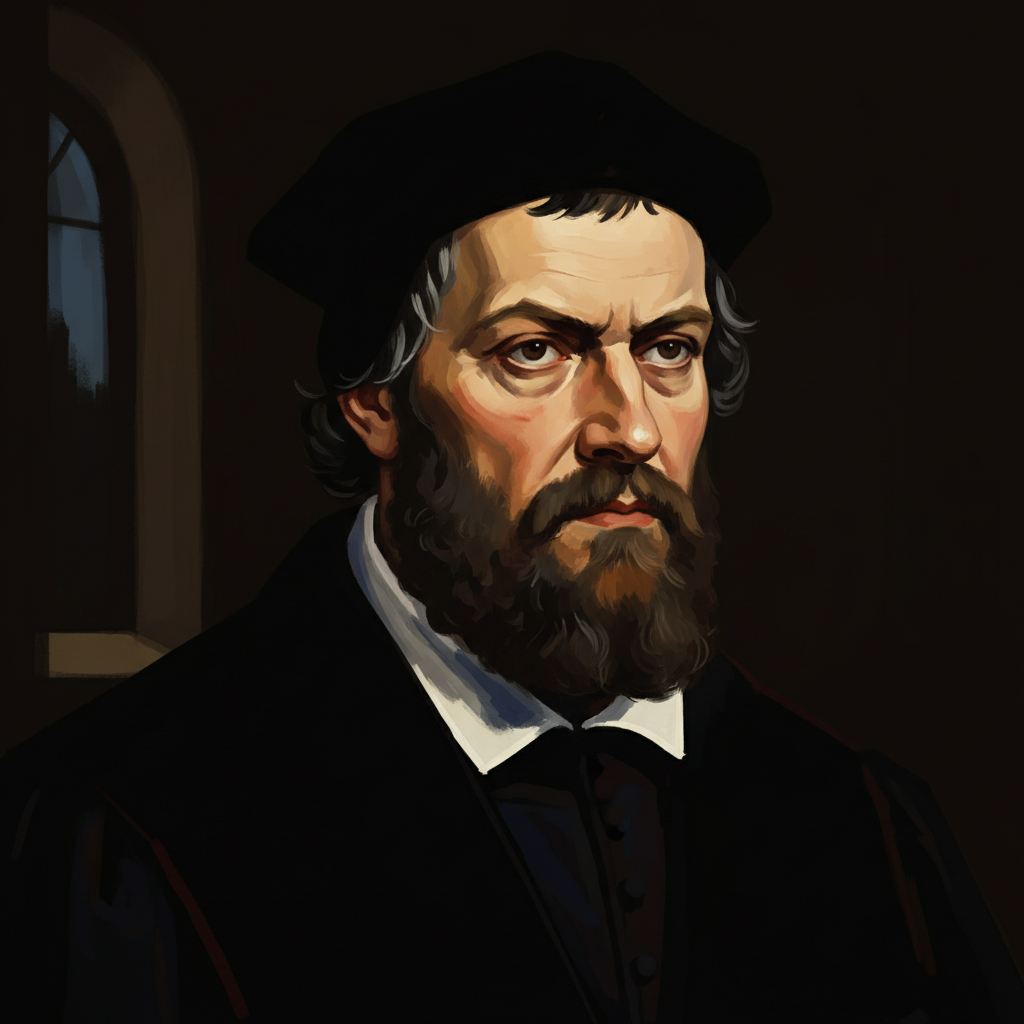
Martin Luther — "All their cash and treasure of silver and gold be taken from them."
All their cash and treasure of silver and gold be taken from them.
All their cash and treasure of silver and gold be taken from them.
Click any product to generate a realistic preview. Up to 3 at a time.
* Initial load can take up to 90 seconds — revising the preview in another color is nearly instant.
"If God has no sense of humor, I don't want to go to Heaven."
"No other sin exists in the world save unbelief."
"If I profess with the loudest voice and clearest exposition every portion of the truth of God except precisely that little point which the world and the devil are at that moment attacking, I am not co…"
"The law of God is not given to make us righteous, but to show us our unrighteousness."
"He who does not understand the devil, does not understand God."
German theologian whose 95 Theses (1517) launched the Protestant Reformation and broke the Catholic Church's monopoly on Western Christianity. Closely associated with Philipp Melanchthon (Lutheran systematizer) and John Calvin (later Reformer who built on Luther's break). For an intellectual contrast, see Pope Leo X, Renaissance pope (1513-1521) — Leo X's indulgence sales triggered Luther's break and Leo excommunicated him in 1521 — Luther's entire Reformation is structured as a direct answer to the indulgence-funded Vatican Leo represented.
Found in 1 providers: gemini
1 source checked
This statement calls for the seizure of all monetary wealth—cash, silver, and gold—from a specific group. It frames confiscation of financial assets as a concrete action to be carried out, stripping the targeted population of their economic resources. In modern terms, it advocates state or communal expropriation of private wealth from a designated community, removing their ability to sustain themselves financially or maintain independence through accumulated capital.
This line comes from Luther's 1543 treatise 'On the Jews and Their Lies,' where he proposed harsh measures against Jewish communities. Though celebrated for translating the Bible into German and sparking the Reformation through his 95 Theses in 1517, Luther's later writings revealed virulent antisemitism. This quote reflects a darker dimension of the reformer who challenged papal authority but also urged princes to persecute Jews economically.
Early modern Europe saw widespread antisemitism, with Jews confined to ghettos, barred from most trades, and frequently expelled from kingdoms. Moneylending was one permitted occupation, fueling resentment. The Reformation era (1517 onward) fractured Christendom, intensifying religious tensions. Princes routinely confiscated Jewish assets during expulsions across Spain, Portugal, and German territories. Luther's writings influenced centuries of Protestant attitudes toward Jews, later cited by 20th-century regimes seeking historical justification for persecution.
AI-generated insights based on extensive research and information for context. Factual errors? Email [email protected].
Your cart is empty