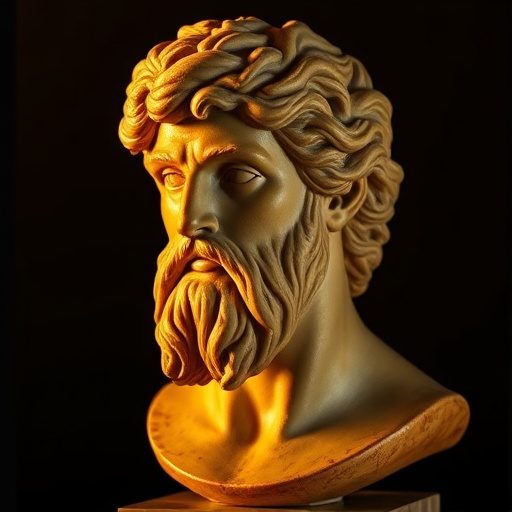
Pythagoras — "Anger begins with folly and ends with repentance."
Anger begins with folly and ends with repentance.
Anger begins with folly and ends with repentance.
Click any product to generate a realistic preview. Up to 3 at a time.
* Initial load can take up to 90 seconds — revising the preview in another color is nearly instant.
"The earth is a sphere."
"Don't keep clawed birds."
"Above all things, reverence yourself."
"Educate the children and it won't be necessary to punish the men."
"Lust weakens both body and mind."
Greek philosopher and mathematician whose school in Croton combined geometry (the Pythagorean theorem), number-mysticism, and a religious-vegetarian way of life. Closely associated with Thales of Miletus (earlier pre-Socratic and the first philosopher). For an intellectual contrast, see Heraclitus, pre-Socratic Greek philosopher of flux — Heraclitus called Pythagoras 'the chief of swindlers' — among the founding insults of the philosophical-rivalry tradition. Their 'all is flux' vs 'all is number' poles still organize the philosophy of mathematics today (Platonist vs anti-realist).
Found in 2 providers: deepseek,gemini
2 sources checked
When you act out of anger, you start from a place of irrationality and poor judgment. The emotion clouds thinking, leading to words or actions you later wish you could take back. Anger feels powerful in the moment but consistently produces outcomes you regret, meaning the cost of losing your temper is always paid afterward, never avoided.
Pythagoras built his entire philosophical school around reason, order, and self-mastery. His Pythagorean brotherhood followed strict ethical codes demanding emotional discipline. For a man who saw mathematical harmony as the universe's foundation, uncontrolled anger represented a fundamental disorder — the antithesis of the rational, measured life he taught his followers to pursue.
In ancient Greece around 500 BCE, city-states were frequently erupting into conflicts fueled by wounded honor and impulsive vendettas. Greek culture idealized sophrosyne — moderation and self-control — as a civic and personal virtue. Pythagorean philosophy emerged partly as a corrective to this volatile world, emphasizing that the disciplined mind, not passionate reaction, was the path to wisdom and social stability.
AI-generated insights based on extensive research and information for context. Factual errors? Email [email protected].
Your cart is empty