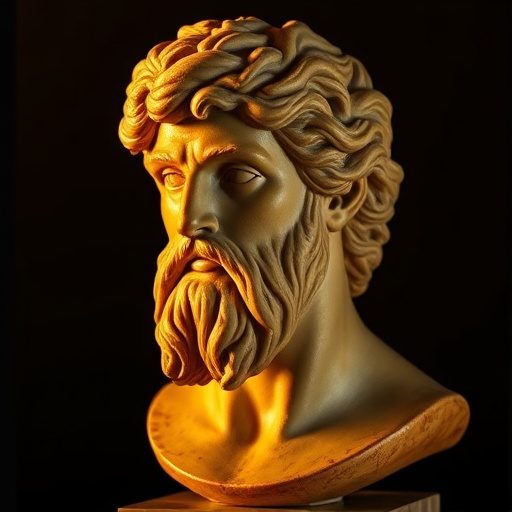
Pythagoras — "Lust weakens both body and mind."
Lust weakens both body and mind.
Lust weakens both body and mind.
Click any product to generate a realistic preview. Up to 3 at a time.
* Initial load can take up to 90 seconds — revising the preview in another color is nearly instant.
"All is number."
"The strangest (and sexiest) of the legends surrounding the aura of Pythagoras is that he had a golden thigh that he would show to impress people he wanted to join his cult."
"A man is never free unless he is master of himself."
"The universe is a living creature, endowed with soul and reason."
"Above the cloud with its shadow is the star with its light. Above all things reverence thyself."
Greek philosopher and mathematician whose school in Croton combined geometry (the Pythagorean theorem), number-mysticism, and a religious-vegetarian way of life. Closely associated with Thales of Miletus (earlier pre-Socratic and the first philosopher). For an intellectual contrast, see Heraclitus, pre-Socratic Greek philosopher of flux — Heraclitus called Pythagoras 'the chief of swindlers' — among the founding insults of the philosophical-rivalry tradition. Their 'all is flux' vs 'all is number' poles still organize the philosophy of mathematics today (Platonist vs anti-realist).
A moral or ethical warning against excessive desire.
Date: c. 570-495 BCE (attributed later)
Power & LeadershipFound in 1 providers: gemini
1 source checked
Unchecked desire—sexual or otherwise—drains both physical vitality and mental sharpness. When you let craving take control, you lose the energy and focus needed to think clearly, make good decisions, and maintain your health. In modern terms: obsessive appetite for anything consumes the discipline required for real achievement. The mind and body perform best when desire is mastered, not indulged.
Pythagoras founded a strict brotherhood in Croton demanding asceticism: vegetarianism, sexual restraint, and rigorous mental training. He believed the soul's purification required subduing bodily appetites. His mathematical worldview saw harmony and order governing the cosmos—lust represented chaos and imbalance. For Pythagoras, intellectual clarity was inseparable from bodily discipline; a mind distracted by desire could not perceive the pure mathematical truths he believed structured all reality.
In 6th-century BCE Greece, Pythagoras emerged alongside Orphic mystery cults preaching soul purification through bodily restraint. Greek culture celebrated athletic beauty while simultaneously fearing unchecked desire—Dionysian excess was both worshipped and feared. Philosophers competed to define the virtuous life, and controlling appetite was central to nearly every school. Pythagoras's ascetic community at Croton represented the extreme disciplinarian pole of this ongoing cultural debate about desire versus reason.
AI-generated insights based on extensive research and information for context. Factual errors? Email [email protected].
Your cart is empty