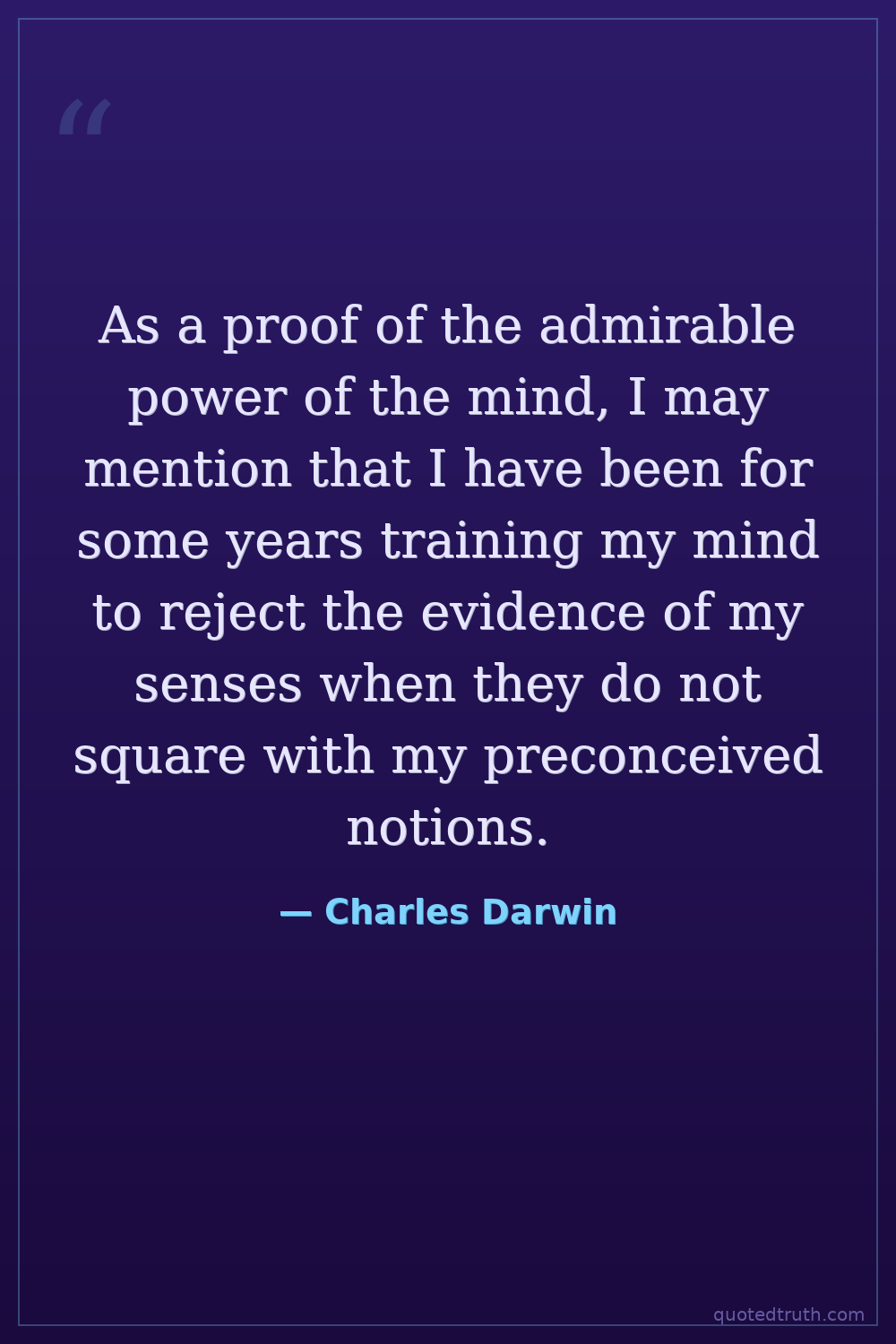
Charles Darwin — "As a proof of the admirable power of the mind, I may mention that I have been fo…"

As a proof of the admirable power of the mind, I may mention that I have been for some years training my mind to reject the evidence of my senses when they do not square with my preconceived notions.
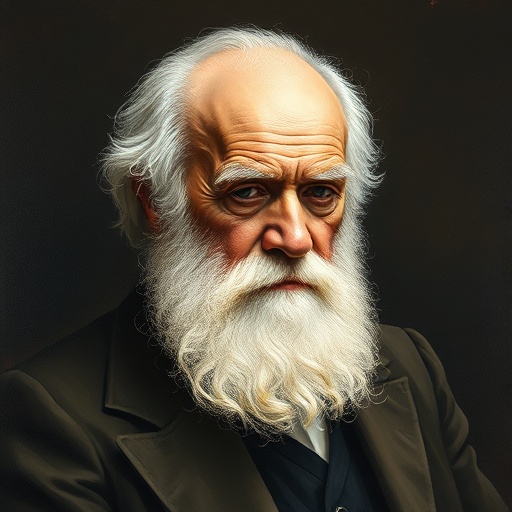
Charles Darwin — Charles Darwin Modern · Theory of evolution

Get This Quote & Author's Image Illustrated On:

Click any product to generate a realistic preview. Up to 3 at a time.
* Initial load can take up to 90 seconds — revising the preview in another color is nearly instant.

Kitchen

Apparel

Other

About Charles Darwin (1809-1882)

British naturalist whose On the Origin of Species (1859) established evolution by natural selection — the unifying theory of modern biology. Closely associated with Thomas Henry Huxley (his 'bulldog' public defender) and Alfred Russel Wallace (independent co-discoverer of natural selection). For an intellectual contrast, see William Paley, Anglican theologian and Natural Theology author (1743-1805) — Origin of Species is structurally a 400-page reply to Paley — Darwin admired Paley's watchmaker-argument as an undergraduate at Cambridge and then spent 20 years building the empirical machinery to displace him. The cleanest 'design argument vs natural selection' founding rebuttal in science.

The standard scholarly entry points to Charles Darwin's work: Janet Browne (Harvard, history of science) — Charles Darwin: Voyaging (1995) and The Power of Place (2002); Adrian Desmond (UCL, biographer) — Darwin: The Life of a Tormented Evolutionist (1991, with James Moore). These are the works graduate seminars cite when teaching Charles Darwin.

Details

This is a misquote/misunderstanding of a passage in his autobiography where he talks about carefully observing things that go against his theories, not rejecting sensory evidence. The actual quote is: 'I had, also, during many years, followed a golden rule, namely, that whenever a published fact, a new observation or thought came across me, which was opposed to my general results, to make a memorandum of it without fail and at once; for I had found by experience that such facts and thoughts were far more apt to escape from the memory than favorable ones.'

Date: 1876

Nature & World
Verification

Unverifiable

Found in 1 providers: grok

1 source checked

Understanding this quote

What it means

The quote uses irony to spotlight a dangerous mental habit: training ourselves to reject real-world evidence when it contradicts what we already believe. What sounds like praise for mental discipline is actually a sharp critique of confirmation bias — the deeply human tendency to filter out inconvenient facts rather than update our understanding. The quote warns that the mind's greatest trick can also be its greatest flaw.

Relevance to Charles Darwin

Darwin spent over two decades methodically documenting evidence for evolution before publishing On the Origin of Species in 1859, knowing his conclusions would shatter prevailing beliefs. His scientific method demanded following evidence regardless of where it led — the precise opposite of this quote's described behavior. His ironic tone reflects frustration with critics who dismissed fossil records and observed variation rather than revise their worldview.

The era

Victorian England in the mid-1800s was dominated by religious orthodoxy and natural theology, which held that species were divinely created and fixed. Darwin's evolutionary theory arrived as a direct challenge to this worldview. Clergy, scientists, and public intellectuals actively resisted mounting evidence rather than revise deeply held beliefs. This quote captures the cultural battle Darwin witnessed: an establishment collectively choosing comfortable dogma over empirical truth.

AI-generated insights based on extensive research and information for context. Factual errors? Email [email protected].

Your Cart

Your cart is empty