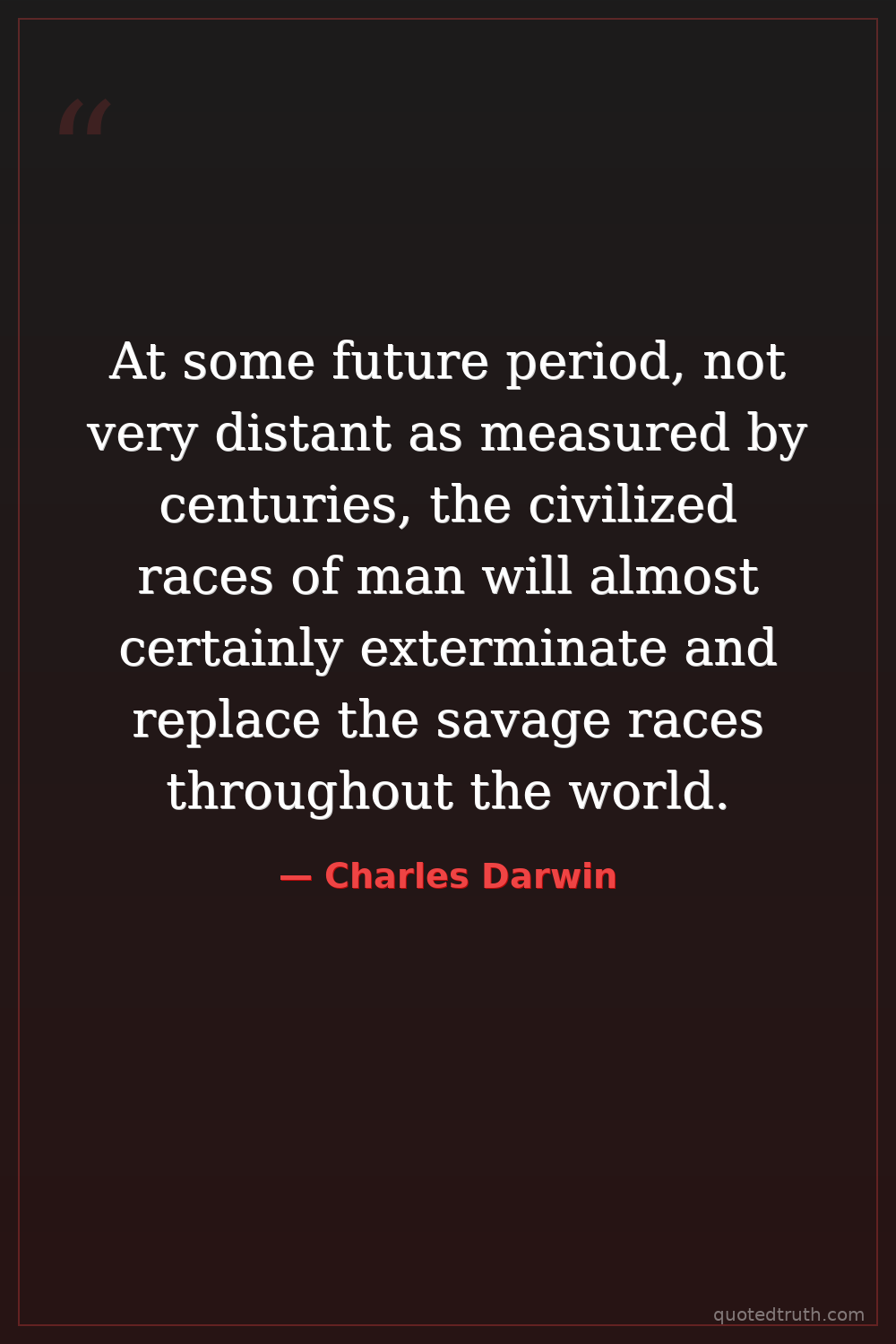
Charles Darwin — "At some future period, not very distant as measured by centuries, the civilized …"

At some future period, not very distant as measured by centuries, the civilized races of man will almost certainly exterminate and replace the savage races throughout the world.
Charles Darwin — Charles Darwin Modern · Theory of evolution

Get This Quote & Author's Image Illustrated On:

Click any product to generate a realistic preview. Up to 3 at a time.
* Initial load can take up to 90 seconds — revising the preview in another color is nearly instant.

Kitchen

Apparel

Other

About Charles Darwin (1809-1882)

British naturalist whose On the Origin of Species (1859) established evolution by natural selection — the unifying theory of modern biology. Closely associated with Thomas Henry Huxley (his 'bulldog' public defender) and Alfred Russel Wallace (independent co-discoverer of natural selection). For an intellectual contrast, see William Paley, Anglican theologian and Natural Theology author (1743-1805) — Origin of Species is structurally a 400-page reply to Paley — Darwin admired Paley's watchmaker-argument as an undergraduate at Cambridge and then spent 20 years building the empirical machinery to displace him. The cleanest 'design argument vs natural selection' founding rebuttal in science.

The standard scholarly entry points to Charles Darwin's work: Janet Browne (Harvard, history of science) — Charles Darwin: Voyaging (1995) and The Power of Place (2002); Adrian Desmond (UCL, biographer) — Darwin: The Life of a Tormented Evolutionist (1991, with James Moore). These are the works graduate seminars cite when teaching Charles Darwin.
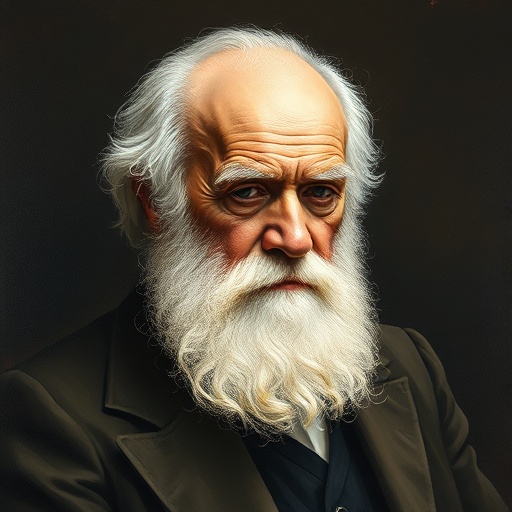
Details

The Descent of Man

Date: 1871

Social & Racial

Verification

Unverifiable

Found in 1 providers: deepseek

1 source checked

Understanding this quote

What it means

Darwin predicts that colonizing, industrialized societies will overwhelm and replace indigenous peoples worldwide through competition. Written before the word 'genocide' existed, it frames colonial conquest as an inevitable extension of natural selection applied to human groups. Today this is recognized as scientific racism — projecting Victorian European supremacist assumptions onto evolutionary biology to make conquest appear biologically ordained rather than politically chosen.

Relevance to Charles Darwin

Darwin wrote this in 'The Descent of Man' (1871), finally applying his evolutionary framework to humanity after deliberately avoiding it in 'On the Origin of Species' (1859). His Beagle voyage (1831–36) brought him face-to-face with Fuegian peoples he viewed through a civilizational hierarchy. This passage shows Darwin as a man of his era — his theory was sound; his racial assumptions were his century's, not evolution's.

The era

Written in 1871 at the apex of British imperialism, as Europe accelerated the Scramble for Africa and indigenous populations across the Americas and Australia were actively being displaced and killed. Social Darwinism was crystallizing — philosophers and politicians seizing evolutionary language to justify racial hierarchy. Darwin's words both reflected and provided intellectual cover for colonial policies that caused some of history's worst atrocities.

AI-generated insights based on extensive research and information for context. Factual errors? Email [email protected].

Your Cart

Your cart is empty