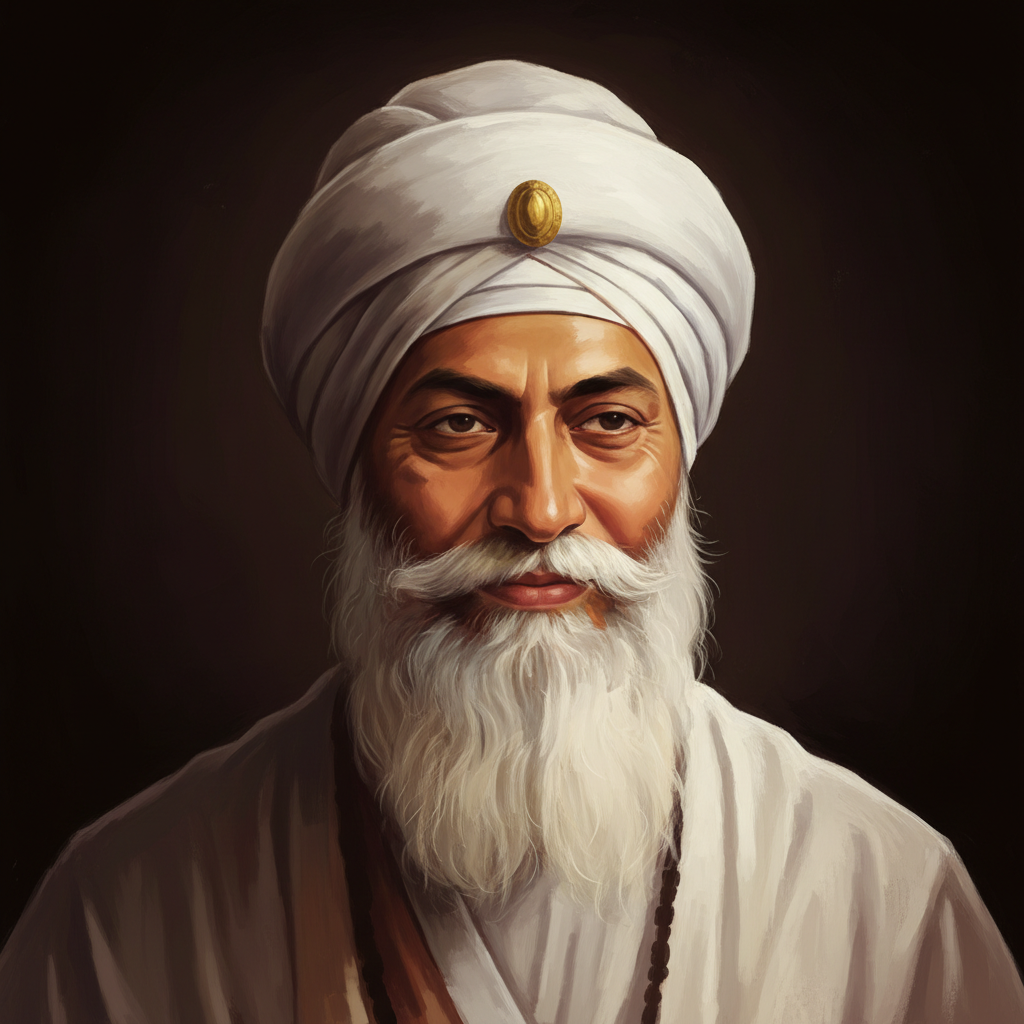
Guru Nanak — "Be kind to all beings, this is more meritorious than bathing at the sixty-eight …"
Be kind to all beings, this is more meritorious than bathing at the sixty-eight sacred shrines of pilgrimage and donating money.
Be kind to all beings, this is more meritorious than bathing at the sixty-eight sacred shrines of pilgrimage and donating money.
Click any product to generate a realistic preview. Up to 3 at a time.
* Initial load can take up to 90 seconds — revising the preview in another color is nearly instant.
"By His Command, all forms came into being, by His Command, life descended into them."
"Why call her bad from whom are born kings?"
"The one who serves others, serves God."
"He who is born into a high caste but does not praise God, is like a worm in filth."
"Let no one be proud of his caste; he who knows God is a Brahmin."
Founder of Sikhism and the first of the Ten Sikh Gurus, whose teachings of one universal God and rejection of caste shaped Punjab. Closely associated with Kabir (mystical poet whose verses appear in the Sikh Guru Granth Sahib). For an intellectual contrast, see Brahmanical orthodoxy, the Hindu caste-and-ritual establishment of his era — Sikhism was founded as a deliberate alternative to both Hindu ritual hierarchy and Islamic exclusivism — Nanak's universalism was a structural rejection of caste and priestly mediation.
Found in 1 providers: gemini
1 source checked
Genuine compassion toward every living being outweighs any formal religious act, including visiting sacred pilgrimage sites or giving money. Kindness is not just equivalent to these practices — it exceeds them. True spiritual merit is measured by how you treat others in daily life, not by grand ceremonial gestures. Outward religious performance, however traditionally prestigious, means less than the simple act of treating all creatures with care.
Guru Nanak (1469–1539) rejected caste hierarchy and empty ritual throughout five major journeys across South Asia, Persia, and Arabia. He founded Sikhism on three pillars: meditate on God, work honestly, share with others. His theology of Ik Onkar — one universal God for all — made seva (selfless service) the central spiritual act. This quote directly embodies his life's mission: compassion, not ceremony, is the truest measure of devotion.
In early 16th-century India, the sixty-eight sacred tirthas (pilgrimage sites) were considered the premier route to spiritual merit, and donating to Brahmins was viewed as supremely virtuous. Caste divisions barred lower-born people from full religious participation. Babur's Mughal invasion (1526) added political upheaval. Nanak's insistence that kindness outranked pilgrimage and donation directly challenged both Hindu orthodoxy and transactional religious culture at a moment when clergy enforced rigid hierarchies.
AI-generated insights based on extensive research and information for context. Factual errors? Email [email protected].
Your cart is empty