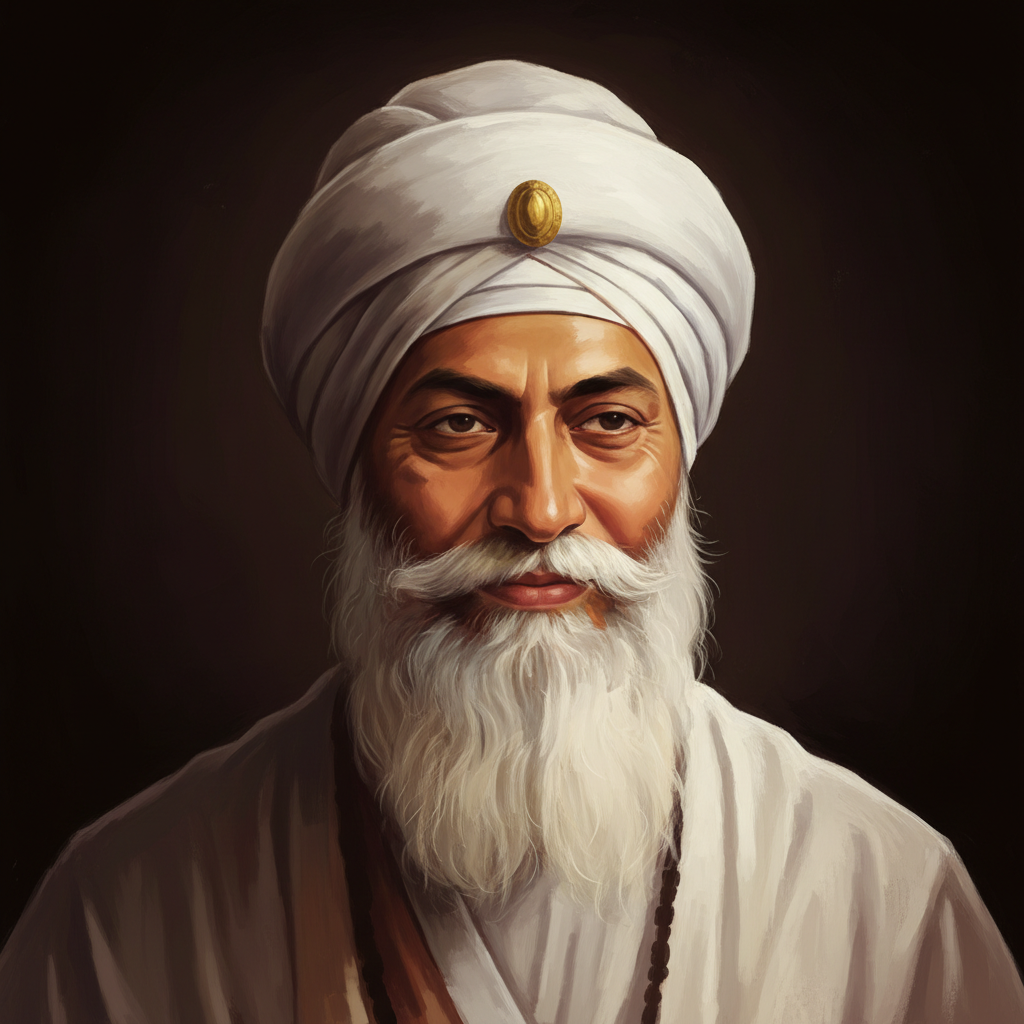
Guru Nanak — "Why call her bad from whom are born kings?"
Why call her bad from whom are born kings?
Why call her bad from whom are born kings?
Click any product to generate a realistic preview. Up to 3 at a time.
* Initial load can take up to 90 seconds — revising the preview in another color is nearly instant.
"The Lord dwells in every heart; why search for Him outside?"
"The Dhoop (burnt incense), lamps and the Naivaed (an offering of eatables presented to deity or idol. All of them become false) by smell. (Then, O Rabb!) If Your Poojaa can be done only with these thi…"
"He who is born into a high caste but does not praise God, is like a worm in filth."
"Let no one be proud of his caste; he who knows God is a Brahmin."
"If a person bathes at sixty-eight holy places, but does not cleanse their mind, what good is it?"
Founder of Sikhism and the first of the Ten Sikh Gurus, whose teachings of one universal God and rejection of caste shaped Punjab. Closely associated with Kabir (mystical poet whose verses appear in the Sikh Guru Granth Sahib). For an intellectual contrast, see Brahmanical orthodoxy, the Hindu caste-and-ritual establishment of his era — Sikhism was founded as a deliberate alternative to both Hindu ritual hierarchy and Islamic exclusivism — Nanak's universalism was a structural rejection of caste and priestly mediation.
Found in 1 providers: grok
1 source checked
This line challenges the habit of disrespecting or devaluing women. It points out the obvious contradiction: the same women who are insulted, blamed, or treated as inferior are the mothers who give birth to every ruler, leader, and respected figure in society. If women produce the people we honor most, treating them as lesser makes no sense. The quote demands we recognize women's fundamental dignity and equal worth.
Guru Nanak founded Sikhism on radical equality, rejecting caste, ritual, and gender hierarchy at a time when all three defined South Asian life. He appointed women to teach, insisted they join communal worship and the shared langar meal, and preached a formless God accessible to everyone. This verse, from his Asa di Var, is one of his most cited defenses of women and reflects his lifelong insistence that spiritual and social worth are not gendered.
In early 16th-century Punjab, under late Delhi Sultanate and emerging Mughal rule, women faced strict purdah, child marriage, denial of scripture-reading rights, and the practice of sati. Both orthodox Hindu caste codes and conservative Islamic custom restricted them. Nanak (1469–1539) preached across this landscape during Babur's invasions, openly confronting Brahmin priests, qazis, and rulers. Defending women publicly was genuinely subversive and helped distinguish the new Sikh community from surrounding religious norms.
AI-generated insights based on extensive research and information for context. Factual errors? Email [email protected].
Your cart is empty