Stephen Hawking — "There is no heaven or afterlife for broken down computers; that is a fairy story…"
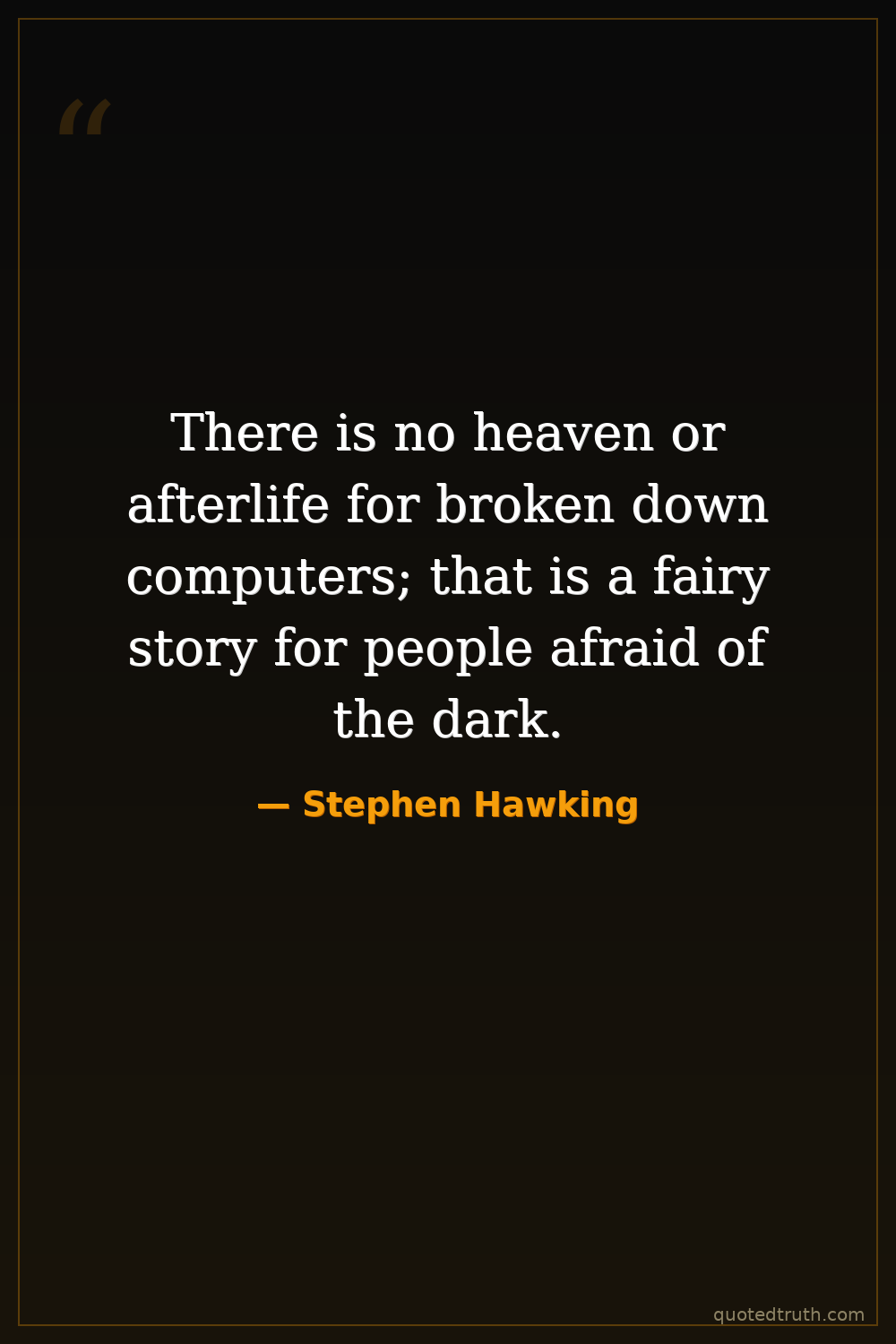
There is no heaven or afterlife for broken down computers; that is a fairy story for people afraid of the dark.
There is no heaven or afterlife for broken down computers; that is a fairy story for people afraid of the dark.
Click any product to generate a realistic preview. Up to 3 at a time.
* Initial load can take up to 90 seconds — revising the preview in another color is nearly instant.
"The downside of my celebrity is that I cannot go anywhere in the world without being recognized. It is not enough for me to wear dark sunglasses and a wig. The wheelchair gives me away."
"I think that the universe is a beautiful and complex place, and I'm very lucky to be able to study it."
"You have no talent. You are like a Chinese food delivery guy without Chinese food."
"The universe is a beautiful mystery, and I'm trying to unravel it."
"Even if there is only one possible unified theory, it is just a set of rules and equations. What is it that breathes fire into the equations and makes a universe for them to describe?"
British theoretical physicist whose Hawking radiation work and A Brief History of Time (1988) brought black-hole physics to a mass audience while he lived with ALS for 55 years. Closely associated with Roger Penrose (his collaborator on singularity theorems) and Carl Sagan (fellow popularizer who wrote Brief History's foreword). For an intellectual contrast, see William Lane Craig, American philosopher of religion — Craig's Kalam cosmological argument depends on the Big Bang requiring a divine first cause; Hawking's no-boundary proposal was specifically designed to remove the moment that would require one — the cleanest cosmology-vs-natural-theology contrast in modern thought.
Found in 1 providers: grok
1 source checked
When a computer breaks down permanently, it simply stops—no data migrates elsewhere, no ghost persists. Hawking applies this same logic to human death: our brains are biological information processors, and death is hardware failure, nothing more. The promise of an afterlife, he argues, is a comforting fiction invented by those unwilling to accept oblivion. Consciousness ends at death—not as tragedy, but as straightforward physical fact.
Diagnosed with ALS at 21 and given two years to live, Hawking spent 55 more years in a body that progressively failed him—communicating through a literal computer. The broken-computer metaphor was deeply personal. A committed atheist, he believed the laws of physics fully explain existence, leaving no room for the supernatural. His cosmological work—studying the universe's origin and structure—convinced him reality needs no divine author or destination.
Said in a 2011 Guardian interview, this quote landed amid the 'New Atheism' cultural moment—Dawkins, Hitchens, and Harris were publicly challenging religion's authority on death and meaning. Neuroscience was rapidly framing consciousness as entirely brain-based. Personal computing and early AI research were normalizing the brain-as-computer analogy. Simultaneous transhumanist debates about mind uploading made the 'broken computer' framing immediately resonant and culturally loaded.
AI-generated insights based on extensive research and information for context. Factual errors? Email [email protected].
Your cart is empty