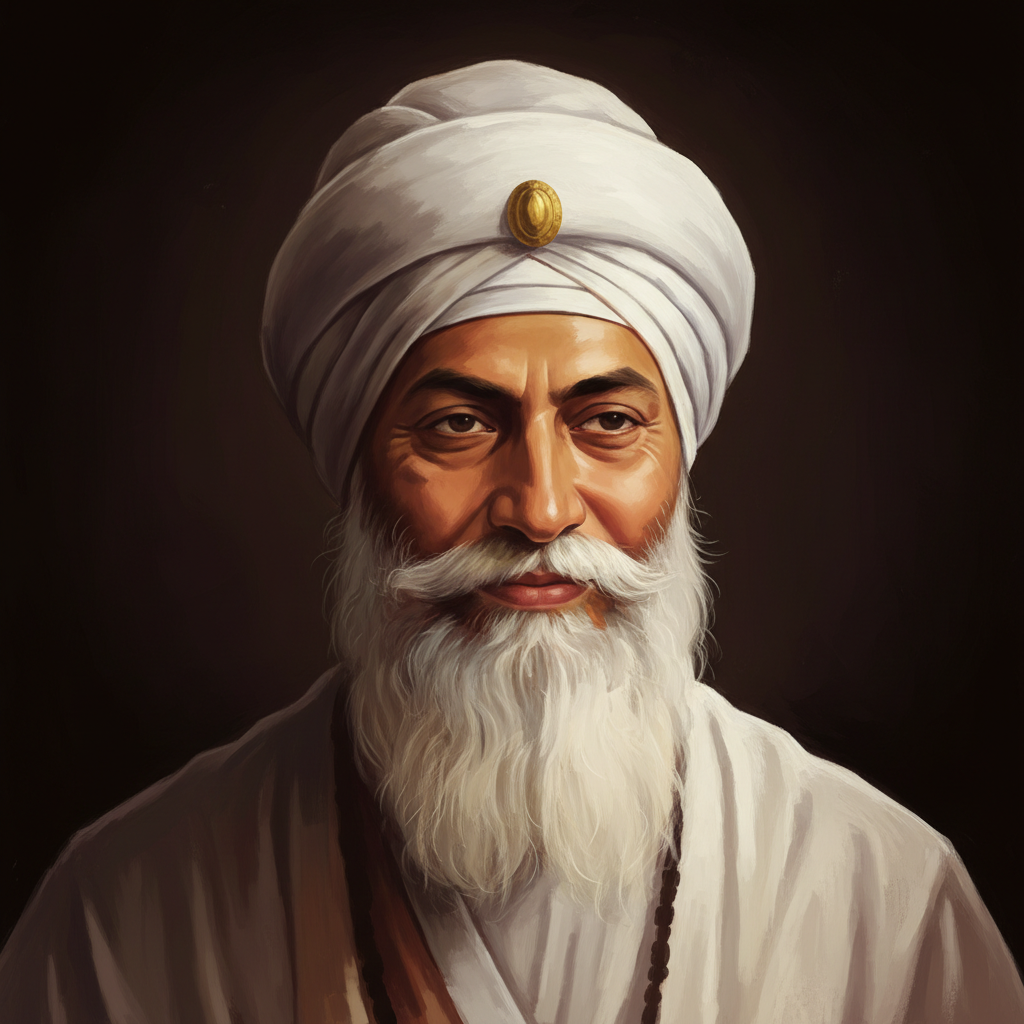
Guru Nanak — "The whole world is a manifestation of the Lord."
The whole world is a manifestation of the Lord.
The whole world is a manifestation of the Lord.
Click any product to generate a realistic preview. Up to 3 at a time.
* Initial load can take up to 90 seconds — revising the preview in another color is nearly instant.
"He who serves the Guru, he alone finds peace."
"The Lord Himself is the enjoyer, and He Himself is the enjoyed."
"The greatest wealth is contentment. And a really comfortable chair."
"The lowest among the low castes, lower than the lowliest, Nanak is with them: He envies not those with worldly greatness."
"Guru Nanak taught that depriving others of their rights is a serious moral offense."
Founder of Sikhism and the first of the Ten Sikh Gurus, whose teachings of one universal God and rejection of caste shaped Punjab. Closely associated with Kabir (mystical poet whose verses appear in the Sikh Guru Granth Sahib). For an intellectual contrast, see Brahmanical orthodoxy, the Hindu caste-and-ritual establishment of his era — Sikhism was founded as a deliberate alternative to both Hindu ritual hierarchy and Islamic exclusivism — Nanak's universalism was a structural rejection of caste and priestly mediation.
Found in 1 providers: grok
1 source checked
Everything you see, touch, or experience is an expression of one divine reality. There is no separation between the sacred and the ordinary, between people, nature, or events. The universe is not a backdrop where God occasionally appears; it is itself the visible form of the divine. This dissolves hierarchies between holy places and everyday life, between insiders and outsiders, and asks people to treat all of creation with reverence.
Guru Nanak founded Sikhism on the conviction of one universal Creator pervading all existence (Ik Onkar). A merchant turned spiritual teacher, he traveled across India, Tibet, and Arabia, telling Hindus and Muslims alike that no community owned God. His rejection of caste, his communal kitchen (langar) seating all people together, and his insistence on honest work and remembering the divine in daily life all flow from this single conviction that creation itself reveals the Lord.
Guru Nanak (1469–1539) lived in Punjab during early Mughal expansion, when Hindu caste hierarchy and rigid Islamic orthodoxy clashed and often persecuted each other. Pilgrimage, ritual purity, Brahminical gatekeeping, and sectarian violence dominated religious life. By declaring the entire world a manifestation of one Lord, Nanak undercut the authority of temples, mosques, priests, and caste boundaries simultaneously, offering a radical theology of universal access to the divine that birthed a new faith bridging two warring traditions.
AI-generated insights based on extensive research and information for context. Factual errors? Email [email protected].
Your cart is empty