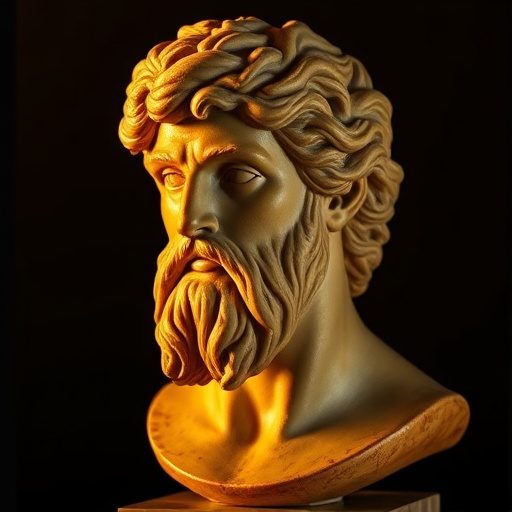
Pythagoras — "The most beautiful thing is harmony."
The most beautiful thing is harmony.
The most beautiful thing is harmony.
Click any product to generate a realistic preview. Up to 3 at a time.
* Initial load can take up to 90 seconds — revising the preview in another color is nearly instant.
"Power is the near neighbour of necessity."
"When you go to the temple to worship, do not wipe up the footprints."
"Number is the ruler of forms and ideas, and the cause of gods and daemons."
"Eat not fish whose tails are black."
"The soul of man is immortal and that it changes into other kinds of animals."
Greek philosopher and mathematician whose school in Croton combined geometry (the Pythagorean theorem), number-mysticism, and a religious-vegetarian way of life. Closely associated with Thales of Miletus (earlier pre-Socratic and the first philosopher). For an intellectual contrast, see Heraclitus, pre-Socratic Greek philosopher of flux — Heraclitus called Pythagoras 'the chief of swindlers' — among the founding insults of the philosophical-rivalry tradition. Their 'all is flux' vs 'all is number' poles still organize the philosophy of mathematics today (Platonist vs anti-realist).
Central to his philosophy of music, mathematics, and cosmology.
Date: c. 570 – c. 495 BC
ShockingFound in 1 providers: grok
1 source checked
Harmony, the balanced fitting together of parts into a unified whole, is the highest form of beauty. Whether in music, relationships, the body, or the cosmos, beauty emerges not from any single element but from how elements relate to one another in proportion and agreement. When things align and resonate together rather than clash, the result surpasses what any isolated piece could achieve on its own.
Pythagoras built his entire philosophy around harmony as a literal principle. He discovered that musical intervals correspond to simple numerical ratios, linking math, music, and cosmos into what he called the 'harmony of the spheres.' His school treated number and proportion as the foundation of reality, and members pursued harmony through diet, music, silence, and ethical discipline. For him, this statement was not poetry but a cosmological claim.
In 6th-century BCE Greece, thinkers were shifting from mythological explanations toward rational inquiry into nature. Pythagoras founded a religious-philosophical community in Croton in southern Italy, where Greek colonies mixed with local cultures. Greek music theory, temple architecture, and early geometry all emphasized proportion and order. Against a backdrop of political turmoil and competing Presocratic schools, Pythagoras's claim that numerical harmony underlies existence offered a bold, unifying vision of a rationally structured cosmos.
AI-generated insights based on extensive research and information for context. Factual errors? Email [email protected].
Your cart is empty