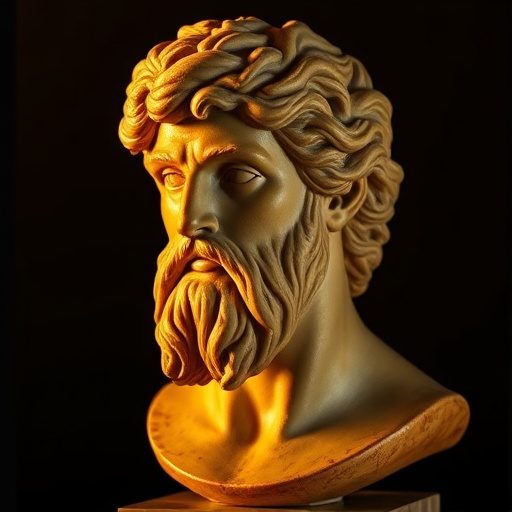
Pythagoras — "All things are numbers."
All things are numbers.
All things are numbers.
Click any product to generate a realistic preview. Up to 3 at a time.
* Initial load can take up to 90 seconds — revising the preview in another color is nearly instant.
"Every man has been made by God in order to acquire knowledge and contemplate."
"Hate and fear breed a poison in the blood, which if continued, affects eyes, ears, nose, and the organs of digestion."
"Declining from the public ways, walk in unfrequented paths."
"Above all things, reverence yourself."
"Do not eat beans."
Greek philosopher and mathematician whose school in Croton combined geometry (the Pythagorean theorem), number-mysticism, and a religious-vegetarian way of life. Closely associated with Thales of Miletus (earlier pre-Socratic and the first philosopher). For an intellectual contrast, see Heraclitus, pre-Socratic Greek philosopher of flux — Heraclitus called Pythagoras 'the chief of swindlers' — among the founding insults of the philosophical-rivalry tradition. Their 'all is flux' vs 'all is number' poles still organize the philosophy of mathematics today (Platonist vs anti-realist).
Found in 2 providers: deepseek,grok
2 sources checked
Reality at its core is mathematical. Numbers aren't just tools humans invented to measure things — they are the actual structure and substance of everything that exists. Quantity and ratio govern music, space, time, and nature itself. This is the assertion that the universe operates on math at its deepest level, and that understanding numbers means understanding existence itself.
Pythagoras built a religious-philosophical brotherhood in Croton around 530 BCE anchored on this conviction. His pivotal insight came from music: harmonic intervals — octave, fifth, fourth — correspond exactly to simple whole-number ratios of string length. If beauty itself obeys numbers, so must everything. His famous theorem expressing spatial relationships as numerical equations was both proof and living expression of this belief.
Pre-Socratic Greece in the 6th century BCE was consumed by one question: what is everything made of? Thales said water, Anaximenes said air, Heraclitus said fire. Pythagoras's answer — numbers — was radical because it abstracted away from physical substance entirely. Greek culture also prized proportion in architecture, sculpture, and music, making a numerical theory of reality feel intuitive. It seeded Plato's mathematical forms and ultimately modern physics.
AI-generated insights based on extensive research and information for context. Factual errors? Email [email protected].
Your cart is empty