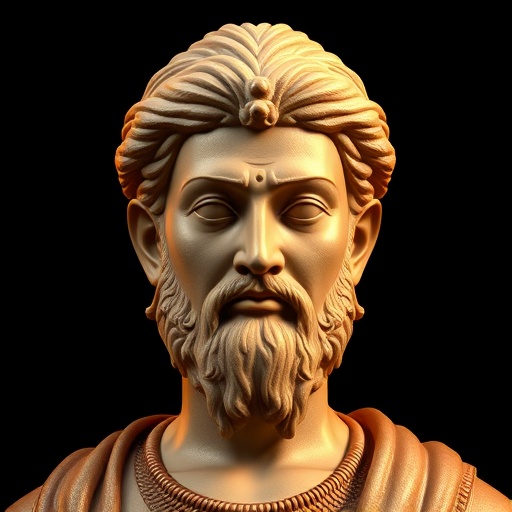
Mahavira — "Do not indulge in unnecessary talk."
Do not indulge in unnecessary talk.
Do not indulge in unnecessary talk.
Click any product to generate a realistic preview. Up to 3 at a time.
* Initial load can take up to 90 seconds — revising the preview in another color is nearly instant.
"The greatest victory is the victory over oneself."
"The greatest mistake of a soul is non-recognition of its real self and can only be corrected by recognizing the real self."
"All living beings desire to live."
"Do not desire anything that is not yours."
"The greatest mistake of a soul is non-restraint."
24th and last Tirthankara of Jainism, whose teachings of strict ahimsa (non-violence), aparigraha (non-attachment), and karma reshaped ancient Indian religion. Closely associated with The Buddha (near-contemporary moral revolutionary, also reacting against Vedic ritualism). For an intellectual contrast, see Vedic Brahmanical ritual sacrifice, the animal-sacrifice-centered Vedic religion of his era — Mahavira's ahimsa demanded total non-violence, including not eating root vegetables that kill the plant — a maximum-distance ethical move from the Vedic priestly tradition that ritually sacrificed cattle and horses. The two cleanest poles of ancient Indian religious ethics.
Found in 1 providers: grok
1 source checked
Speak only when words serve a genuine purpose. Every unnecessary sentence wastes energy, spreads potential falsehood, and disturbs the speaker's inner calm. Silence is not emptiness but discipline — a conscious choice to act rather than chatter. Words multiplied without purpose become noise, and noise obscures truth. This is a call to intentional, economical communication rooted in self-mastery.
Mahavira practiced extreme asceticism, renouncing all possessions including clothing for twelve years of silent meditation before achieving enlightenment. His teaching of ahimsa extended to speech — careless words harm living beings. As a Tirthankara who perfected omniscience through rigorous self-control, he embodied the principle that restraint of mind, body, and speech together constitute the path to liberation.
In 6th-century BCE India, wandering ascetics debated endlessly in public forums — philosophical schools competed loudly for followers. Brahminical ritual culture prized elaborate recitation. Against this backdrop, Mahavira's radical emphasis on speech-restraint challenged both Vedic oral tradition and Sophist-style debate culture, positioning silence as spiritually superior to eloquence and marking a distinct break from dominant religious expression.
AI-generated insights based on extensive research and information for context. Factual errors? Email [email protected].
Your cart is empty