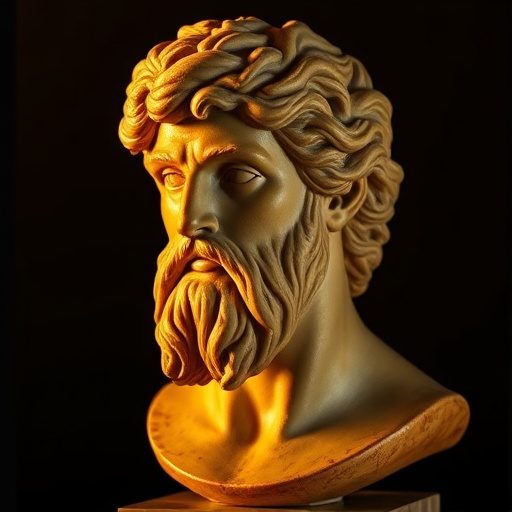
Pythagoras — "Wisdom thoroughly learned will never be forgotten."
Wisdom thoroughly learned will never be forgotten.
Wisdom thoroughly learned will never be forgotten.
Click any product to generate a realistic preview. Up to 3 at a time.
* Initial load can take up to 90 seconds — revising the preview in another color is nearly instant.
"Respect yourself, and others will respect you."
"The highest goal of music is to connect one's soul to their Divine Nature, not entertainment."
"Don't help with a burden but put it on."
"The strangest (and sexiest) of the legends surrounding the aura of Pythagoras is that he had a golden thigh that he would show to impress people he wanted to join his cult."
"Don't piss or stand on your cut nails and hair."
Greek philosopher and mathematician whose school in Croton combined geometry (the Pythagorean theorem), number-mysticism, and a religious-vegetarian way of life. Closely associated with Thales of Miletus (earlier pre-Socratic and the first philosopher). For an intellectual contrast, see Heraclitus, pre-Socratic Greek philosopher of flux — Heraclitus called Pythagoras 'the chief of swindlers' — among the founding insults of the philosophical-rivalry tradition. Their 'all is flux' vs 'all is number' poles still organize the philosophy of mathematics today (Platonist vs anti-realist).
A philosophical statement on the enduring nature of true wisdom.
Date: c. 570-495 BCE (attributed later)
EducationalFound in 1 providers: gemini
1 source checked
Knowledge that is truly mastered — absorbed deeply rather than skimmed — becomes a permanent part of you. This quote draws a hard line between memorizing facts and genuinely understanding them. Real wisdom, fully internalized, cannot be taken away by time or circumstance. It becomes embedded in how you think and act, making thorough learning not just more effective but the only kind of learning that actually lasts.
Pythagoras founded a secretive mathematical brotherhood in Croton that demanded rigorous, multi-year study before initiates could advance. He taught that numbers govern all reality — a conviction requiring deep comprehension, not surface familiarity. His school transmitted knowledge orally, making thorough internalization essential. He also believed the soul transmigrates across lifetimes accumulating wisdom, meaning knowledge truly learned transcends even death. This quote mirrors both his pedagogical discipline and his spiritual conviction about wisdom's permanence.
In 6th-century BCE Greece, books were rare and expensive; knowledge lived primarily in memory and oral transmission. Pythagoras operated before widespread literacy, in an era when a teacher's death could erase an entire intellectual tradition. The Pre-Socratic age was also a turning point — rational inquiry was replacing myth, making rigorously understood knowledge newly precious. In that fragile ecosystem, only wisdom deeply enough learned to be unforgettable could survive and propagate across generations.
AI-generated insights based on extensive research and information for context. Factual errors? Email [email protected].
Your cart is empty