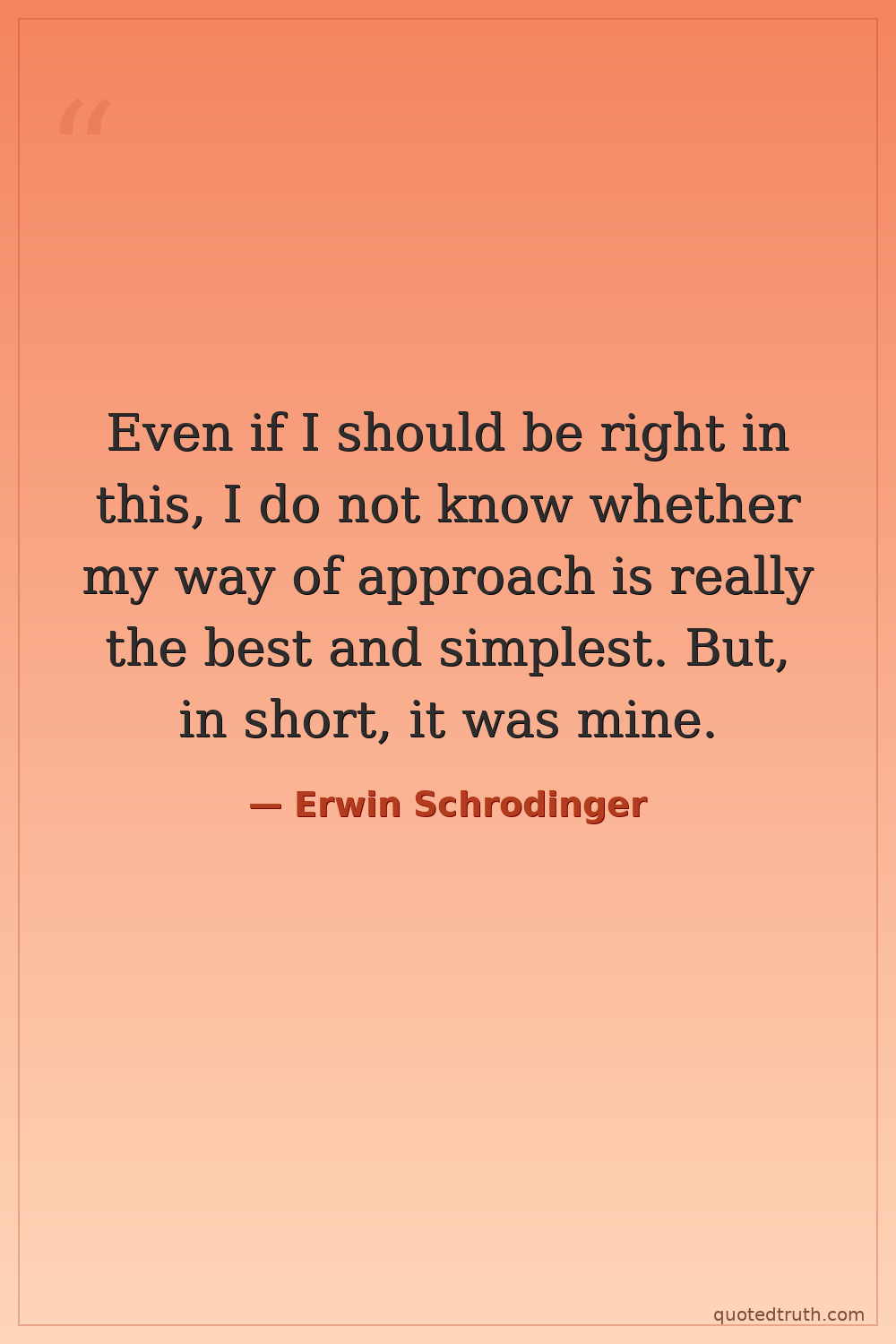
Erwin Schrodinger — "Even if I should be right in this, I do not know whether my way of approach is r…"
Even if I should be right in this, I do not know whether my way of approach is really the best and simplest. But, in short, it was mine.
Even if I should be right in this, I do not know whether my way of approach is really the best and simplest. But, in short, it was mine.
Click any product to generate a realistic preview. Up to 3 at a time.
* Initial load can take up to 90 seconds — revising the preview in another color is nearly instant.
"We are thus faced with the following dilemma: either the cells of the organism contain a highly efficient 'memory' for all the details of previous events, or they are, in some mysterious way, able to …"
"The present is the only thing that has no end."
"In fact, I should say that the world is a picture drawn by ourselves, and that we are ourselves part of the picture."
"The most important thing is not to stop questioning. Curiosity has its own reason for existence."
"We do not belong to this material world that science constructs for us. We are not in it; we are outside. We are only spectators. The reason why we believe that we are in it, that we belong to the pic…"
Austrian physicist who shared the 1933 Nobel for the wave equation that bears his name and the famous cat thought-experiment. Closely associated with Werner Heisenberg (matrix-mechanics rival who reached the same physics by different math) and Albert Einstein (his pen-pal on quantum interpretation). For an intellectual contrast, see Niels Bohr, Danish physicist and architect of the Copenhagen interpretation — Schrödinger's cat thought-experiment was specifically designed to ridicule Bohr's 'observer-dependent reality' reading of quantum mechanics — Schrödinger thought the Copenhagen interpretation was absurd; the cat was meant as reductio ad absurdum.
A self-aware and slightly defiant statement on his scientific methodology.
Date: Mid 20th century
GeneralFound in 1 providers: gemini
1 source checked
The speaker admits their approach may not be the most efficient or correct, yet claims it as authentically their own. Intellectual humility meets personal ownership: you don't need the perfect method, only an honest one. Originality matters more than optimization. A personal path carries inherent worth not because it beats alternatives, but because it reflects genuine independent thought rather than borrowed convention.
Schrödinger developed wave mechanics in 1926 as an alternative to Heisenberg's matrix mechanics — both valid quantum frameworks, fiercely debated at the time. He worked largely independently, grounded in classical wave intuition. He admitted uncertainty about his wave function ψ's physical meaning; Born's probability interpretation later corrected him. His philosophical writings, especially "What Is Life?", also charted unconventional territory. He embodied confident uncertainty: committed to his approach while honestly acknowledging its limitations.
The 1920s–30s quantum revolution produced multiple competing formalisms to describe atomic behavior — Heisenberg's matrices, Schrödinger's waves, Dirac's synthesis. No established correct approach existed; physicists were inventing frameworks in real time while Einstein-Bohr debates raged over interpretation. Scientists faced radical uncertainty about which methods would prove fundamental. Claiming ownership of your approach rather than waiting for consensus was practically a survival strategy in frontier physics.
AI-generated insights based on extensive research and information for context. Factual errors? Email [email protected].
Your cart is empty