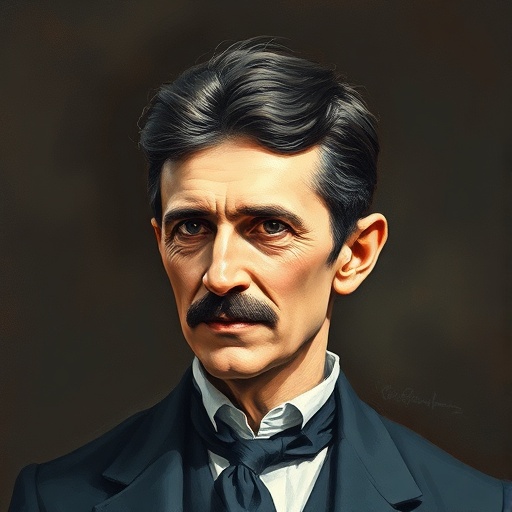
Nikola Tesla — "Every effort under compulsion demands a sacrifice of life-energy. I never paid s…"
Every effort under compulsion demands a sacrifice of life-energy. I never paid such a price. On the contrary, I have thrived on my thoughts.
Every effort under compulsion demands a sacrifice of life-energy. I never paid such a price. On the contrary, I have thrived on my thoughts.
Click any product to generate a realistic preview. Up to 3 at a time.
* Initial load can take up to 90 seconds — revising the preview in another color is nearly instant.
"Though free to think and act, we are held together, like the stars in the firmament, with ties inseparable. These ties cannot be seen, but we can feel them. I cut myself in the finger, and it pains me…"
"Nothing enters our minds or determines our actions, and what we call soul or spirit, is nothing more than the sum of the functionings of the body. When this functioning ceases, the soul or the spirit …"
"I do not eat meat."
"It is paradoxical, yet true, to say, that the more we know, the more ignorant we become in the absolute sense, for it is only through enlightenment that we become conscious of our limitations. Precise…"
"The scientists of today think deeply instead of clearly. One must be sane to think clearly, but one can think deeply and be quite insane."
Serbian-American inventor and electrical engineer whose alternating-current designs powered the modern electrical grid; died poor and largely forgotten. Closely associated with George Westinghouse (his AC-power business partner) and Mihajlo Pupin (fellow Serbian-American physicist at Columbia). For an intellectual contrast, see Thomas Edison, American inventor and direct-current advocate — Edison's direct-current power-distribution scheme was displaced by Tesla-Westinghouse AC in the 1890s 'War of Currents'. Edison ran a public-relations campaign electrocuting animals to discredit AC — the most famous engineering-ethics rivalry in American history. Tesla's AC won and powers nearly every electrical grid on Earth.
Philosophical statement on work, compulsion, and the energizing nature of passionate thought.
Date: Approximate
PhilosophicalFound in 1 providers: gemini
1 source checked
Work done out of obligation or force drains a person's vitality and spirit. The speaker never experienced that drain because their intellectual pursuits weren't burdens but sources of energy. Thinking deeply and freely actually sustained and energized them rather than depleting them, suggesting that alignment between one's nature and one's work creates a fundamentally different, regenerative relationship with effort.
Tesla worked obsessively in his laboratory, often sleeping only two hours, yet described his inventive work as invigorating rather than exhausting. His AC motor concept reportedly came to him during a walk reciting Goethe. He chose poverty over compromise with Edison, refusing forced collaboration. His mind generated the Tesla coil, radio patents, and bladeless turbine through pure intrinsic fascination, not commercial obligation.
The late 19th and early 20th centuries saw industrial capitalism demanding grueling compulsory labor from millions in factories and mines. Tesla worked during the height of the Second Industrial Revolution, where most workers had no autonomy. His statement stood in stark contrast to the era's dominant experience of work as coerced toil, reflecting Romantic ideals of the inspired genius whose inner life transcended material circumstances.
AI-generated insights based on extensive research and information for context. Factual errors? Email [email protected].
Your cart is empty