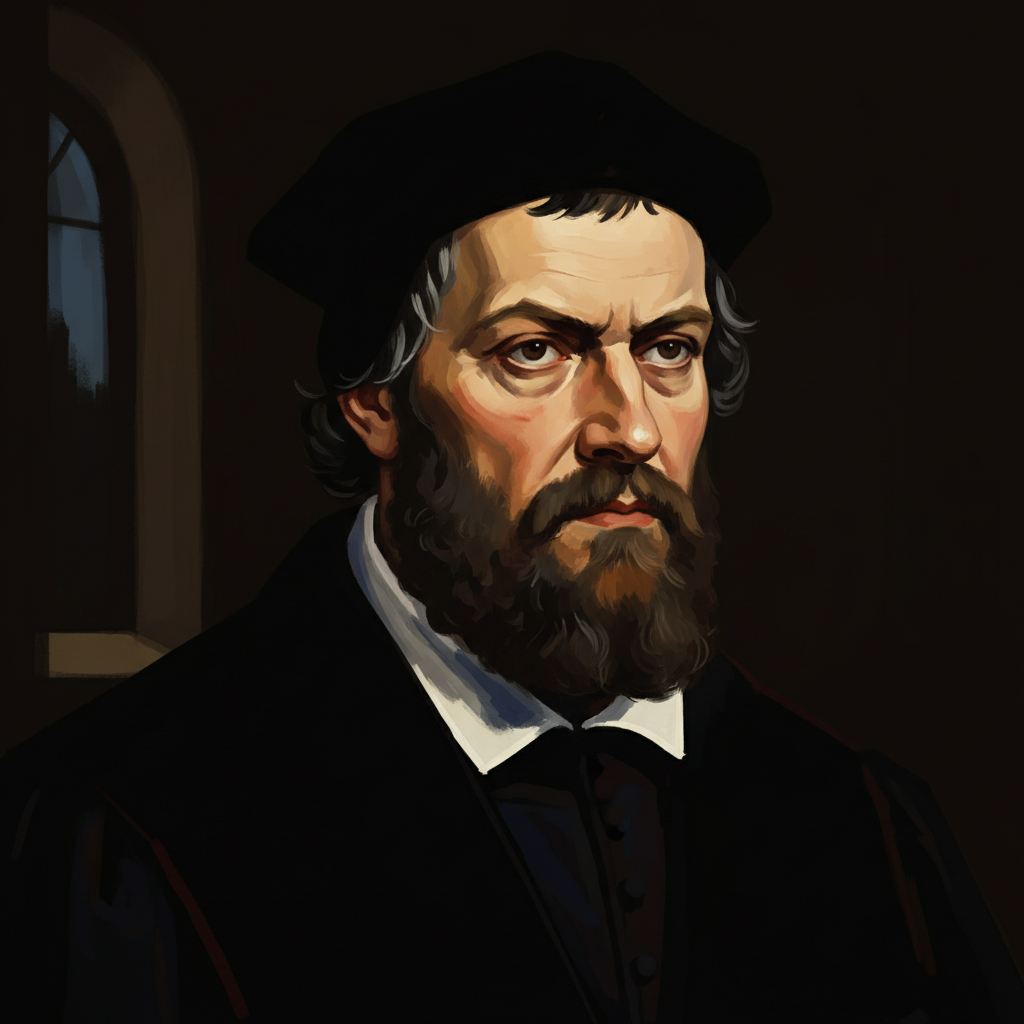
Martin Luther — "Every man must do two things alone; he must do his own believing and his own dyi…"
Every man must do two things alone; he must do his own believing and his own dying.
Every man must do two things alone; he must do his own believing and his own dying.
Click any product to generate a realistic preview. Up to 3 at a time.
* Initial load can take up to 90 seconds — revising the preview in another color is nearly instant.
"You people are more stupid than a block of wood."
"Why should the Devil have all the good tunes?"
"This life therefore is not righteousness, but growth in righteousness, not health, but healing, not being but becoming, not rest but exercise. We are not yet what we shall be, but we are growing towar…"
"I would have all Christians educated enough to be able to read the Bible. It is not for priests alone, but for all."
"Nor let ministers cease studying until they have discovered and are sure that they have taught the devil to death and have become more learned than God himself and all His saints."
German theologian whose 95 Theses (1517) launched the Protestant Reformation and broke the Catholic Church's monopoly on Western Christianity. Closely associated with Philipp Melanchthon (Lutheran systematizer) and John Calvin (later Reformer who built on Luther's break). For an intellectual contrast, see Pope Leo X, Renaissance pope (1513-1521) — Leo X's indulgence sales triggered Luther's break and Leo excommunicated him in 1521 — Luther's entire Reformation is structured as a direct answer to the indulgence-funded Vatican Leo represented.
Found in 1 providers: grok
1 source checked
Faith and death are experiences no one else can take on for you. Another person cannot believe on your behalf, and nobody can step into your place when your life ends. These are solitary acts, demanding personal responsibility. You can receive teaching, comfort, and support from others, but the actual decision to trust and the actual moment of dying belong entirely to you. Ownership of conviction and mortality cannot be outsourced or delegated.
Luther spent his career insisting that salvation comes through personal faith, not through priests, indulgences, or church hierarchy mediating on a believer's behalf. At the Diet of Worms in 1521, he refused to recant, staking his own conscience against Rome. This quote distills his signature doctrine of individual accountability before God, the same conviction that drove him to translate the Bible into German so ordinary people could read and believe for themselves.
In early sixteenth-century Europe, the Catholic Church sold indulgences promising to shorten purgatory for the buyer or deceased relatives, and priests were seen as essential intermediaries between God and humanity. Luther's 95 Theses in 1517 attacked this system, sparking the Protestant Reformation. The printing press spread his ideas rapidly across a Europe already straining against clerical corruption, plague, and political fragmentation, making personal faith a revolutionary and dangerous claim.
AI-generated insights based on extensive research and information for context. Factual errors? Email [email protected].
Your cart is empty