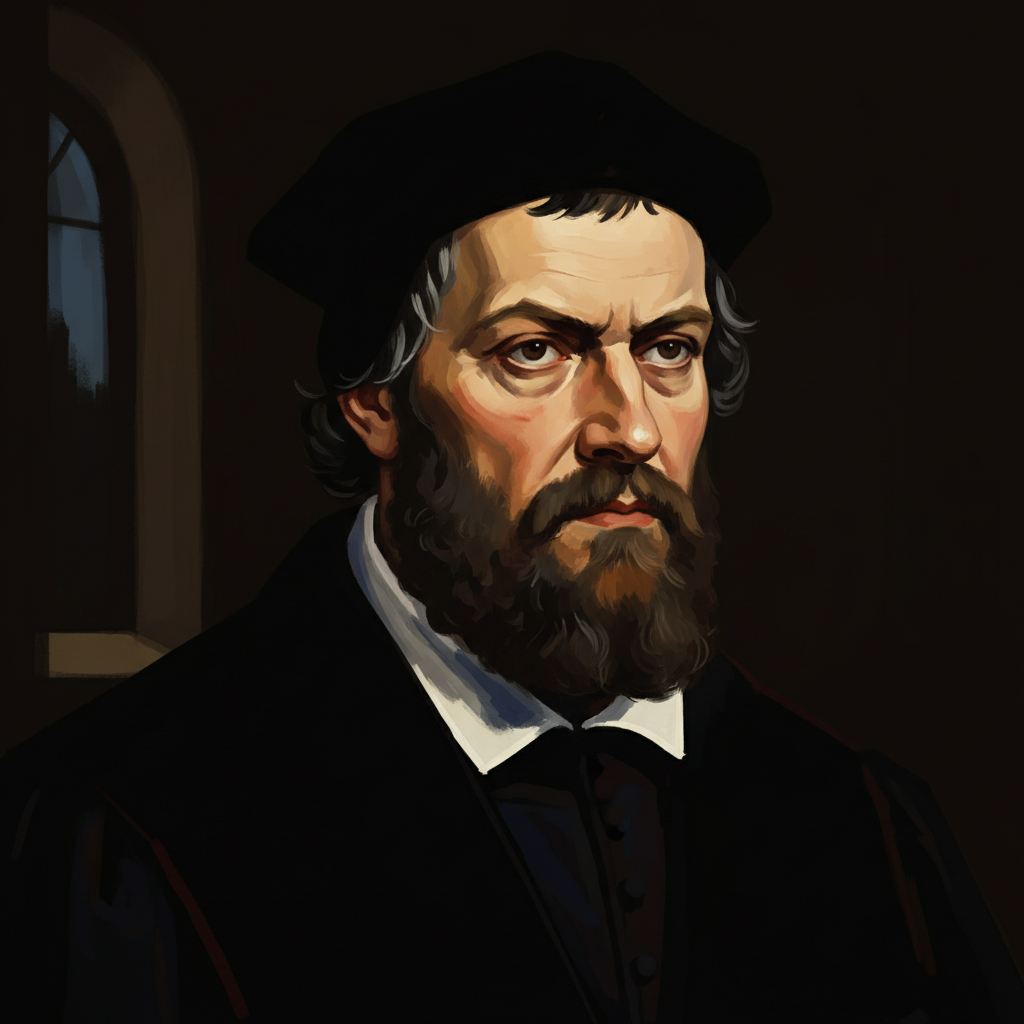
Martin Luther — "I would have all Christians educated enough to be able to read the Bible. It is …"
I would have all Christians educated enough to be able to read the Bible. It is not for priests alone, but for all.
I would have all Christians educated enough to be able to read the Bible. It is not for priests alone, but for all.
Click any product to generate a realistic preview. Up to 3 at a time.
* Initial load can take up to 90 seconds — revising the preview in another color is nearly instant.
"Drinking and eating are the highest pleasures."
"I am a peasant, a son of a peasant; my father, grandfather, all my ancestors were genuine peasants."
"The greatest vice is pride."
"A flail, an ax, a hoe, a spade be put into their hands so young, strong Jews and Jewesses could earn their bread in the sweat of their brow."
"With threefold horrible sins against God and men have these peasants loaded themselves, for which they have deserved a manifold death of body and soul."
German theologian whose 95 Theses (1517) launched the Protestant Reformation and broke the Catholic Church's monopoly on Western Christianity. Closely associated with Philipp Melanchthon (Lutheran systematizer) and John Calvin (later Reformer who built on Luther's break). For an intellectual contrast, see Pope Leo X, Renaissance pope (1513-1521) — Leo X's indulgence sales triggered Luther's break and Leo excommunicated him in 1521 — Luther's entire Reformation is structured as a direct answer to the indulgence-funded Vatican Leo represented.
Found in 1 providers: gemini
1 source checked
Every believer should know how to read so they can access sacred scripture directly. Religious texts shouldn't be locked behind a professional clergy class who interpret them on everyone else's behalf. Ordinary people deserve the tools to engage with their faith firsthand, forming their own understanding rather than depending on intermediaries. Literacy and direct access to source material are treated as spiritual rights, not privileges reserved for the trained elite.
Luther lived this conviction: he translated the Bible into vernacular German so plowboys and bakers could read it without Latin-trained priests. A former Augustinian monk turned reformer, he rejected papal authority partly because he believed scripture, not clergy, held spiritual truth. His doctrine of sola scriptura and the priesthood of all believers made lay literacy a theological necessity, fueling schools and catechisms across Protestant territories.
In early-1500s Europe, the Catholic Church controlled scripture through Latin Vulgate Bibles only clergy could read. Gutenberg's press (c.1450) had just made mass-produced books possible, and literacy was climbing among urban merchants. Luther's 1517 Ninety-Five Theses and 1534 German Bible exploited both trends, shattering the Church's interpretive monopoly. This fueled the Reformation, religious wars, and a European push toward common-schools education that reshaped the continent for centuries.
AI-generated insights based on extensive research and information for context. Factual errors? Email [email protected].
Your cart is empty