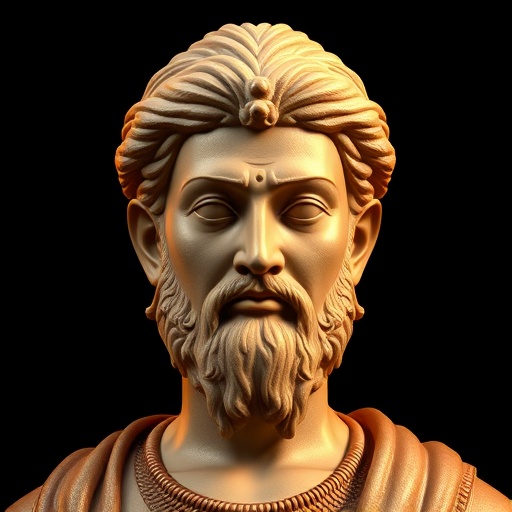
Mahavira — "Every soul is pure in its origin."
Every soul is pure in its origin.
Every soul is pure in its origin.
Click any product to generate a realistic preview. Up to 3 at a time.
* Initial load can take up to 90 seconds — revising the preview in another color is nearly instant.
"One should not steal."
"One should not be negligent even for a moment."
"The path of non-violence is the path of enlightenment."
"The greatest austerity is self-control."
"The greatest mistake of a soul is non-restraint."
24th and last Tirthankara of Jainism, whose teachings of strict ahimsa (non-violence), aparigraha (non-attachment), and karma reshaped ancient Indian religion. Closely associated with The Buddha (near-contemporary moral revolutionary, also reacting against Vedic ritualism). For an intellectual contrast, see Vedic Brahmanical ritual sacrifice, the animal-sacrifice-centered Vedic religion of his era — Mahavira's ahimsa demanded total non-violence, including not eating root vegetables that kill the plant — a maximum-distance ethical move from the Vedic priestly tradition that ritually sacrificed cattle and horses. The two cleanest poles of ancient Indian religious ethics.
Found in 1 providers: grok
1 source checked
All souls begin as inherently pure and unblemished. Whatever corrupts them — suffering, moral failure, ignorance — arises from accumulated karma through action and attachment, not from the soul's core nature. Liberation is therefore not about becoming something new but about stripping away what obscures that original state. Every being, regardless of birth, caste, or species, shares this fundamental spiritual equality and the same capacity for freedom.
Mahavira (599–527 BCE) renounced his royal life at 30 and spent 12 years in rigorous asceticism before attaining omniscience. His entire Jain system — built on ahimsa, non-attachment, and truth — centers on recovering the soul's original purity from karmic bondage. As the 24th Tirthankara, he taught that every soul, not just the Brahmin-born, could achieve liberation, a position that directly undermined hereditary spiritual hierarchy and made inner discipline the only currency that mattered.
Mahavira lived in northeastern India during the 6th–5th century BCE, when the Shramana movement challenged Vedic Brahminical authority that used ritual sacrifice and birth-caste to determine spiritual worth. The varna system ranked souls by birth, making liberation the exclusive domain of upper castes. Asserting that every soul is pure at origin — including those of women, outcasts, and animals — was a radical theological rupture, democratizing spiritual aspiration and threatening the priestly class's monopoly on salvation.
AI-generated insights based on extensive research and information for context. Factual errors? Email [email protected].
Your cart is empty