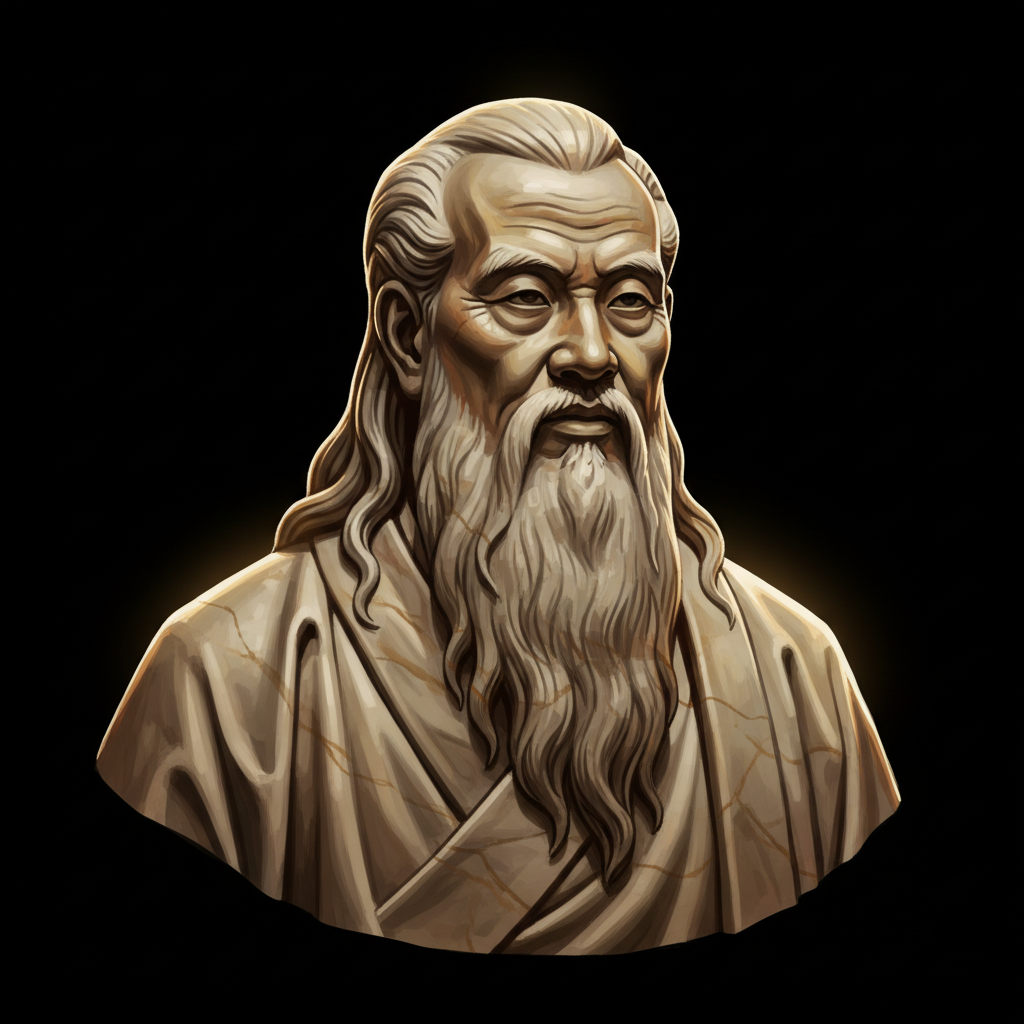
Laozi — "Fill your bowl to the brim and it will spill."
Fill your bowl to the brim and it will spill.
Fill your bowl to the brim and it will spill.
Click any product to generate a realistic preview. Up to 3 at a time.
* Initial load can take up to 90 seconds — revising the preview in another color is nearly instant.
"When people see some things as beautiful, other things become ugly. When people see some things as good, other things become bad."
"The universe is a sacred vase. It should not be tampered with."
"When the great sage is born, the world is at peace."
"Seal the openings, shut the doors, and until your last day you will not be exhausted. Widen the openings, interfere, and until your last day you will not be safe."
"The reason why the river and the sea are able to be the lords of the hundred valleys is that they excel in taking the lower position. That is why they are able to be the lords of the hundred valleys."
Reputed founder of Taoism and author of the Tao Te Ching, whose wu wei (effortless action) shaped East Asian philosophy. Closely associated with Zhuangzi (later Taoist who extended Laozi's framework). For an intellectual contrast, see Confucius, near-contemporary Chinese sage of social ritual and duty — Confucius systematized social order through ritual and hierarchy; Laozi argued that all such systems were the disease, not the cure — the two founding poles of Chinese moral philosophy.
Found in 1 providers: grok
1 source checked
Pushing anything to its absolute limit guarantees loss. A bowl filled past capacity overflows, wasting what you worked to gather. The same pattern holds for wealth, power, ambition, and effort: when you refuse to stop at enough, the excess escapes you. Restraint is not weakness but the only way to actually keep what you have. Knowing when to stop is itself a skill, and often more valuable than the drive to accumulate more.
Laozi built Taoism around wu wei, non-forcing action that yields by aligning with natural limits rather than straining against them. Tradition casts him as a royal archivist who grew disillusioned with court ambition and rode west into retreat, leaving the Tao Te Ching behind. That personal refusal of excess mirrors the bowl image: a man who saw grasping officials spill their fortunes chose instead to walk away while his own vessel was still intact and his mind still clear.
Laozi lived in the late Zhou dynasty, roughly the sixth century BCE, as central authority crumbled and rival states clawed for territory in what preceded the Warring States period. Aristocrats hoarded land, armies, and ritual prestige, and many overreached into ruin. Competing schools like Confucianism pushed active striving and social duty. Against this backdrop of accumulation and collapse, Laozi's warning against overfilling spoke directly to rulers watching neighbors fill their bowls until everything spilled.
AI-generated insights based on extensive research and information for context. Factual errors? Email [email protected].
Your cart is empty