What it means
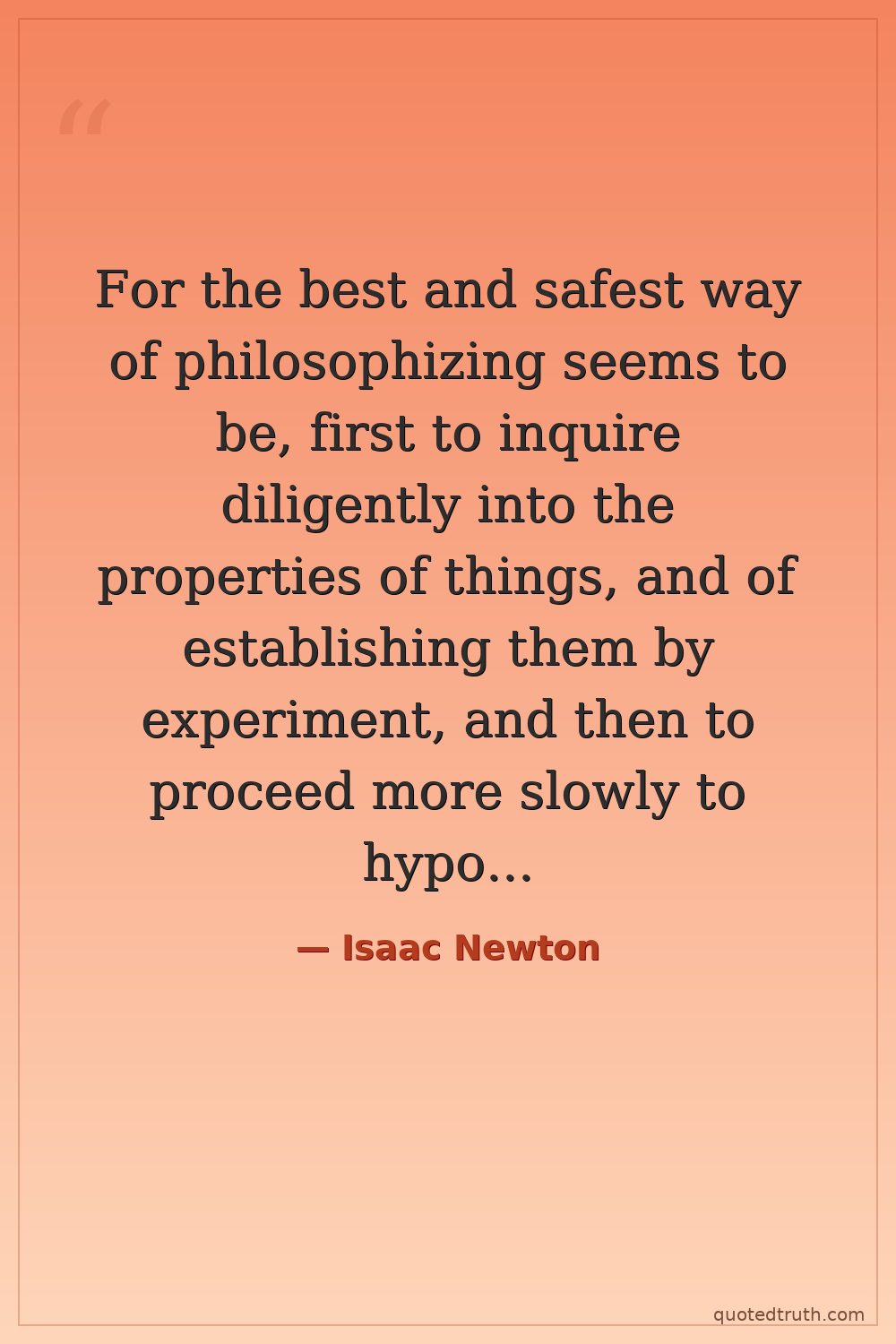
Rather than beginning with abstract theories, this quote argues for starting with careful observation and experiment to establish facts first, then cautiously building explanations from that evidence. It defends inductive reasoning — letting data drive theory rather than forcing observations to fit preconceived ideas. The emphasis on 'slowly' and 'diligently' reflects a warning against hasty speculation, privileging methodical evidence-gathering as the foundation of reliable knowledge.
Relevance to Isaac Newton
Newton embodied this principle throughout his career. His optics work involved years of prism experiments before any theory emerged. His famous declaration 'Hypotheses non fingo' in the Principia echoed this stance — he refused to speculate on the cause of gravity, only its mathematical behavior. As someone deeply suspicious of unfounded speculation, Newton saw rigorous experiment as intellectual honesty and a form of reverence toward the rational order embedded in nature.
The era
Newton lived amid the Scientific Revolution's conflict between scholastic tradition and emerging empirical methods. Descartes' hugely influential system built grand theories from pure reason, while Aristotelian deduction still dominated universities. Francis Bacon had called for inductive, experiment-first science, but speculative hypotheses remained common. The Royal Society, founded in 1660, championed experimental philosophy — Newton's statement directly endorses this program and implicitly rebukes those who theorized freely without first subjecting claims to rigorous observation and test.
AI-generated insights based on extensive research and information for context. Factual errors? Email [email protected].