Isaac Newton — "For the conservation of motion, it is necessary that the body should be moved in…"
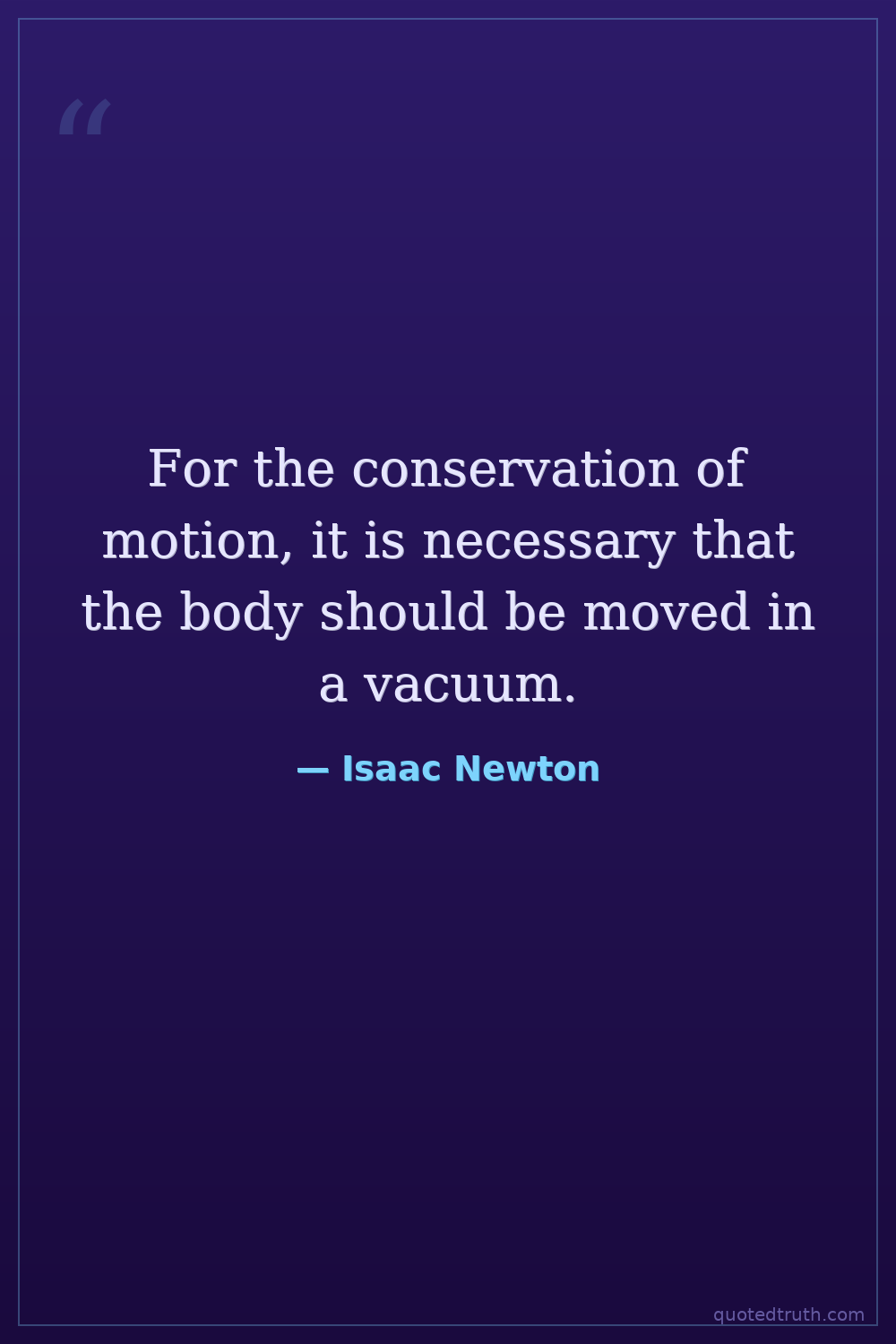
For the conservation of motion, it is necessary that the body should be moved in a vacuum.
For the conservation of motion, it is necessary that the body should be moved in a vacuum.
Click any product to generate a realistic preview. Up to 3 at a time.
* Initial load can take up to 90 seconds — revising the preview in another color is nearly instant.
"It seems probable to me, that God in the beginning formed matter in solid, massy, hard, impenetrable, moveable particles..."
"The way to chastity is not to struggle directly with incontinent thoughts but to avert the thoughts by some employment, or by reading, or by meditating on other things."
"To me there has never been a higher source of earthly honor or distinction than that connected with advances in science."
"The light which comes from the sun, and from all fire, consists of all the primary colours mixed together."
"Nature is pleased with simplicity. And nature is no dummy."
From 'Principia Mathematica', Book II, Section VII, Proposition XXXII, Theorem XXVI
Date: 1687
WisdomFound in 1 providers: grok
1 source checked
This quote states that for motion to be truly conserved—maintained without degradation—a moving body must travel through a vacuum, free from air resistance and friction. Without any medium to resist movement, an object continues indefinitely at the same speed. This directly anticipates Newton's First Law of Motion: objects remain in motion unless an external force acts on them, with air and fluid resistance being the primary real-world disruptors of that ideal state.
Newton's three laws of motion, codified in the Principia Mathematica (1687), rest on exactly this insight. His First Law requires the theoretical baseline of zero resistance to hold cleanly. Newton performed pendulum and projectile experiments, always treating air drag as a corrupting variable. His celestial mechanics assumed planets moved through near-vacuum space, empirically validating the idea that sustained, conserved motion demands the absence of a resisting medium—a principle central to his entire physics framework.
The 17th century saw fierce conflict between Cartesian plenum theory—which held all space was filled with ethereal matter—and experimental evidence for vacuums from Torricelli and Boyle's air pump. Aristotelian physics had required a medium for motion; Newton's generation dismantled this. The vacuum question carried theological stakes too, touching on where God resided in space. Newton's insistence that conserved motion required a vacuum was a direct, consequential challenge to the dominant natural philosophy of his era.
AI-generated insights based on extensive research and information for context. Factual errors? Email [email protected].
Your cart is empty