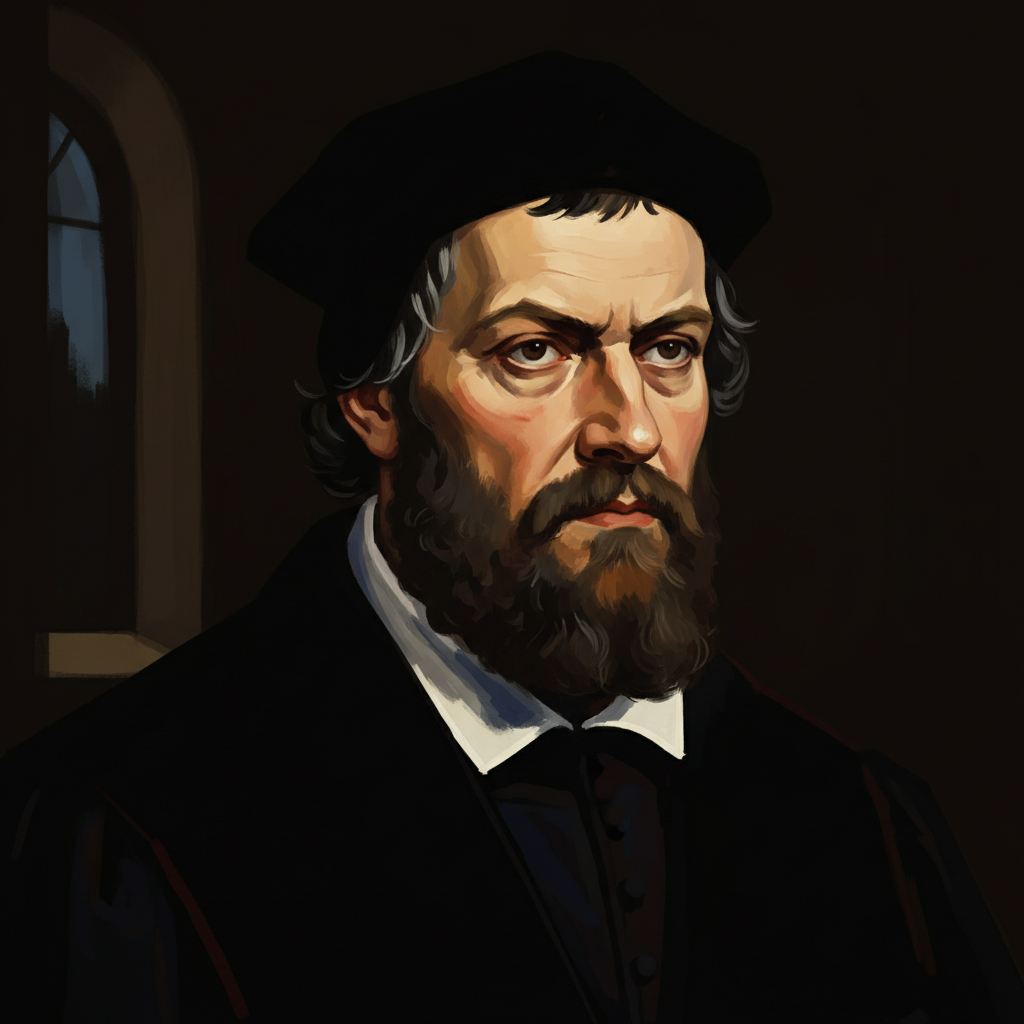
Martin Luther — "Fourthly, their rabbis must be forbidden under threat of death to teach any more…"
Fourthly, their rabbis must be forbidden under threat of death to teach any more.
Fourthly, their rabbis must be forbidden under threat of death to teach any more.
Click any product to generate a realistic preview. Up to 3 at a time.
* Initial load can take up to 90 seconds — revising the preview in another color is nearly instant.
"I am a man of contention, and I thank God for it."
"If you are a preacher of grace, then preach not a legal but a true and spiritual grace. If grace is true, you must bear a true and not a fictitious sin. God does not save those who are only fictitious…"
"We consider EVERYTHING allowable against the deception and depravity of the papal antichrist."
"You must say my sins are not mine; they are not in me at all; they are the sins of another; they are Christ's and none of my business."
"I have had many struggles with the devil, and I know him well."
German theologian whose 95 Theses (1517) launched the Protestant Reformation and broke the Catholic Church's monopoly on Western Christianity. Closely associated with Philipp Melanchthon (Lutheran systematizer) and John Calvin (later Reformer who built on Luther's break). For an intellectual contrast, see Pope Leo X, Renaissance pope (1513-1521) — Leo X's indulgence sales triggered Luther's break and Leo excommunicated him in 1521 — Luther's entire Reformation is structured as a direct answer to the indulgence-funded Vatican Leo represented.
Found in 1 providers: grok
1 source checked
Luther demands that Jewish religious teachers be banned from instructing anyone in their faith, with execution as the penalty for disobedience. He is calling for the forced silencing of Judaism by threatening rabbis with death if they continue their traditional role of teaching scripture, law, and tradition to their communities. It is a direct attempt to extinguish Jewish religious transmission through state violence.
This comes from Luther's 1543 treatise On the Jews and Their Lies, written late in life after Jews refused to convert to his reformed Christianity. Though he had earlier urged kinder treatment in 1523, his disappointment curdled into venomous hostility. The treatise lists seven harsh measures, and this is the fourth. It reveals a darker side of the reformer whose theology otherwise emphasized scripture, conscience, and grace alone.
In early modern Europe, Jews were already marginalized, expelled from England, France, and Spain, and confined to ghettos or specific trades. Religious uniformity was enforced by princes, and blasphemy or heresy often carried capital penalties. Luther's Reformation had shattered Christian unity, intensifying anxieties about religious deviance. His 1543 tract influenced Saxon policy and, centuries later, was weaponized by Nazi propagandists as justification for antisemitic persecution.
AI-generated insights based on extensive research and information for context. Factual errors? Email [email protected].
Your cart is empty