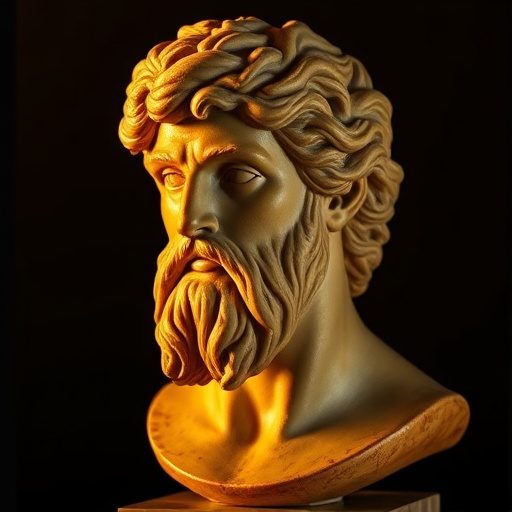
Pythagoras — "Friends are as companions on a journey, who ought to aid each other to persevere…"
Friends are as companions on a journey, who ought to aid each other to persevere in the road to a happier life.
Friends are as companions on a journey, who ought to aid each other to persevere in the road to a happier life.
Click any product to generate a realistic preview. Up to 3 at a time.
* Initial load can take up to 90 seconds — revising the preview in another color is nearly instant.
"Do not break bread."
"The strangest (and sexiest) of the legends surrounding the aura of Pythagoras is that he had a golden thigh that he would show to impress people he wanted to join his cult."
"Do not look in a mirror by lamplight."
"Above the cloud with its shadow is the star with its light."
"A chewed bean placed in the sun smells of human semen or of murderously spilt human blood."
Greek philosopher and mathematician whose school in Croton combined geometry (the Pythagorean theorem), number-mysticism, and a religious-vegetarian way of life. Closely associated with Thales of Miletus (earlier pre-Socratic and the first philosopher). For an intellectual contrast, see Heraclitus, pre-Socratic Greek philosopher of flux — Heraclitus called Pythagoras 'the chief of swindlers' — among the founding insults of the philosophical-rivalry tradition. Their 'all is flux' vs 'all is number' poles still organize the philosophy of mathematics today (Platonist vs anti-realist).
Found in 3 providers: deepseek,grok,gemini
3 sources checked
True friendship means actively supporting each other through life's difficulties, not just sharing good times. Friends serve a mutual purpose: helping one another stay committed to living well and pursuing genuine happiness. The journey metaphor captures that life requires sustained effort, and companions who encourage perseverance matter more than those who merely provide comfort or entertainment along the way.
Pythagoras founded a secretive philosophical brotherhood in Croton where members lived communally, shared possessions, and held each other accountable to strict ethical and intellectual standards. For him, friendship wasn't casual — it was a structured mutual obligation. His school demanded loyalty, shared purpose, and collective pursuit of wisdom, making this quote a direct reflection of how he actually organized his community.
In ancient Greece, philosophical schools were tight-knit communities, not institutions. Pythagoras lived around 570–495 BCE, a time when city-states were small and survival — physical, moral, intellectual — depended on trusted bonds. The Greek concept of eudaimonia (flourishing life) was central to ethical thought, and friendship was considered essential infrastructure for achieving it, not merely a personal pleasure.
AI-generated insights based on extensive research and information for context. Factual errors? Email [email protected].
Your cart is empty