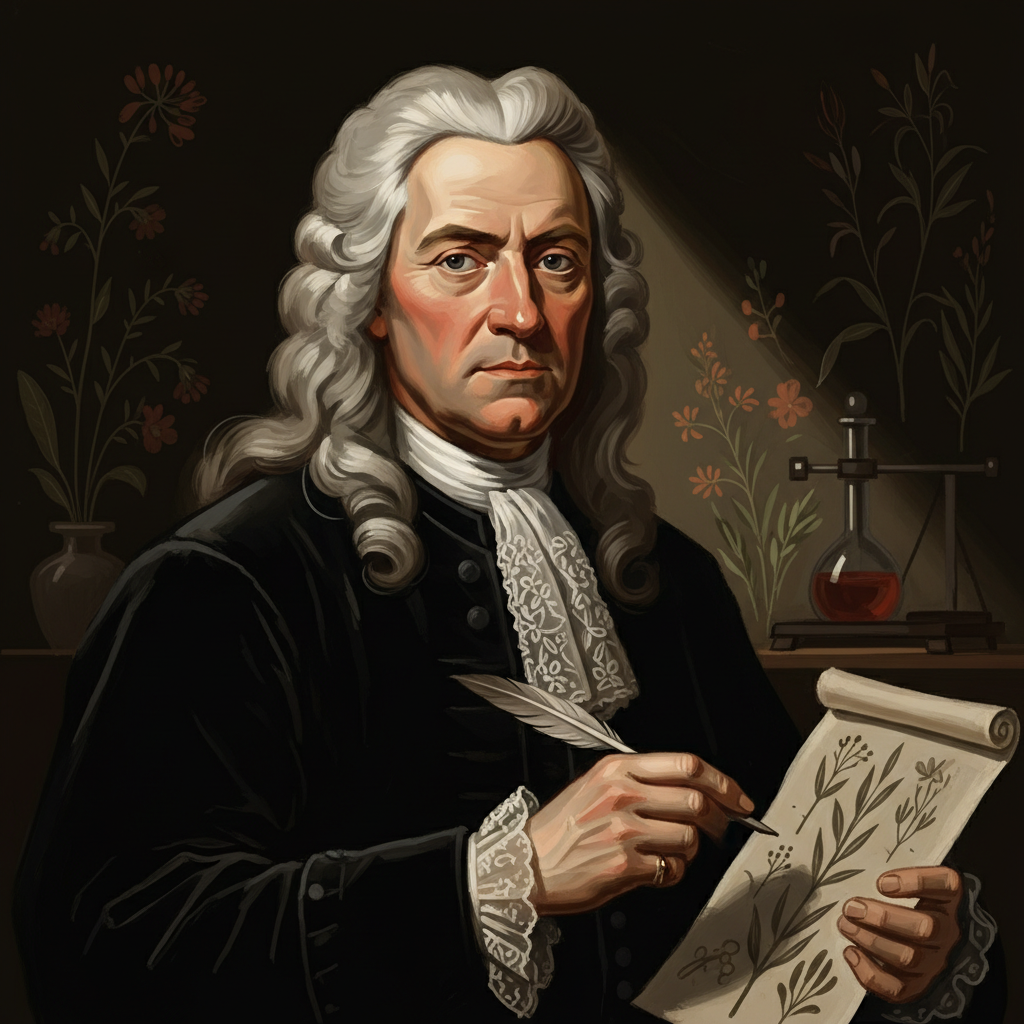
Carl Linnaeus — "God created, Linnaeus organized."
God created, Linnaeus organized.
God created, Linnaeus organized.
Click any product to generate a realistic preview. Up to 3 at a time.
* Initial load can take up to 90 seconds — revising the preview in another color is nearly instant.
"The whole world is a collection of wonders."
"The species are the work of the divine hand, the genera are the work of reason."
"A natural arrangement is one which is based on all parts of the plant."
"If you want to know yourself, study nature."
"It is the genus that gives the characters, and not the characters that make the genus."
Swedish botanist and the father of modern taxonomy whose Systema Naturae (1735) introduced binomial nomenclature for naming all species. Closely associated with Joseph Banks (British naturalist who carried Linnaean classification on Cook's voyages). For an intellectual contrast, see Comte de Buffon, French naturalist and Histoire Naturelle author (1749-1788) — Buffon explicitly attacked Linnaean fixed-categories taxonomy as artificial and rejected the binomial system; his gradualist, environment-shaped natural history was the explicit alternative. Anticipates the fixed-species-vs-evolution debate Darwin would later resolve.
A self-aggrandizing statement reflecting his profound impact on taxonomy.
Date: c. 1730-1770s
BiblicalFound in 1 providers: gemini
1 source checked
This saying draws a clear line between divine creation and human organization. Nature exists as a given, but its staggering variety means nothing to people until someone sorts it into a workable system. The statement credits a higher power with making life while crediting Linnaeus with making sense of it, turning a chaotic catalog of plants and animals into something humans can name, study, group, and pass down reliably.
Linnaeus spent his career classifying living things, publishing Systema Naturae in 1735 and refining it across twelve editions. He devised binomial nomenclature, the genus-species naming still used today, and grouped organisms into kingdoms, classes, orders, genera, and species. A devout Lutheran, he believed he was revealing God's design, not replacing it. The quote captures both his religious humility and the monumental intellectual pride he took in imposing order on biology.
Linnaeus worked during the early modern Enlightenment, when European naturalists were flooded with specimens from colonial voyages to the Americas, Asia, and the Pacific. Previous naming systems were inconsistent, multilingual, and often paragraph-long descriptions. Scientists urgently needed a shared framework. Natural theology, the belief that studying nature revealed God's handiwork, still dominated science, so cataloging creation was seen as a devotional act. Linnaeus's tidy hierarchies fit the era's appetite for rational, universal systems applied to the natural world.
AI-generated insights based on extensive research and information for context. Factual errors? Email [email protected].
Your cart is empty