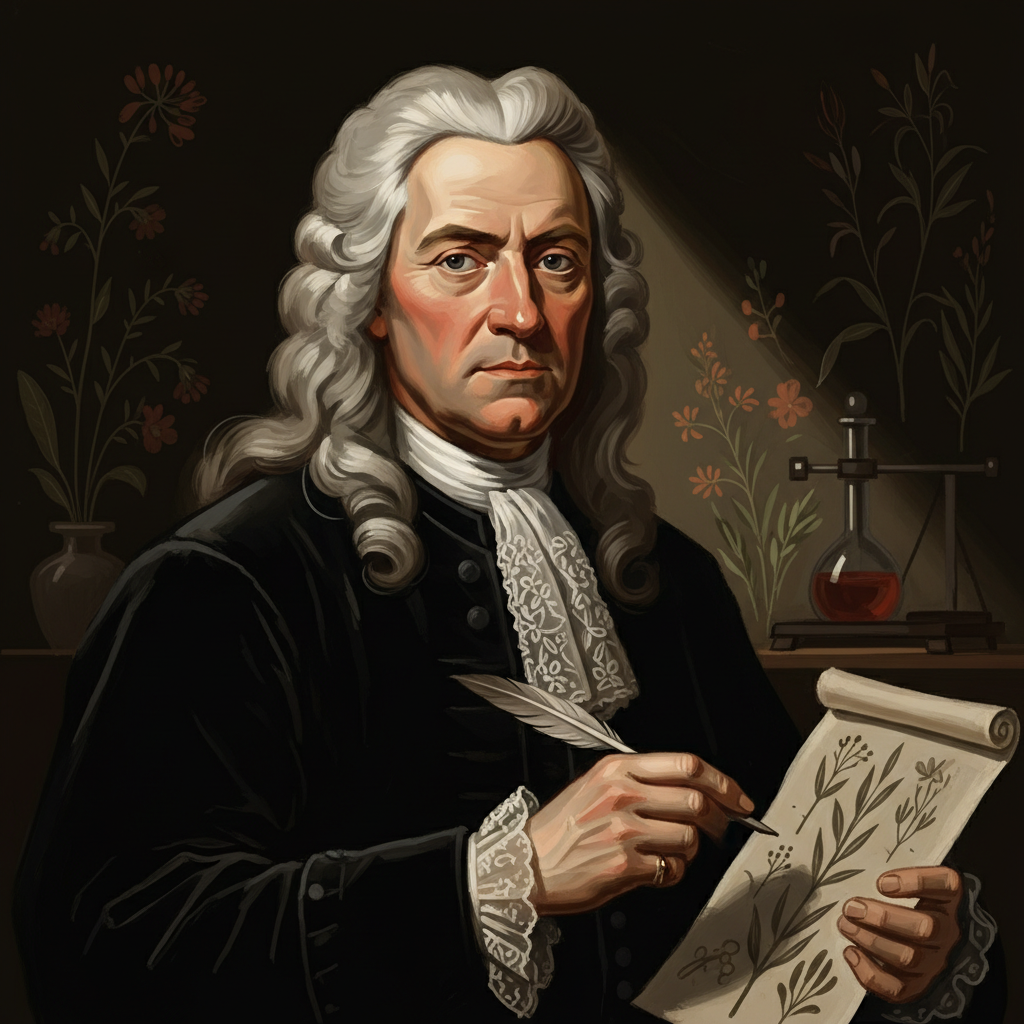
Carl Linnaeus — "If you want to know yourself, study nature."
If you want to know yourself, study nature.
If you want to know yourself, study nature.
Click any product to generate a realistic preview. Up to 3 at a time.
* Initial load can take up to 90 seconds — revising the preview in another color is nearly instant.
"The method is the soul of science."
"The purpose of science is to know the works of God."
"The system of nature is a mirror of God's wisdom."
"It is not the business of a botanist to know all the plants, but to know how to find out what they are."
"The natural system is the highest goal of botany."
Swedish botanist and the father of modern taxonomy whose Systema Naturae (1735) introduced binomial nomenclature for naming all species. Closely associated with Joseph Banks (British naturalist who carried Linnaean classification on Cook's voyages). For an intellectual contrast, see Comte de Buffon, French naturalist and Histoire Naturelle author (1749-1788) — Buffon explicitly attacked Linnaean fixed-categories taxonomy as artificial and rejected the binomial system; his gradualist, environment-shaped natural history was the explicit alternative. Anticipates the fixed-species-vs-evolution debate Darwin would later resolve.
A philosophical statement linking self-knowledge to the study of the natural world.
Date: Uncertain (attributed)
EducationalFound in 1 providers: gemini
1 source checked
Self-knowledge comes not just from introspection but from observing the natural world. By studying the patterns, organisms, and systems of nature, we come to understand our own place within it — our biological origins, instincts, and dependencies. Nature acts as a mirror: its laws govern us too. Outward observation, not inward rumination alone, reveals what humans truly are and where we fit in the broader web of life.
Linnaeus spent his life classifying every living organism, most controversially placing humans as Homo sapiens within the animal kingdom alongside primates in 1758. He believed nature's order reflected creation's deeper logic, and that naming all life — including ourselves — was a philosophical act. His Systema Naturae argued humans are not separate from nature but embedded in it. Studying nature was, for him, the most direct route to understanding the human creature.
Eighteenth-century Enlightenment Europe was replacing scripture with reason and observation as the primary sources of truth. Natural philosophy surged as explorers catalogued species from every continent, yet most Europeans still viewed humans as divinely separate from animals. Linnaeus worked directly in that tension. Classifying Homo sapiens biologically was culturally provocative. Nature study was becoming the era's dominant intellectual framework, redefining not just science but humanity's understanding of its own identity and place in creation.
AI-generated insights based on extensive research and information for context. Factual errors? Email [email protected].
Your cart is empty