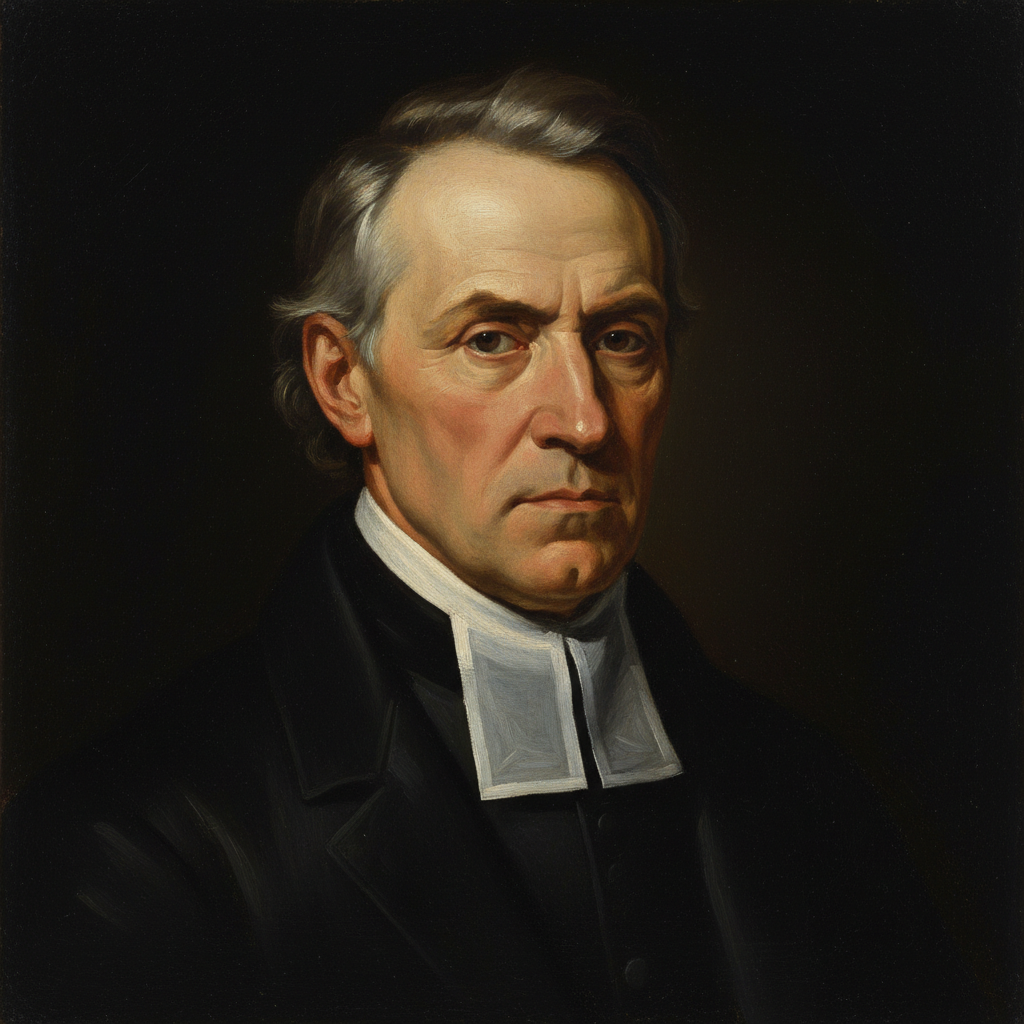
John Wesley — "God grant that I may never live to be useless!"
God grant that I may never live to be useless!
God grant that I may never live to be useless!
Click any product to generate a realistic preview. Up to 3 at a time.
* Initial load can take up to 90 seconds — revising the preview in another color is nearly instant.
"The Bible knows nothing of solitary religion."
"Satan has no objection to our being religious, provided we are not too religious."
"I have been accounted a madman, a fool, a knave, a liar, a deceiver, and a devil."
"I desire to have but one thing in view, to please God."
"Beware you be not swallowed up in books! An ounce of love is worth a pound of knowledge."
English Anglican cleric and founder of Methodism, whose open-air preaching and class-meeting structure created the largest 18th-century evangelical revival. Closely associated with Charles Wesley (his hymn-writing brother) and George Whitefield (early co-revivalist, later doctrinal opponent). For an intellectual contrast, see George Whitefield, Calvinist evangelical revivalist — Whitefield's predestinarian Calvinism vs Wesley's free-grace Arminian theology split the early Methodist movement permanently in the 1739-41 break. The founding evangelical Calvinist-Arminian schism — the two parallel evangelical traditions American Christianity descends from.
Found in 1 providers: grok
1 source checked
A prayer asking God to keep the speaker from becoming idle or purposeless. It expresses deep fear of wasted existence — of being alive without contributing. In modern terms: dreading irrelevance, wanting one's life to matter through action and service rather than passive occupation. Not about fame or achievement, but about remaining genuinely useful to others until the very end, treating inactivity itself as a kind of failure worth praying against.
Wesley rode 250,000 miles on horseback preaching across Britain and delivered over 40,000 sermons, still active at 87. He founded schools, clinics, and lending societies for the poor. His theology of practical holiness demanded active service, not passive belief. He organized lay preachers to reach workers the Church ignored. For Wesley, ceaseless labor was worship — idleness was spiritual death. This prayer isn't rhetorical; it reflects his lifelong, documented terror of stopping.
Wesley lived 1703–1791 through Britain's early industrialization, when millions flooded into cities with no church, education, or social safety net. The Church of England was largely disengaged from the working poor — corrupt, complacent, and class-bound. Methodist societies filled that vacuum directly. In an era when a person's worth was tightly tied to productive contribution, and institutional uselessness was visibly destroying communities, a clergyman praying never to become useless carried both theological conviction and urgent social meaning.
AI-generated insights based on extensive research and information for context. Factual errors? Email [email protected].
Your cart is empty