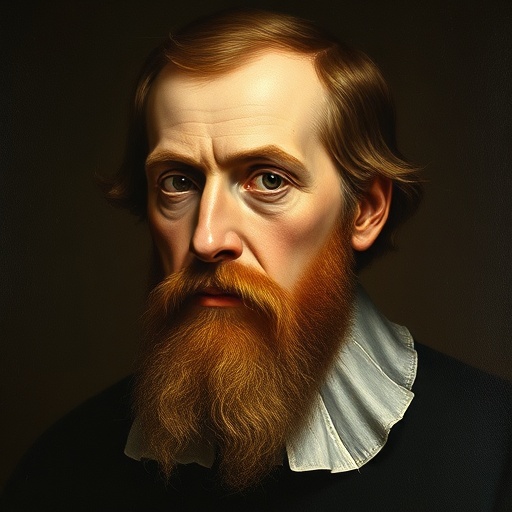
John Calvin — "God has no greater enemy than the proud man."
God has no greater enemy than the proud man.
God has no greater enemy than the proud man.
Click any product to generate a realistic preview. Up to 3 at a time.
* Initial load can take up to 90 seconds — revising the preview in another color is nearly instant.
"God blinds the minds of the reprobate, and hardens their hearts, that they may not believe."
"Man's chief end is to glorify God and to enjoy him forever."
"This is not laid down on human authority; it is God who speaks and prescribes a perpetual rule for his Church."
"It is not in our power to believe, but it is the gift of God."
"The grace of God is the only foundation of our salvation."
French theologian whose Institutes of the Christian Religion (1536) systematized Protestant Reformed doctrine, including predestination. Closely associated with Martin Luther (Reformation founder, Calvin's predecessor). For an intellectual contrast, see Jacobus Arminius, Dutch Reformed theologian (1560-1609) — Arminius's rejection of strict double-predestination founded Arminianism — the theological tradition modern Methodism, most evangelicalism, and Pentecostalism descend from. The Calvinist-Arminian debate has divided Protestantism for 400 years.
Found in 1 providers: grok
1 source checked
Pride places the self at the center where God belongs, making it not merely a character flaw but an act of cosmic defiance. The proud person trusts their own judgment, merits, and will above divine authority. This asserts that no sin is more corrosive to the human-God relationship than self-exaltation, because it is the root condition from which all other rebellion grows — the refusal to acknowledge dependence on anything greater than oneself.
Calvin's theology rested on two pillars: God's absolute sovereignty and humanity's total depravity. His Institutes of the Christian Religion frames pride as the primal sin that blinds humans to their own corruption. In Geneva, Calvin enforced strict moral codes against ostentation and self-display. His doctrine of predestination explicitly strips human pride by denying any merit in salvation — grace is entirely God's act, making human boasting theologically impossible.
The 16th-century Reformation erupted partly as a reaction against institutional Church pride — popes claiming supreme authority, clergy selling indulgences, the Church accumulating vast wealth. Simultaneously, Renaissance humanism celebrated individual human greatness. Calvin's theology challenged both currents, insisting human nature is fundamentally fallen, and that any culture placing man at its center — whether Church hierarchy or secular humanism — was committing the same ancient error of dethroning God.
AI-generated insights based on extensive research and information for context. Factual errors? Email [email protected].
Your cart is empty