What it means
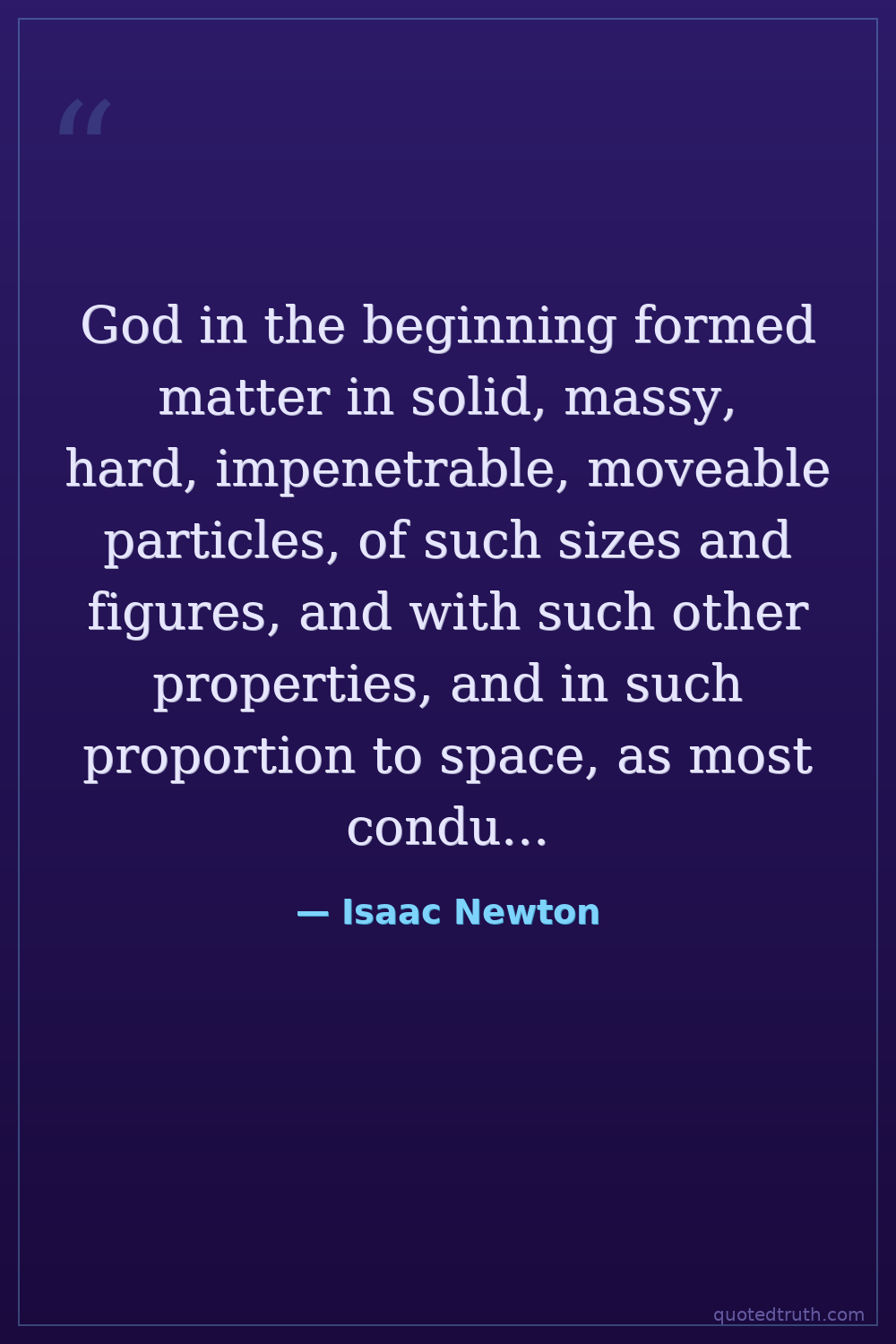
God deliberately engineered the fundamental building blocks of the universe — solid, hard, impenetrable particles (essentially atoms) — with specific sizes, shapes, and properties. Nothing was random; every physical characteristic was purposefully chosen to serve a divine goal. It argues that the material world's structure reflects intentional design, not accident. The physics we observe traces back to a Creator who made precise choices about what matter is and how it behaves.
Relevance to Isaac Newton
Newton was as devoted to theology as to physics — he wrote over a million words on Biblical prophecy and spent decades studying scripture and alchemy. His atomistic view of matter directly underpinned his laws of motion: unchanging, hard particles ensured nature's rules stayed constant across time. He saw uncovering natural laws as reading God's mind. This quote appears in his Opticks (1704), where science and theology merge most explicitly.
The era
The late 17th and early 18th centuries saw fierce debate between Aristotelian matter theory and the new mechanical philosophy, which explained everything through particles in motion. Descartes proposed fluid vortices; Newton countered with hard, discrete atoms governed by measurable forces. Natural theology — the idea that scientific discovery reveals God's handiwork — was intellectually mainstream across Europe, making Newton's fusion of atomism and divine intention entirely orthodox rather than controversial.
AI-generated insights based on extensive research and information for context. Factual errors? Email [email protected].