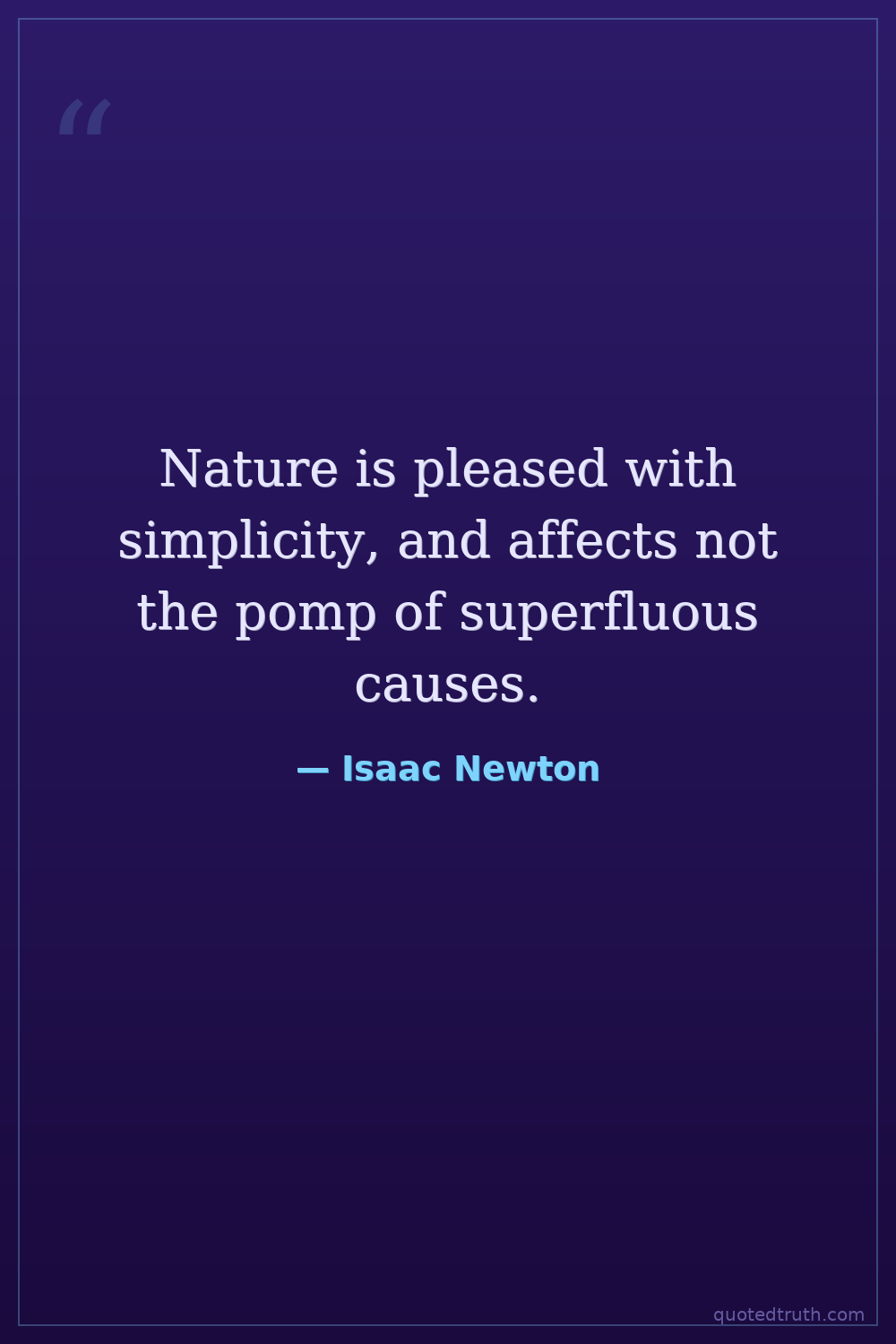
Isaac Newton — "Nature is pleased with simplicity, and affects not the pomp of superfluous cause…"
Nature is pleased with simplicity, and affects not the pomp of superfluous causes.
Nature is pleased with simplicity, and affects not the pomp of superfluous causes.
Click any product to generate a realistic preview. Up to 3 at a time.
* Initial load can take up to 90 seconds — revising the preview in another color is nearly instant.
"I keep the subject constantly before me and wait till the first dawnings open slowly, by little and little, into a full and clear light."
"The greatest challenges to the truth of the Holy Scriptures are not the work of infidels, but of professing Christians."
"For if the experiments which I relate be accurate, the science of colours will be a new one; for although colours have been observed from antiquity, yet the cause of their productions has remained unk…"
"Plato is my friend, Aristotle is my friend, but truth is more my friend."
"The particles of light are exceedingly small, and move with exceeding swiftness."
From 'Principia Mathematica', Book III, Rules of Reasoning in Philosophy, Rule I
Date: 1687
Nature & WorldFound in 1 providers: grok
1 source checked
Nature operates through the simplest possible mechanisms and doesn't pile on unnecessary causes. When a lean explanation works, extra complexity is a human imposition, not nature's design. Strip away ornamental assumptions that add no explanatory power. This is essentially Occam's Razor applied to physics: the correct account of any phenomenon is almost always the minimal one, not the elaborate one.
Newton lived this principle directly. His law of universal gravitation unified falling apples and planetary orbits under one equation, collapsing what had been separate phenomena. His three laws reduced all mechanics to bare essentials. He formalized parsimony as Rule 1 in Principia Mathematica's Rules of Reasoning, making it an explicit scientific method — and his career proved that minimal, elegant equations govern the most complex observable phenomena.
Newton worked at the Scientific Revolution's peak, when natural philosophers routinely explained phenomena through elaborate Aristotelian frameworks — hidden qualities, teleological purposes, and Ptolemaic epicycles stacked upon epicycles to track planetary motion. Scholastic tradition embraced ornate causal chains as intellectual virtue. Newton's insistence on mathematical simplicity and his refusal to feign hypotheses he couldn't empirically ground was a radical departure that defined what modern science would become.
AI-generated insights based on extensive research and information for context. Factual errors? Email [email protected].
Your cart is empty