Isaac Newton — "As a blind man has no idea of colours, so have we no idea of the manner by which…"
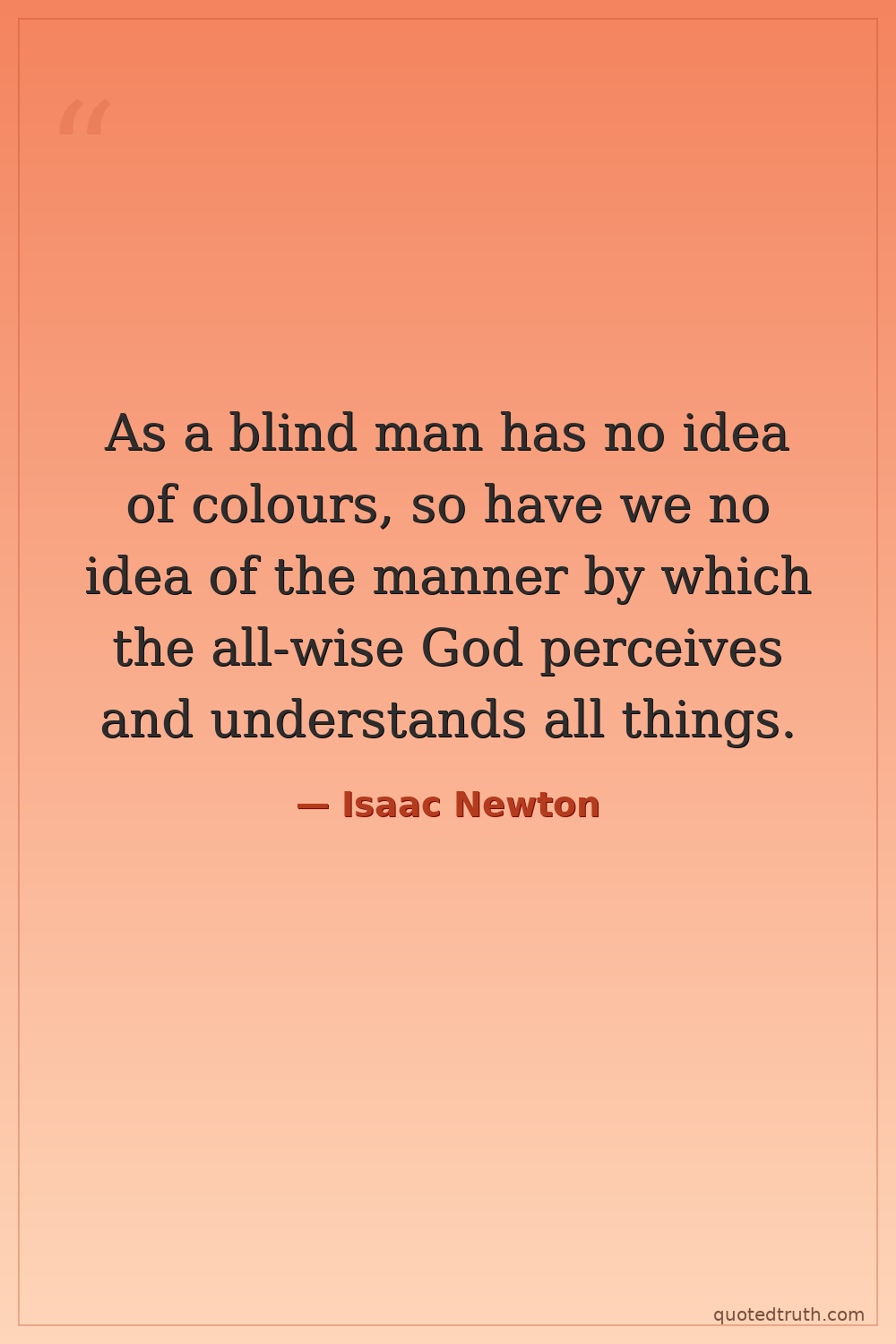
As a blind man has no idea of colours, so have we no idea of the manner by which the all-wise God perceives and understands all things.
As a blind man has no idea of colours, so have we no idea of the manner by which the all-wise God perceives and understands all things.
Click any product to generate a realistic preview. Up to 3 at a time.
* Initial load can take up to 90 seconds — revising the preview in another color is nearly instant.
"Nothing can be divided into fewer parts than it hath."
"The whole difficulty of philosophy seems to consist in this—from the phenomena of motions to investigate the forces of nature, and then from these forces to demonstrate the other phenomena."
"Hypotheses non fingo. (I frame no hypotheses.)"
"What is there in places almost empty of air (such as the space between the planets) to hinder the free motion of bodies?"
"Can it be by accident that all birds beasts and men have their right side and left side alike shaped (except in their bowels) and just two eyes and no more on either side the face & just two ears on e…"
Found in 1 providers: grok
1 source checked
Just as a person born blind cannot grasp color—real yet wholly inaccessible to them—humans cannot grasp how God perceives and understands all things. Newton argues for radical epistemic humility: God's mode of knowing isn't just greater than ours, it's categorically different. Human minds, no matter how sharp, lack the cognitive apparatus even to imagine divine omniscience. The analogy makes the point concrete rather than abstract.
Newton wrote more on theology than physics, viewing his scientific discoveries as uncovering God's design. He held unorthodox Arian beliefs—rejecting the Trinity, believing in one supreme, omniscient God. Despite revolutionizing mechanics and optics, he insisted human reason has absolute limits before divine omniscience. This quote captures that conviction: the man who decoded planetary motion still considered God's manner of understanding wholly beyond human reach.
Newton lived through the Scientific Revolution's peak—a period when natural philosophy was rapidly expanding human knowledge, raising fears it might displace God. Debates between empiricism and religious authority were acute. Deism was emerging, and thinkers like Locke were reframing human understanding. Newton positioned science as revealing God's handiwork, not replacing theology. This quote reflects that era's urgency to affirm divine transcendence even as human knowledge surged.
AI-generated insights based on extensive research and information for context. Factual errors? Email [email protected].
Your cart is empty