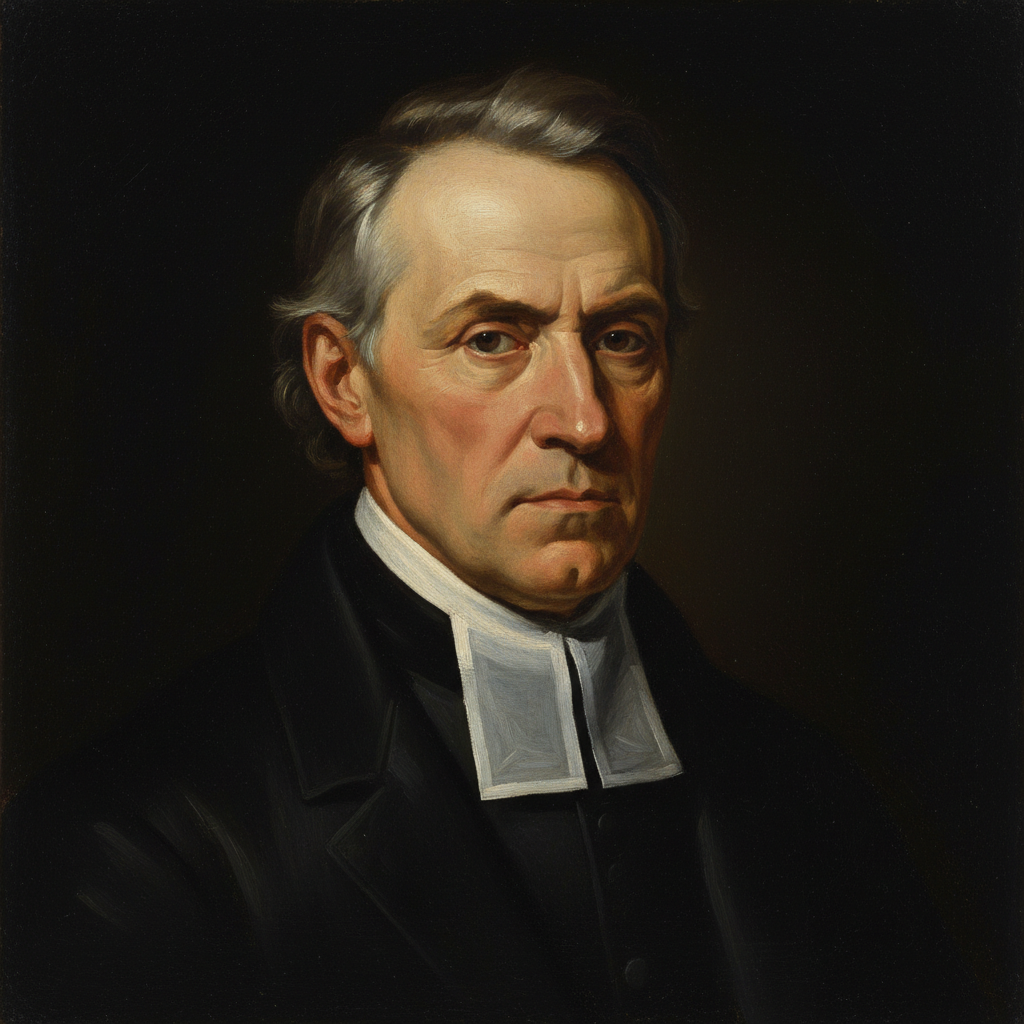
John Wesley — "The rich, the honourable, the great, will hardly enter into the kingdom of heave…"
The rich, the honourable, the great, will hardly enter into the kingdom of heaven.
The rich, the honourable, the great, will hardly enter into the kingdom of heaven.
Click any product to generate a realistic preview. Up to 3 at a time.
* Initial load can take up to 90 seconds — revising the preview in another color is nearly instant.
"I have been accounted a madman, a fool, a knave, a liar, a deceiver, and a devil."
"The Methodists are a people who profess to pursue a Christian life by Scriptural rules and methods."
"The world is my parish."
"Diseases are the instruments of God to punish men for their sins."
"I have often wondered that any man, who has tasted of the pleasures of retirement, can ever be prevailed upon to quit them."
English Anglican cleric and founder of Methodism, whose open-air preaching and class-meeting structure created the largest 18th-century evangelical revival. Closely associated with Charles Wesley (his hymn-writing brother) and George Whitefield (early co-revivalist, later doctrinal opponent). For an intellectual contrast, see George Whitefield, Calvinist evangelical revivalist — Whitefield's predestinarian Calvinism vs Wesley's free-grace Arminian theology split the early Methodist movement permanently in the 1739-41 break. The founding evangelical Calvinist-Arminian schism — the two parallel evangelical traditions American Christianity descends from.
Found in 1 providers: deepseek
1 source checked
Wealth, honor, and high social rank create nearly insurmountable barriers to genuine spiritual life. Those who benefit most from earthly hierarchies resist the humility, repentance, and self-emptying that authentic faith demands. This echoes Christ's camel-through-a-needle warning: the more one possesses materially or reputationally, the harder it becomes to surrender ego, serve others unconditionally, and enter a kingdom defined by radical equality rather than privilege.
Wesley spent decades preaching to coal miners, prisoners, and the destitute in open fields after the Anglican establishment, dominated by gentry patrons, rejected him. He voluntarily gave away nearly all his substantial income, lived austerely, and deliberately built Methodism among the poor and working class. His Oxford education made his rejection of privilege a conscious theological conviction, forged through direct ministry among people the respectable church ignored.
Eighteenth-century Britain was undergoing early industrialization, concentrating vast wealth among merchants and landowners while factory workers and miners lived in brutal poverty. The Church of England was structurally captured by the aristocracy, with wealthy patrons controlling parish appointments and clergy salaries. Wesley's movement directly challenged this fusion of Christian institutions with class hierarchy, emerging at the precise moment when inequality was becoming permanently embedded in British economic life.
AI-generated insights based on extensive research and information for context. Factual errors? Email [email protected].
Your cart is empty