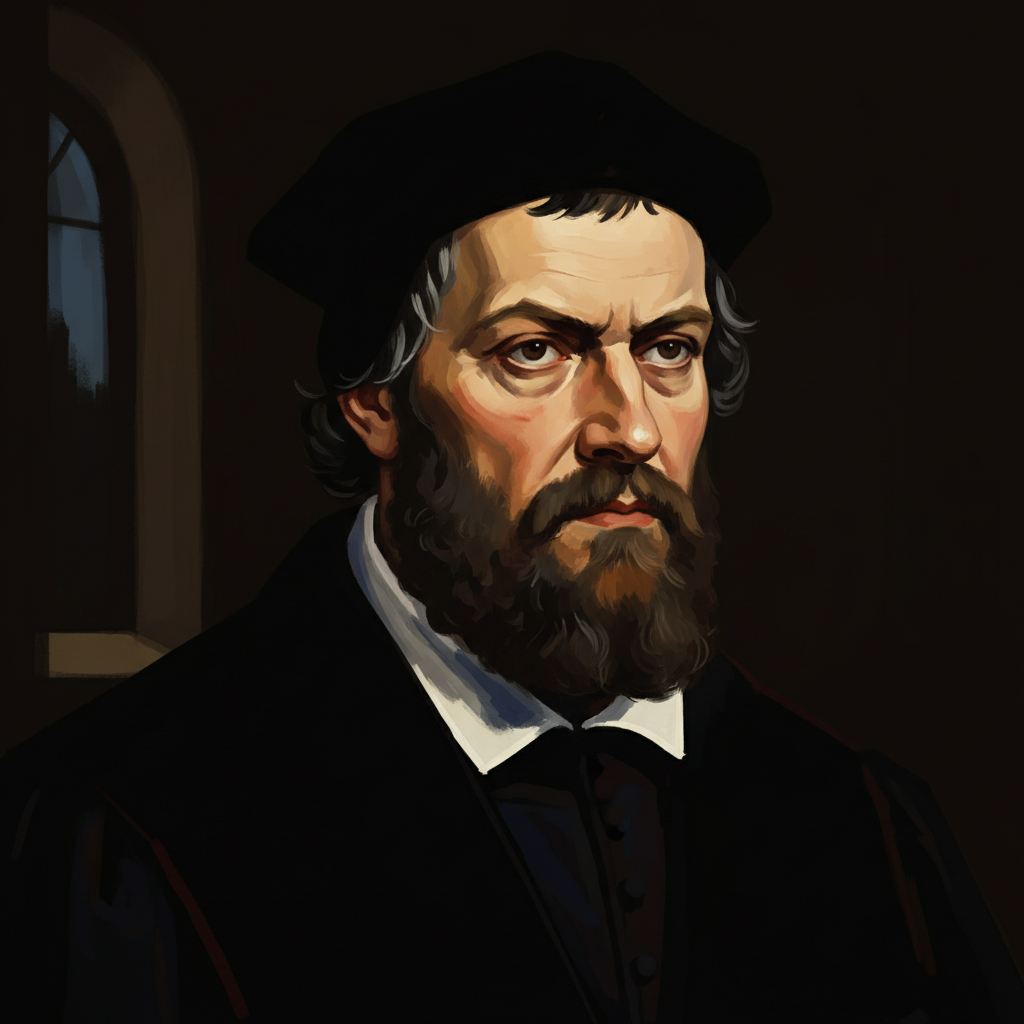
Martin Luther — "He who lets himself be led by reason will never escape sin."
He who lets himself be led by reason will never escape sin.
He who lets himself be led by reason will never escape sin.
Click any product to generate a realistic preview. Up to 3 at a time.
* Initial load can take up to 90 seconds — revising the preview in another color is nearly instant.
"The more a man is skilled in the Scriptures, the more he is tempted."
"The mad mob does not ask how it could be better, only that it be different. And when it then becomes worse, it must change again."
"Let the wife make her husband glad to come home and let him make her sorry to see him leave."
"A man must have a good mind, and a strong body, and a pure heart, to be a good preacher."
"I am a peasant's son; my father, grandfather, and great-grandfather were genuine peasants."
German theologian whose 95 Theses (1517) launched the Protestant Reformation and broke the Catholic Church's monopoly on Western Christianity. Closely associated with Philipp Melanchthon (Lutheran systematizer) and John Calvin (later Reformer who built on Luther's break). For an intellectual contrast, see Pope Leo X, Renaissance pope (1513-1521) — Leo X's indulgence sales triggered Luther's break and Leo excommunicated him in 1521 — Luther's entire Reformation is structured as a direct answer to the indulgence-funded Vatican Leo represented.
Found in 1 providers: grok
1 source checked
Relying purely on human logic and rational thinking cannot free a person from moral failure or wrongdoing. Reason alone is insufficient as a guide for righteous living because it operates within the limits of a flawed human nature. No matter how carefully someone reasons through ethical choices, they will still fall short. True deliverance from sin requires something beyond intellectual effort, namely faith and divine grace working from outside human capability.
Luther, an Augustinian monk turned reformer, built his entire theology on the insufficiency of human works and rational striving. His doctrine of sola fide, justification by faith alone, rejected the scholastic confidence in reason championed by thinkers like Aquinas. Luther called reason 'the devil's whore' when used to judge spiritual matters. This quote reflects his deep conviction that humans are bound in sin and cannot think or reason their way to salvation without Christ's grace.
In early modern Europe, the Catholic Church had merged Aristotelian philosophy with theology through scholasticism, placing reason alongside revelation. The Renaissance was elevating human capability and intellect. Luther's 1517 Ninety-Five Theses challenged indulgences and church authority, sparking the Reformation. Amid printing-press debates, peasant revolts, and religious wars, Luther insisted that Scripture and faith, not papal logic or philosophical reasoning, governed salvation, fundamentally reshaping Western Christianity and European political order.
AI-generated insights based on extensive research and information for context. Factual errors? Email [email protected].
Your cart is empty