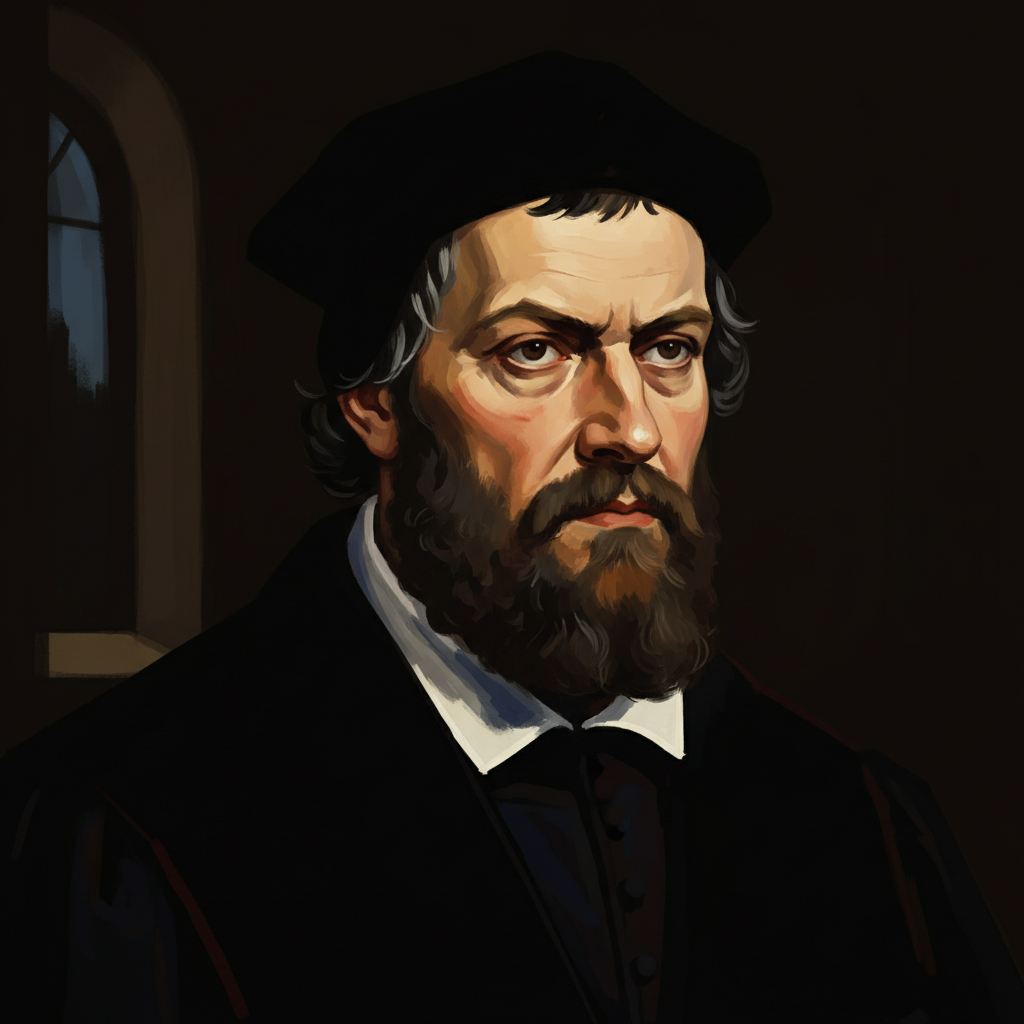
Martin Luther — "I am a peasant's son; my father, grandfather, and great-grandfather were genuine…"
I am a peasant's son; my father, grandfather, and great-grandfather were genuine peasants.
I am a peasant's son; my father, grandfather, and great-grandfather were genuine peasants.
Click any product to generate a realistic preview. Up to 3 at a time.
* Initial load can take up to 90 seconds — revising the preview in another color is nearly instant.
"The Christian's life is not a bed of roses, but a cross."
"Those who despise these, or treat them with contempt, are worthy of purchasing, adoring, and praising the pope's excrement as balsam."
"If you want to have a good laugh, read the Papal Bulls. They are so full of nonsense that they will make you split your sides."
"I feel much freer now that I am certain the pope is the Antichrist."
"The world is like a drunken peasant. If you help him to mount on one side of his horse, he tumbles off on the other."
German theologian whose 95 Theses (1517) launched the Protestant Reformation and broke the Catholic Church's monopoly on Western Christianity. Closely associated with Philipp Melanchthon (Lutheran systematizer) and John Calvin (later Reformer who built on Luther's break). For an intellectual contrast, see Pope Leo X, Renaissance pope (1513-1521) — Leo X's indulgence sales triggered Luther's break and Leo excommunicated him in 1521 — Luther's entire Reformation is structured as a direct answer to the indulgence-funded Vatican Leo represented.
Found in 1 providers: grok
1 source checked
The speaker openly states his working-class roots, tracing generations of farmers in his family. He isn't hiding humble origins or dressing them up; he's claiming them directly. The point is that his background is ordinary rural labor, not nobility, wealth, or inherited status. He presents this as a plain fact about who he is and where he comes from.
Luther really did descend from Thuringian peasants, though his father Hans rose into copper mining and smelting, funding Martin's education. Luther often invoked his rustic heritage to underscore authenticity against Rome's aristocratic hierarchy. His blunt, earthy German prose, coarse humor, and distrust of ecclesiastical privilege all trace to this self-understanding as a commoner speaking plainly to other commoners.
In early modern Europe, birth determined everything: clergy, nobility, and peasants occupied fixed estates. The Church was dominated by aristocratic bishops and cardinals, while 90% of Germans worked the land under feudal obligations. For a university doctor and reformer to proudly claim peasant lineage was a pointed challenge, aligning him with the common people against Rome's wealthy hierarchy during the 1520s social upheavals.
AI-generated insights based on extensive research and information for context. Factual errors? Email [email protected].
Your cart is empty