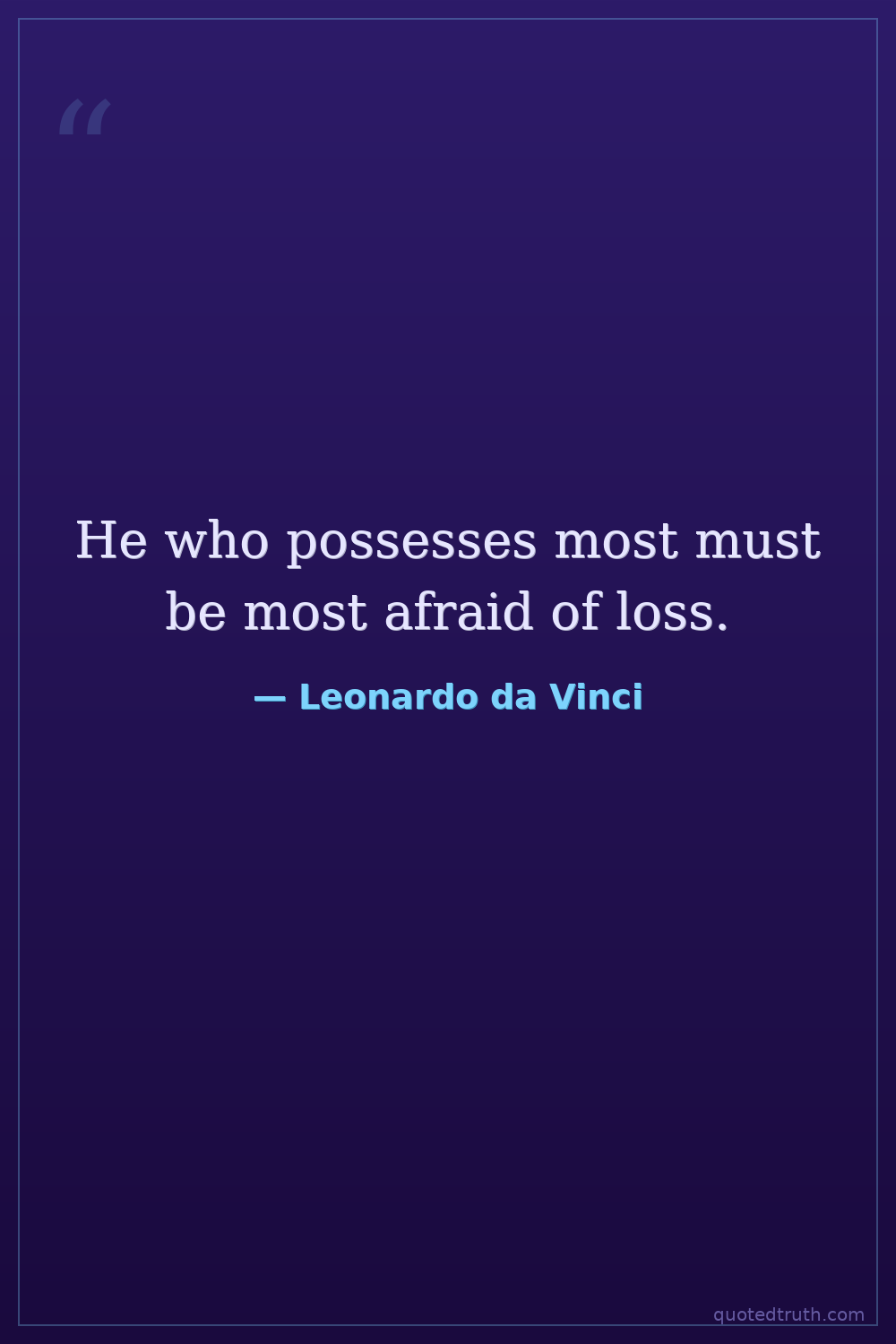
Leonardo da Vinci — "He who possesses most must be most afraid of loss."
He who possesses most must be most afraid of loss.
He who possesses most must be most afraid of loss.
Click any product to generate a realistic preview. Up to 3 at a time.
* Initial load can take up to 90 seconds — revising the preview in another color is nearly instant.
"I have been impressed with the urgency of doing. Knowing is not enough; we must apply. Being willing is not enough; we must do."
"Experience is never wrong; only our judgments are wrong in promising themselves results which are not caused by our experiments."
"Human subtlety will never devise an invention more beautiful, more simple or more direct than does nature, because in her inventions nothing is lacking and nothing is superfluous."
"To develop a complete mind: Study the art of science; Study the science of art. Learn how to see. Realize that everything connects to everything else."
"Where the spirit does not work with the hand, there is no art."
Found in 1 providers: grok
1 source checked
The more you accumulate — wealth, power, status, knowledge — the greater your fear of losing it. Abundance creates vulnerability rather than security. Those with little have little to lose; those with everything live in constant dread of its collapse. Possession becomes its own burden, breeding anxiety proportional to what you hold. True freedom may paradoxically belong to those who own least, since attachment to what you have enslaves you to protecting it.
Leonardo accumulated extraordinary wealth in knowledge — thousands of notebook pages spanning anatomy, engineering, and art — yet rarely published or completed work. His illegitimate birth made every achievement feel precarious, with no institutional safety net. He obsessively guarded his notebooks, fearing theft by rivals. When Milan fell in 1499 and his Sforza patronage collapsed overnight, he fled carrying his manuscripts personally — embodying the anxiety of someone who possessed much and trusted nothing to last.
The Italian Renaissance was defined by volatile fortunes — Medici wealth collapsed, city-states fell to foreign invasion, and patronage networks dissolved overnight. Leonardo witnessed Milan's fall to France in 1499, watching powerful men lose everything instantly. Plague, war, and political betrayal erased accumulated wealth and influence with no warning. In this climate, possessing great resources, status, or artistic reputation meant living in constant awareness of how swiftly circumstances reversed, making this observation lived reality rather than abstract wisdom.
AI-generated insights based on extensive research and information for context. Factual errors? Email [email protected].
Your cart is empty